avatarAvi Kotzer

Free AI web copilot to create summaries, insights and extended knowledge, download it at here

3828

Abstract

uld it be that bats have gotten more fame than they deserve thanks to a superhero that, unlike the animal it’s named after, does not <i>echolocate</i>. I’m not going to name him, but you probably know who I’m talking about…</p><figure id="d138"><img src="https://cdn-images-1.readmedium.com/v2/resize:fit:800/0*7LOSgk2w2HpxxlXd"><figcaption>Photo by <a href="https://unsplash.com/@yuliamatvienko?utm_source=medium&amp;utm_medium=referral">Yulia Matvienko</a> on <a href="https://unsplash.com?utm_source=medium&amp;utm_medium=referral">Unsplash</a></figcaption></figure><p id="7418">Dolphins and whales, of course, do come a close second to the bat as known animals that <i>echolocate</i>.</p><p id="4069">The etymology of the word is practically self-explanatory: <i>echo</i> (repetition of a sound caused by reflection of sound waves) + <i>locate</i> (to find). The dictionary further explains that echolocation is the “process that is used by an animal (such as a bat) to orient itself and avoid obstacles especially in darkness and that involves emission of high-frequency sounds which are reflected back from environing surfaces and thus indicate the relative distance and direction of such surfaces”. Hmmm, they just love that bat!</p><p id="7a3b">Those high-frequency sounds in the definition are known as ultrasounds, because their frequencies are above the upper audible limit human beings possess. In other words, we can’t hear these signals that bats emit. But Petteri Aimonen was kind enough to make an illustration of what bat echolocation looks like, and then post is as public domain.</p><figure id="0f27"><img src="https://cdn-images-1.readmedium.com/v2/resize:fit:800/0*FNQQkXPfQa6J_X-B.png"><figcaption>Image by Petteri Aimonen. Duh! Weren’t you paying attention?</figcaption></figure><p id="8067">Did you know that there are other animals besides bats, dolphins, and whales that <i>echolocate</i>? Of course you did. But because I didn’t, I had to look it up. Turns out that some shrews, tenrecs, and rats use echolocation. So do the oilbird (whose clicks are audible to humans) and the swiftlet. You’re probably wondering what the hell is a <a href="https://www.britannica.com/animal/tenrec-mammal-family">tenrec</a>. It’s a term used to describe any of the 29 species of mammals that look like shrews or hedgehogs; most are native to Madagascar.</p><figure id="b804"><img src="https://cdn-images-1.readmedium.com/v2/resize:fit:800/0*7qzCtETEqCvZFezw.jpg"><figcaption>Credit: wikicommons</figcaption></figure><p id="3665">Back to bats… their echolocation was first deduced by an Italian priest named Lazzaro Spallanzani, which brings us to…</p><h2 id="c2c3">Lazzaro Spallanzani</h2><p id="1048">Born 293 years and 10 days ago, Spallanzani was a post-<a href="https://en.wikipedia.org/wiki/Renaissance">Renaissance</a> Renaissance man. By the age of 25 he had been ordained, and was professor of logic, metaphysics, and Greek in the University of Reggio. This after also having studied law, mathematics, and natural philosophy.</p><p id="4fe8">A statue of Spallanzani in his native town of Scandiano shows him examining a frog with a magnifying glass.</p><figure id="a5ed"><img src="https://cdn-images-1.readmedium.com/v2/resize:fit:800/0*EloqyAdRz1mDIhZl.jpg"><figcaption>Credit: wikicommons</figcaption></figure><p id="a7d6">And boy did this guy loooove to examine stuff!. Don’t believe me? Here are a few things he studied exhaustively:</p><p id="6a04">▹ Spontaneous generation, which he strongly disagreed with. After conducting an experiment in which he boiled gravy and then sealed it in glass to prove that it would not produce living forms. It did take another century, however, for Louis Pasteur to completely disprove spontaneous generation.</p><p id="9ecc">▹ Digestion, for which he obtained evidenc

Options

e that the process is not merely physical (as was believed up to then) but also chemical.</p><p id="d9cf">▹ Reproduction, establishing the seminal role of, well, um, semen. Spallanzani proved that the sperm and the egg need to join in order for fertilization to occur. He also was the first person to perform in vitro fertilization (in frogs) and an artificial insemination (in dogs).</p><p id="4ac0">▹ Echolocation, in bats. After noticing that a barn owl could not fly well in complete darkness, Spallanzani captured three bats and put them to the test. His description of what happened was thus:</p><blockquote id="d9f5"><p>“Having seen this, the candle was taken away, and for my eyes like for those of my brother and cousins we were in complete darkness. Yet the animals continued to fly around as before and never struck against obstacles, nor did they fall down, as would have happened with a night-bird. Thus a place which we believe to be completely dark is not at all so, because bats certainly could not see without light.”</p></blockquote><p id="fdc8">He performed another test in which he covered the bats’ eyes and they responded by still flying as they normally did.</p><p id="f361">Then Spallanzani went a bit batty and turned his experiments into sadistic torture. He took out the poor bats’ eyes, then plugged their ears, then burning their exterior ears and piercing their inner ones. Unfortunately that’s how a lot of the research on animals was conducted back then: with reckless cruelty.</p><p id="2ecc">Perhaps this fact may help keep Spallanzani in your good graces: he is credited for naming the tardigrades their name (<i>tardigradum</i> means “slow walker” in Latin). These microscopic creatures are better-known as “water bears” or “moss piglets”, and look very cute under an electron microscope:</p><figure id="fbd9"><img src="https://cdn-images-1.readmedium.com/v2/resize:fit:800/0*FCrSE6bwwrPsJyf6.jpg"><figcaption>Image by Bob Goldstein and Vicky Madden, UNC Chapel Hill</figcaption></figure><p id="8a0a">As far as I know, Spallanzani never got to torture these <a href="https://www.treehugger.com/tardigrade-facts-5075769">torture-proof</a> animals, or determine whether they too could <i>echolocate</i> anything.</p><p id="d729">Who knows why the Spelling Bee rejected echolocate. Perhaps the editors the editors of the Spelling Bee read it as the spoonerism “echocolate” and declared it a dord*.</p><p id="4b0f">You can check out my previous entry on another <b>dord* </b>here:</p><div id="cd0b" class="link-block"> <a href="https://readmedium.com/peepul-907af61c7f81"> <div> <div> <h2>Peepul</h2> <div><h3>Being one of the oldest trees in the world still wasn’t enough…for the Spelling Bee</h3></div> <div><p>medium.com</p></div> </div> <div> <div style="background-image: url(https://miro.readmedium.com/v2/resize:fit:320/0*MEZzqmzPNO409QiX)"></div> </div> </div> </a> </div><p id="da60">*What the heck is a <b>dord, </b>you ask? Here’s the answer:</p><div id="66c4" class="link-block"> <a href="https://www.merriam-webster.com/words-at-play/dord-a-ghost-word"> <div> <div> <h2>'Dord': A Ghost Word</h2> <div><h3>One of the questions people like to ask lexicographers is this: Can you sneak something into the dictionary? Can you…</h3></div> <div><p>www.merriam-webster.com</p></div> </div> <div> <div style="background-image: url(https://miro.readmedium.com/v2/resize:fit:320/0*9VHaxL2VGdVDP5RI)"></div> </div> </div> </a> </div></article></body>

Echolocate

The Spelling Bee whiffs during this at bat
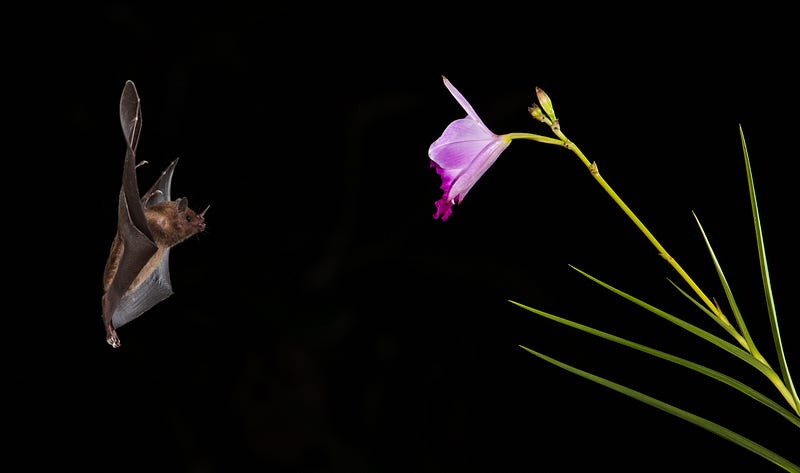
Photo by Zdeněk Macháček on Unsplash

Today’s New York Times Spelling Bee letters:
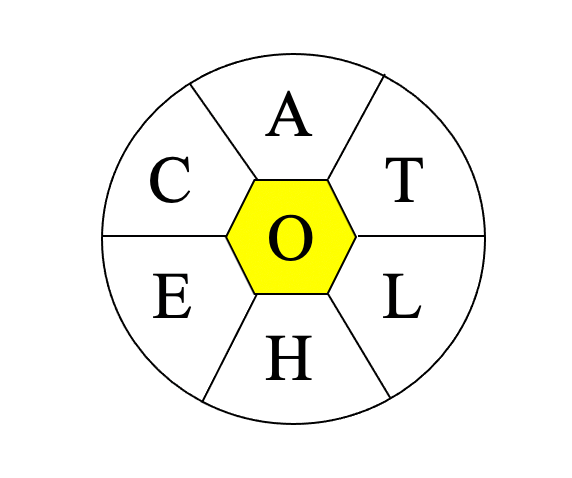
Art: Iva Reztok

A, C, E, H, L, T, and center O (all words must include O)

Merriam-Webster says…
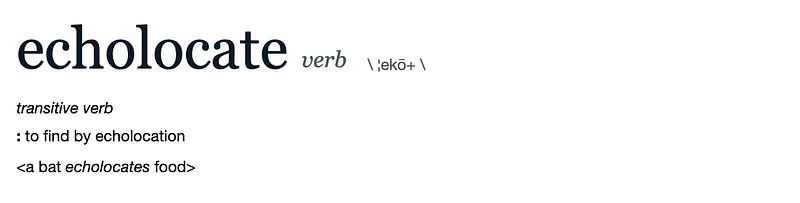
Credit: merriam-webster.com

Silly little dictionary! Don’t you know echolocate can’t possibly be a word if the New York Times says it ain’t?

For further fascinating facts, check out the Spelling Bee Master.

What’s your favorite dord* from today’s puzzle?

My Two Cents

How many of you saw echocolate instead of echolocate when you looked at the title of today’s column? Raise your hand. I’m raising mine, as it happened to me even though I knew what the word was. This is a common slip of the tongue that happens to many people even if they are not dyslexic. It’s known as metathesis, from the Greek metatithenai, meaning “to transpose”, from the combination of meta- and tithenai, “to place”.

These mixups are also known as spoonerisms, especially when done on purpose. The name comes from Oxford, England minister William Archibald Spooner, who supposedly was fond of doing them, particularly during his sermons. Today, however, it’s accepted that most of the spoonerisms attributed to him are apocryphal, or of doubtful authenticity. Spooner himself declared he had only ever said one in his entire lifetime.

Some of the best known examples of spoonerisms attributed to him are:

  • “Three cheers for our queer old dean!” (rather than “dear old queen”)
  • “Is it kisstomary to cuss the bride?” (as opposed to “customary to kiss”)
  • “The Lord is a shoving leopard.” (instead of “a loving shepherd”)
  • “A blushing crow.” (“crushing blow”)
  • “A well-boiled icicle” (“well-oiled bicycle”)

This all reminds me of my favorite “man walks into a bar” joke, which has the added distinction of being an extremely short one at only seven words: A dyslexic man walks into a bra

Going batty

It’s no surprise our friends at Merriam-Webster used the bat in the example sentence they provided for echolocate. That’s because it’s the animal that’s provided the best marketing for this special skill. Could it be because of the expression “as blind as a bat” that, by the way, is not true at all? I mean, if you’re blind (again, not true at all) but fly around pretty accurately without bumping into people while managing to feast on insects, well, that’s some impressive echolocation ability you’ve get there, pal!

Or could it be that bats have gotten more fame than they deserve thanks to a superhero that, unlike the animal it’s named after, does not echolocate. I’m not going to name him, but you probably know who I’m talking about…
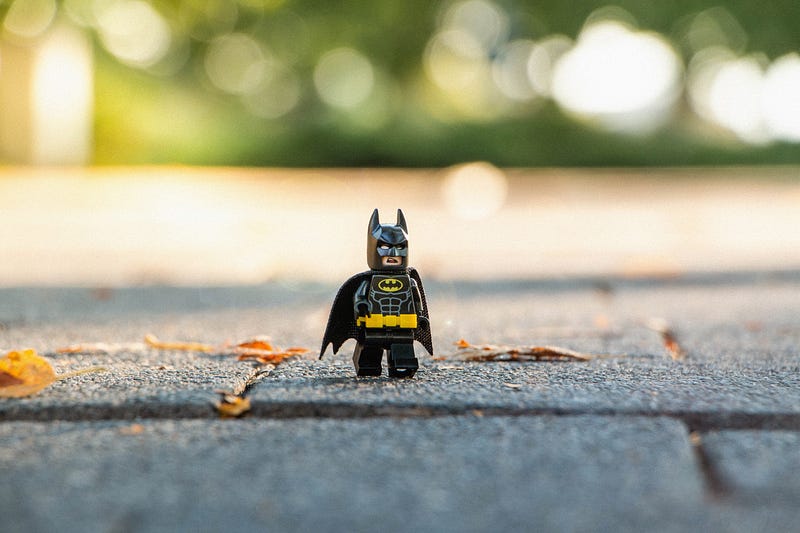
Photo by Yulia Matvienko on Unsplash

Dolphins and whales, of course, do come a close second to the bat as known animals that echolocate.

The etymology of the word is practically self-explanatory: echo (repetition of a sound caused by reflection of sound waves) + locate (to find). The dictionary further explains that echolocation is the “process that is used by an animal (such as a bat) to orient itself and avoid obstacles especially in darkness and that involves emission of high-frequency sounds which are reflected back from environing surfaces and thus indicate the relative distance and direction of such surfaces”. Hmmm, they just love that bat!

Those high-frequency sounds in the definition are known as ultrasounds, because their frequencies are above the upper audible limit human beings possess. In other words, we can’t hear these signals that bats emit. But Petteri Aimonen was kind enough to make an illustration of what bat echolocation looks like, and then post is as public domain.
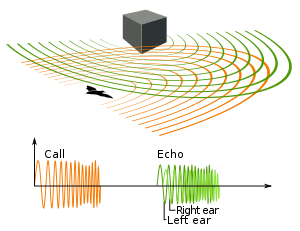
Image by Petteri Aimonen. Duh! Weren’t you paying attention?

Did you know that there are other animals besides bats, dolphins, and whales that echolocate? Of course you did. But because I didn’t, I had to look it up. Turns out that some shrews, tenrecs, and rats use echolocation. So do the oilbird (whose clicks are audible to humans) and the swiftlet. You’re probably wondering what the hell is a tenrec. It’s a term used to describe any of the 29 species of mammals that look like shrews or hedgehogs; most are native to Madagascar.
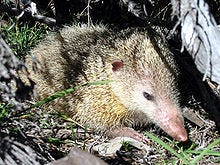
Credit: wikicommons

Back to bats… their echolocation was first deduced by an Italian priest named Lazzaro Spallanzani, which brings us to…

Lazzaro Spallanzani

Born 293 years and 10 days ago, Spallanzani was a post-Renaissance Renaissance man. By the age of 25 he had been ordained, and was professor of logic, metaphysics, and Greek in the University of Reggio. This after also having studied law, mathematics, and natural philosophy.

A statue of Spallanzani in his native town of Scandiano shows him examining a frog with a magnifying glass.
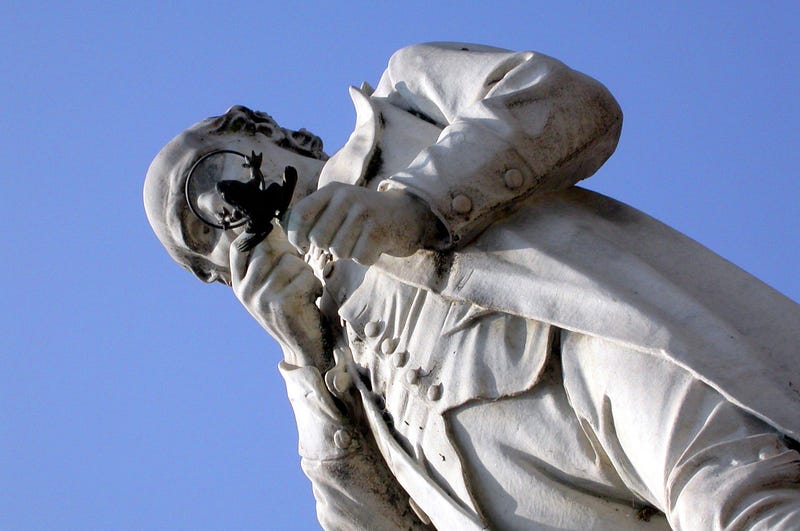
Credit: wikicommons

And boy did this guy loooove to examine stuff!. Don’t believe me? Here are a few things he studied exhaustively:

▹ Spontaneous generation, which he strongly disagreed with. After conducting an experiment in which he boiled gravy and then sealed it in glass to prove that it would not produce living forms. It did take another century, however, for Louis Pasteur to completely disprove spontaneous generation.

▹ Digestion, for which he obtained evidence that the process is not merely physical (as was believed up to then) but also chemical.

▹ Reproduction, establishing the seminal role of, well, um, semen. Spallanzani proved that the sperm and the egg need to join in order for fertilization to occur. He also was the first person to perform in vitro fertilization (in frogs) and an artificial insemination (in dogs).

▹ Echolocation, in bats. After noticing that a barn owl could not fly well in complete darkness, Spallanzani captured three bats and put them to the test. His description of what happened was thus:

“Having seen this, the candle was taken away, and for my eyes like for those of my brother and cousins we were in complete darkness. Yet the animals continued to fly around as before and never struck against obstacles, nor did they fall down, as would have happened with a night-bird. Thus a place which we believe to be completely dark is not at all so, because bats certainly could not see without light.”

He performed another test in which he covered the bats’ eyes and they responded by still flying as they normally did.

Then Spallanzani went a bit batty and turned his experiments into sadistic torture. He took out the poor bats’ eyes, then plugged their ears, then burning their exterior ears and piercing their inner ones. Unfortunately that’s how a lot of the research on animals was conducted back then: with reckless cruelty.

Perhaps this fact may help keep Spallanzani in your good graces: he is credited for naming the tardigrades their name (tardigradum means “slow walker” in Latin). These microscopic creatures are better-known as “water bears” or “moss piglets”, and look very cute under an electron microscope:
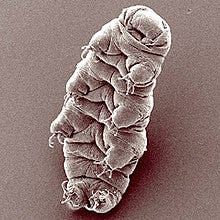
Image by Bob Goldstein and Vicky Madden, UNC Chapel Hill

As far as I know, Spallanzani never got to torture these torture-proof animals, or determine whether they too could echolocate anything.

Who knows why the Spelling Bee rejected echolocate. Perhaps the editors the editors of the Spelling Bee read it as the spoonerism “echocolate” and declared it a dord*.

You can check out my previous entry on another dord* here:

*What the heck is a dord, you ask? Here’s the answer:

Spelling Bee
Language
Science
History
Animals
Recommended from ReadMedium