
Ebbet
A newt — and a stadium — that disappeared
Today’s New York Times Spelling Bee letters:
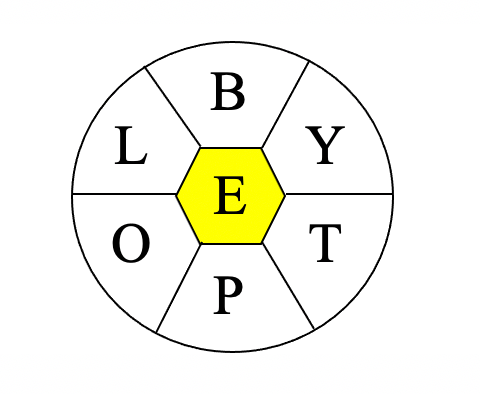
B, L, O, P, T, Y, and center E (all words must include E).
Merriam-Webster says…
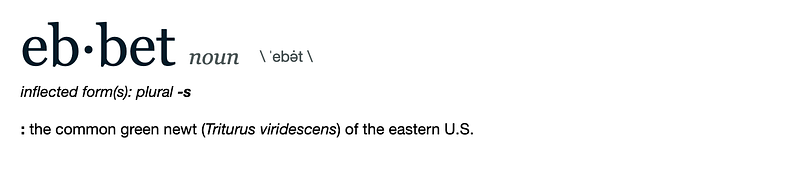
Silly little dictionary! Don’t you know that ebbet can’t possibly be a word if the New York Times says it ain’t?
For further fascinating facts, check out the Spelling Bee Master.
What’s your favorite dord* from today’s puzzle?
My Two Cents
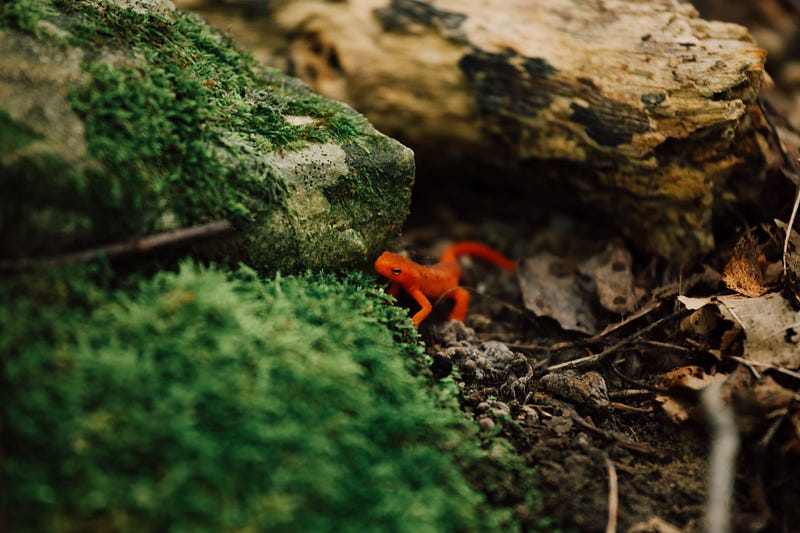
After some serious detective work today, I’m still not sure to which species of newt the dictionary refers to in its definition of ebbet. I think the one in the photo is the eastern newt, also known as an eft. Now, the juvenile stage of the eastern newt displays the bright orange color seen in the picture. The fact that the dictionary describes it as “green” is not an issue, because the aquatic adult male is green:
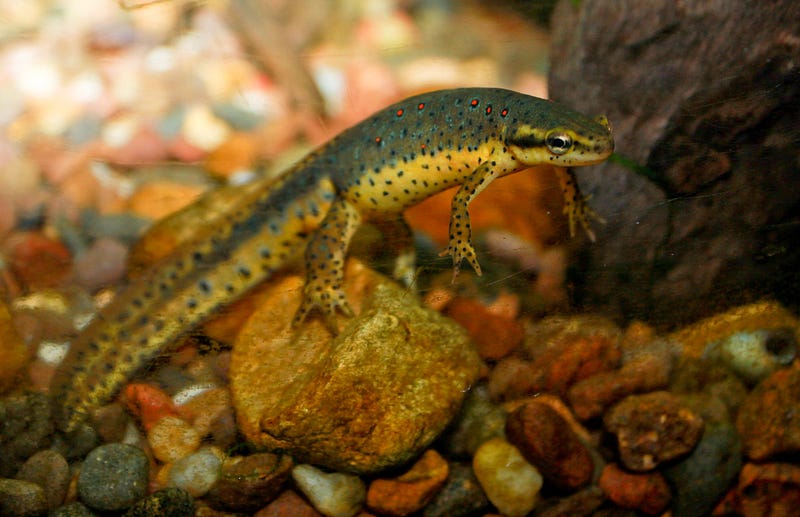
Newt outta here!
Merriam-Webster explains that ebbet is an altered form of evat or evet, from Middle English evete or ewte, which came from the Old English efete. And efete is the origin of eft, too.
So things seem to point in the right direction, etymologically speaking. Taxonomically, things get complicated, and I suspect I’m missing a link. It’s possible that the common eastern newt may have been known as Triturus viridescens early on in scientific literature. Here is an example of a paper published by Amy Elizabeth Adams, an American zoologist:
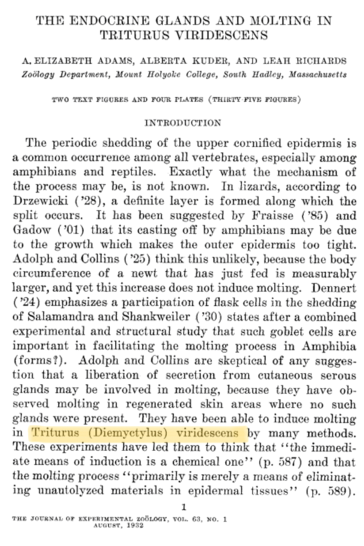
Notice the species name highlighted in yellow. Also, that reference to ’85 is not 1985, but 1885. Adams published this in 1932!
James E Turner and Kathleen A. Glaze still use the same species name in 1977, in their paper titled “The early stages of wallerian degeneration in the severed optic nerve of the newt (Triturus viridescens)”.
Note their use of the word newt.
It seems that at some point over the last 44 years the common eastern newt joined the witness protection program and got a new name: Notophthalmus viridescens. What this means is that someone decided it belonged to a different genus.
Triturus is a genus of crested and marbled newts; it may have taken a while, but newtologists finally realized the ebbet was neither crested nor marbled enough to deserve that first name. No need to change the viridescens part, since that means “green”.
I’m gonna have a serious talk with Merriam and Webster. Maybe over coffee this weekend. Yesterday I discovered that they think the Tasmanian Tiger is still alive, and today they use an archaic taxonomy to describe the most beloved newt of them all. (The most hated newt may be the one with a capital N.)
In any case, although the ebbet is very common throughout the eastern half of the U.S. and produces a toxin that protects it from predatory fish and crayfish, it’s still threatened by the most destructive animal on the planet: humans. Habitat destruction, climate change, and invasive species are all slowly wreaking havoc on this, and other, newts. Slowly enough that of this writing the ebbet is not even in the “near threatened” category yet.
But with our pernicious ecological habits, I’m sure it will get there soon enough.
Yer outta here!
Normally that’s what an umpire with a Brooklyn accent might yell at a manager when he ejects him on account of some rude chest-bumping or sand-kicking.
In our case, it’s what Walter O’Malley yelled at his Brooklyn Dodgers after the 1957 baseball season, when the team relocated to Los Angeles. O’Malley had become the majority owner of the team in 1950 when he bought 25% of the team from Branch Rickey, famous for signing Jackie Robinson to the team in 1945 when Rickey was also the General Manager of the team. Robinson would go on to become the first Black player in the Major Leagues in 1947, breaking the “color barrier” and forever changing baseball… for the better.
Why am I talking about the Brooklyn Dodgers? Because of this:
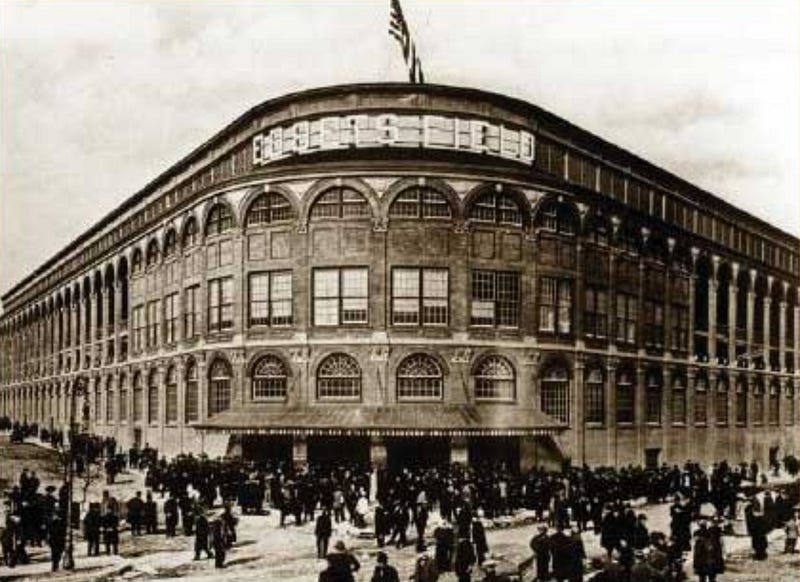
That’s Ebbets Field, home of the Dodgers from 1913 until they left in 1957. Since we’re talking about ebbets today, I felt like sneaking this reference in. Ebbets Field was named in honor of the owner who built the stadium, Charles Ebbets.
O’Malley ultimately left because he was unhappy with the stadium and the fact that he was being given a hard time by Robert Moses about building a new one in Brooklyn. Moses wanted the Dodgers to move to Queens, where eventually the New York Mets — my team! — would end up.
The Mets had a lovely stadium called Shea, which much to my disgust was torn down in 2008 to make way for CitiField:
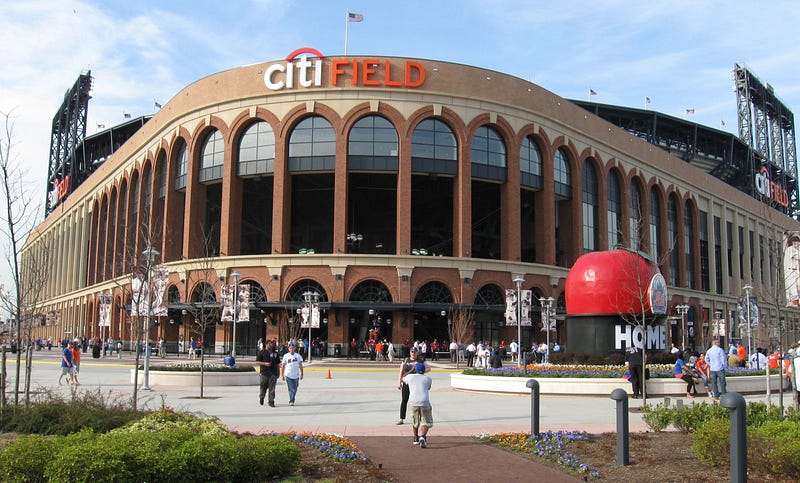
Notice any similarities between the outer facade of this stadium and Ebbets Field? The reason this happened is because former (thank goodness!) owner Fred Wilpon had been a huge obsession with the stadium in Brooklyn. (His wife was Branch Rickey’s secretary.)
I, on the other hand, am obsessed with Shea Stadium, having many days there as a former season ticket holder. (Keeping my tickets while I live in Spain would be lovely, but I need to win the lottery first.) I have my Shea Stadium seats here in my apartment in Madrid, plus an assortment of additional memorabilia, including a piece of concrete from the stadium that I picked myself.
After Shea was murdered (demolished is too kind a word), the nomas-nyc online store began selling t-shirts stamped with “I’m calling it Shea”, perfect for fans like me who were not happy about having to pronounce the word “CitiField”.
And so comes the time for me to share a personal story. One season the Mets decided to have greeters at the entrance of the new stadium, droning “Welcome to CitiField” after your ticket had been scanned and as you were headed inside. I was sporting my Shea t-shirt, ready to snarl at anyone who mentioned the verboten stadium name to me.
When the greeter saw me, without missing a beat he smiled and said: “Welcome to Shea”.
Coaxed a reluctant smile out of me.
So that’s about it for today… except I can’t leave without mentioning one more ebbet: Charles Clyde Ebbets, a photographer most famous for this iconic New York picture:
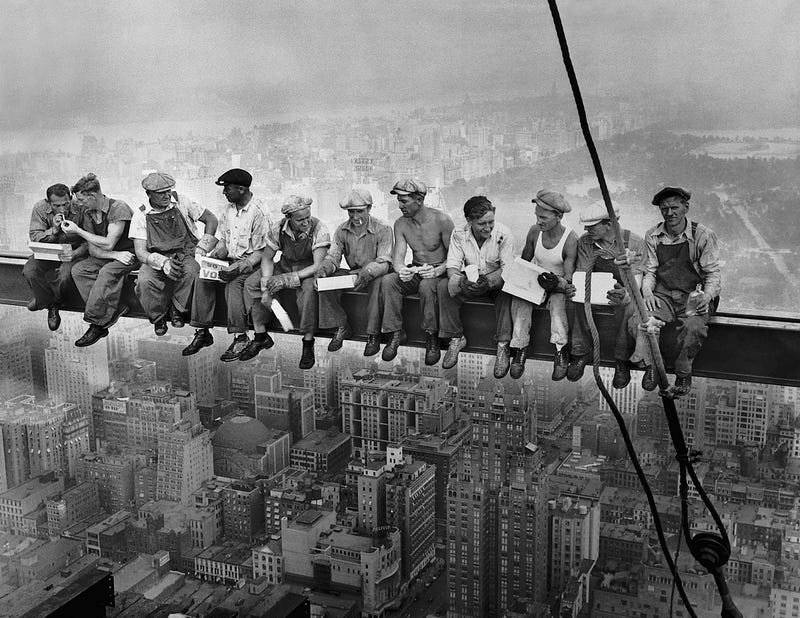
Lunch atop a Skyscraper, now also stamped on t-shirts everywhere in the world.
Okay, now we’re done. Just remember that you can talk about Ebbets Field all you want, even though it no longer exists. But you can’t talk about the ebbet that does exist, the newt, because the editors of the Spelling Bee puzzle decided that the word ebbet is a dord.*
You can check out my previous entry on another dord* here:
*What the heck is a dord, you ask? Here’s the answer: