
Philosophy
John Locke’s Epistemology
An introduction to Locke’s theory of human perception.
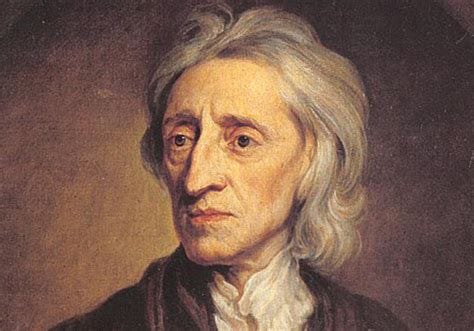
Thomas Jefferson wrote, “(Francis) Bacon, (John) Locke, and (Isaac) Newton…I consider them as the three greatest men that have ever lived, without any exception, and as having laid the foundations of those superstructures which have been raised in the Physical & Moral sciences.”
Jefferson mentions John Locke (1632–1704) with good reason. Locke was an intellectual giant within his own lifetime and remains one of the most important philosophers. He is equally well known for his political philosophy and his epistemology (the study of knowledge and perception). Locke talks more about beliefs than knowledge because, as he correctly observes, every idea we have is a belief. Locke was concerned primarily with establishing the limits of human understanding and the grounds of our beliefs. Locke was, therefore, interested in understanding how it is we come to our beliefs.
Locke’s philosophical influences were Rene Descartes, Francis Bacon, and Isaac Newton. This is part of why I stressed the importance of Descartes’ scientific method. Locke didn’t see Descartes as a dreamy meditator. He understood that Descartes’ rules for clear thinking and forming justified beliefs was a way forward for science. Locke, like Descartes, was interested in helping clarify and strengthen science.
In trying to understand how it is we come to our beliefs, Locke had the benefit that Descartes had not had of the tremendous innovations of Isaac Newton. Locke wanted to develop a Newtonian view of belief to understand why certain ideas were often found together as though attracted to each other by a kind of mental gravity.
Locke’s word for our beliefs is “idea.” You need to lose your preconception of what “idea” means to understand fully Locke’s use of the term. For Locke, an idea is anything in the human mind — not just something we create, as in “I have an idea — let’s order pizza.” See? I put the idea of pizza in your mind because you had the experience of reading “pizza,” which you associated with your prior experiences of pizza, both past and present experiences becoming ideas in your mind. So now we all have the idea of pizza, which is usually connected with the idea of wanting pizza. I really want pizza now.
Locke insists that we had no innate idea of pizza or of anything else. Innate ideas are ideas that are inherently known by the mind. Knowledge of Plato’s Forms is an example. A Platonist would say we recognize a pizza because we have the innate idea of Pizzaness; Locke says we only know about pizza because we have had the experience of delicious, hot, savory, pizza. Okay, I will stop talking about pizza to avert cravings. Other examples of alleged innate ideas are the basic concepts of logic, mathematics, and moral laws. The theory of innate ideas claims that everyone universally has these basic bits of knowledge. Locke counters that even if some ideas are universally known, that doesn’t prove they are innate. The ideas could be universal because human experience is universal. He also rejects the idea that logical and moral ideas are universally held by people, pointing to the ample evidence that there are illogical and immoral people.
Locke’s claim is that we have ideas only because we have experienced objects in the world. For example, we have the idea of a tree from our experiencing sensations furnished by external objects that we have come to know as “tree.” Our minds are like blank sheets of paper, Locke says, on which experiences make their marks. The only ideas in our minds, Locke says, have been put there by our experiences.
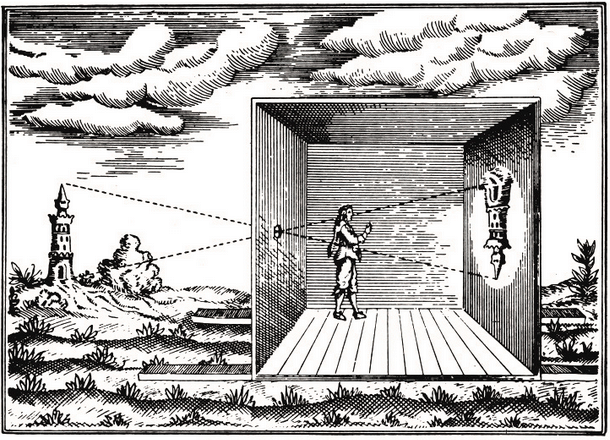
Locke also likens our minds to a camera obscura (Latin for “dark chamber” and, yes, where we get the word “camera” from). The camera obscura was a well-known device in Locke’s time, a small hole in a wall through which light would pass and shine an image onto a wall or canvas. It was used primarily by artists as a drawing or painting aid as shown here. The artist could trace the image shown by the light shining on the canvas.
The camera obscura of our mind is a dark box with holes (the senses) through which sensations enter. Inside the dark chamber, the mind begins life as a tabula rasa (Latin for “blank slate”) on which sensations make their mark. As we have experiences in life, we gather more and more ideas, which Locke calls “simple ideas of sensation.” These are ideas like green, flat, smooth, hard, tall, hot, sweet, and so on. That is all our senses give us — simple minute qualities presented to the mind as sensations.
But what happens in the mind to these simple ideas of sensation? Clearly, the human mind is more than a dark box into which simple sensations pour. Locke says that the human mind is also aware of its operations, and this is “the other fountain from which experience furnisheth the understanding with ideas.” (Essay, II.I.4) This set of ideas is our internal sense. These ideas come not from external objects but from our own “thinking, doubting, believing, reasoning, knowing, willing, and all the different actings of our own minds…[ideas] the mind gets by reflecting on its own operations within itself.” (Essay, II.I.4) Locke calls ideas of our internal sense “ideas of reflection.” For example, the simple ideas that enter our mind of an object that is flat, smooth, and hard are simple ideas of sensation; being aware and thinking about these simple ideas of sensation are simple ideas of reflection.
Locke contends that together with the simple ideas of sensation, the simple ideas of reflection are the only ideas that are ever present in the mind. “External objects furnish the mind with the ideas of sensible qualities, which are all those different perceptions they produce in us; and the mind furnishes the understanding with ideas of its own operations.” (Essay, II.I.5) That’s it. Those are the entire contents of the human mind, and because the mind can reflect only on ideas of sensation furnished to it by external objects, Locke concludes that “the mind thinks in proportion to the matter it gets from experience to think about.” (Essay, II.I.22) The contents of our minds, then, are strictly products of our experiences — initially of external objects, then by reflecting on our experiences of external objects. Our minds, Locke says, can neither create nor destroy ideas, but they can process them.
Locke says that the mind has the power to repeat, compare, and unite the simple ideas. In so doing, the mind creates complex ideas. Locke identifies three mental operations that we use to process simple ideas into complex ideas: compounding, comparing, and abstracting. For example, if we have the simple ideas of flat, smooth, and hard, we can combine these simple ideas into the complex idea of a tabletop. The simple ideas of green and tall can be combined into the complex idea of a tree. Much of our thinking uses this activity of compounding simple ideas. We don’t think “that’s flat, smooth, and hard”; we think “that’s a tabletop.” Our dealings with the world are mostly in terms of complex ideas like “tabletop.”
The second activity we use is comparing. Exactly as it seems, we compare ideas. It’s hotter today than yesterday, that tree is taller than that one, and so on. Comparing also includes relations such as mother and son, over and under, cause and effect — ideas that you don’t experience but determine from comparing relations between things.
The third activity is abstraction, the process that gives us abstract or general ideas. Locke sees these as an important set of ideas. Compounding gives us the complex ideas of a tabletop and a tree, and abstraction gives us the general ideas of tabletops and trees. This is Locke’s answer to the problem of universals. Treeness doesn’t exist, either as a Form or in particular objects. The complex idea of trees is a general idea that comes from the process of abstraction. We experience a number of trees, and in thinking about trees in general, we hold in our minds an abstract idea of “tree” without a particular size, color, or other qualities. Our minds abstract all of the qualities that particular trees have in common and ignore individual differences. What remains is the general abstract idea of trees. An abstract idea, therefore, is a vague combination of qualities we have experiences of as external objects. One of the examples Locke gives of an abstract idea is the notion of infinity — a notion others, including Descartes, believed was an innate idea. Locke countered that the idea of finite, in both space and time, is a simple idea. Through the process of compounding, we can mentally observe a repeating without end of a finite length of space or time. This is all the abstract idea of infinity is. Our idea is not innate but determined by a mental process — a faculty of our mind. Our idea of infinity is vague because our minds are finite, but then all of our abstract ideas are vague, not definitive, something to which George Berkeley would respond.


