avatarLucianoSphere (Luciano Abriata, PhD)

Free AI web copilot to create summaries, insights and extended knowledge, download it at here

2999

Abstract

20/1*CXeipZFR5kloxSLiBgiWEA.png)"></div> </div> </div> </a> </div><h1 id="2b4b">New educational AR and VR tools for chemistry and biology</h1><p id="d120">Now, the Journal of Molecular Graphics and Modelling just published our peer-reviewed article describing our new tool to create AR and VR scenes from atomic coordinates and volumetric data. Starting with atom coordinates, you can describe any molecule, from the smallest compounds to the largest biomolecular assemblies ever solved such as ribosomes; while starting from volumetric data you can get to see from large biomolecular assemblies observed by low-resolution cryo-electron microscopy to whole particles such as viruses reconstructed by cryo-electron tomography.</p><figure id="a954"><img src="https://cdn-images-1.readmedium.com/v2/resize:fit:800/1*b6__WmSwFfepWHnmHuMnsQ.png"><figcaption>Top: various augmented reality views generated with the tool. Bottom: Two virtual reality views, one also showing a user from outside. This person is the author.</figcaption></figure><p id="b424">Starting from atomic coordinates, the tool automatically grabs PDB files from the Protein Data Bank or from AlphaFold-EBI’s database, and prepares them as AR/VR objects.</p><p id="8df6">The alternative is to start with objects already exported by the user from the VMD program. This can include everything from VMD’s own representations of atomic coordinates to isosurfaces depicting pieces of volumetric data from cryo-electron microscopy or tomography, atomic or molecular orbitals, electron densities, molecular surfaces, etc.</p><figure id="596e"><img src="https://cdn-images-1.readmedium.com/v2/resize:fit:800/1*vCOQ0r2lmE7I7YbN8xv6zg.png"><figcaption></figcaption></figure><p id="4f73">After submitting your coordinates or VMD-exported objects through the web interface, you’ll get an e-mail with links to its AR and VR modes. You can open all of them on your regular device (tablet, smartphone, laptop or desktop computer) or even in the web browsers of modern VR headsets. In the latter, you can manipulate the objects with your bare hands or with the device’s controls. It’s a very neat experience that you should try out!</p><figure id="5a2e"><img src="https://cdn-images-1.readmedium.com/v2/resize:fit:800/1*L8buAvwgybpwFhIMJRMnXQ.png"><figcaption></figcaption></figure><h1 id="09ab">The web tool and paper are both for free</h1><p id="f4d0">The tool is freely accessible at no cost and without registration here:</p><div id="04f5" class="link-block"> <a href="https://molecularweb.epfl.ch/pages/pdb2ar.html"> <div> <div> <h2>PDB2AR</h2> <div><h3>👋 Build your own webAR views from raw PDB files, PDB entries, or by uploading your own VMD-made virtual scenes…</h3></div> <div><p>molecularweb.epfl.ch</p></div> </div> <div> <div style="background-image: url(https://mir

Options

o.readmedium.com/v2/resize:fit:320/)"></div> </div> </div> </a> </div><p id="dfcb">The paper is free to read on Open Access. It includes several pictures displaying the various kinds of visualization available, and several links for you to try right away on the web browser of your smartphone, tablet, computer, or VR headset.</p><div id="6a37" class="link-block"> <a href="https://www.sciencedirect.com/science/article/pii/S1093326322000432"> <div> <div> <h2>Online tools to easily build virtual molecular models for display in augmented and virtual reality…</h2> <div><h3>Augmented and Virtual Reality (AR/VR) have educational potential in chemistry and biology. * But tools to create…</h3></div> <div><p>www.sciencedirect.com</p></div> </div> <div> <div style="background-image: url(https://miro.readmedium.com/v2/resize:fit:320/0*gCdlXJBiLSE_nwYb)"></div> </div> </div> </a> </div><h1 id="2b97">Interested in the programming of this?</h1><p id="692d">We made the code available on GitHub on an AGPL-3 license:</p><div id="bdf9" class="link-block"> <a href="https://github.com/fcor/pdb2ar-templates"> <div> <div> <h2>GitHub - fcor/pdb2ar-templates: This repo has the templates needed to build WebXR apps for…</h2> <div><h3>PDB2AR is a free web-based tool to create immersive experiences to visualize and manipulate molecules. From PDBs, PDB…</h3></div> <div><p>github.com</p></div> </div> <div> <div style="background-image: url(https://miro.readmedium.com/v2/resize:fit:320/0*W5tQskETvid9BxJ9)"></div> </div> </div> </a> </div><p id="b016">For more, you can contact me or the talented programmer behind all this, <a href="undefined">Fabio Cortes</a>.</p><p id="702e"><b>The development of this tool was funded by the Swiss National Science Foundation and the Hasler Foundation.</b></p><p id="8353"><a href="https://www.lucianoabriata.com/"><b><i>www.lucianoabriata.com</i></b></a><i> I write and photoshoot about everything that lies in my broad sphere of interests: nature, science, technology, programming, etc. <a href="https://lucianosphere.medium.com/membership"><b>Become a Medium member</b></a> to access all its stories (affiliate links of the platform for which I get small revenues without cost to you) and <a href="https://lucianosphere.medium.com/subscribe"><b>subscribe to get my new stories</b></a><b> by email</b>. To <b>consult about small jobs</b> check my <a href="https://lucianoabriata.altervista.org/services/index.html"><b>services page here</b></a>. You can <a href="https://lucianoabriata.altervista.org/office/contact.html"><b>contact me here</b></a><b>.</b></i></p></article></body>

This and other figures by the author, Luciano Abriata.

Perfect to teach and study, and for free!

Easily build virtual molecular models of chemical and biological entities for display in web-based augmented and virtual reality

The Metaverse should not be just for entertainment, but for easier education and work too. We just published a paper describing one of the very first tools for this! It works on various devices from regular phones, tablets and computers to high-end VR headsets.

You probably saw earlier my articles on moleculARweb and other technologies that use commodity augmented reality to help teachers teach and students learn about chemistry and biology:

New educational AR and VR tools for chemistry and biology

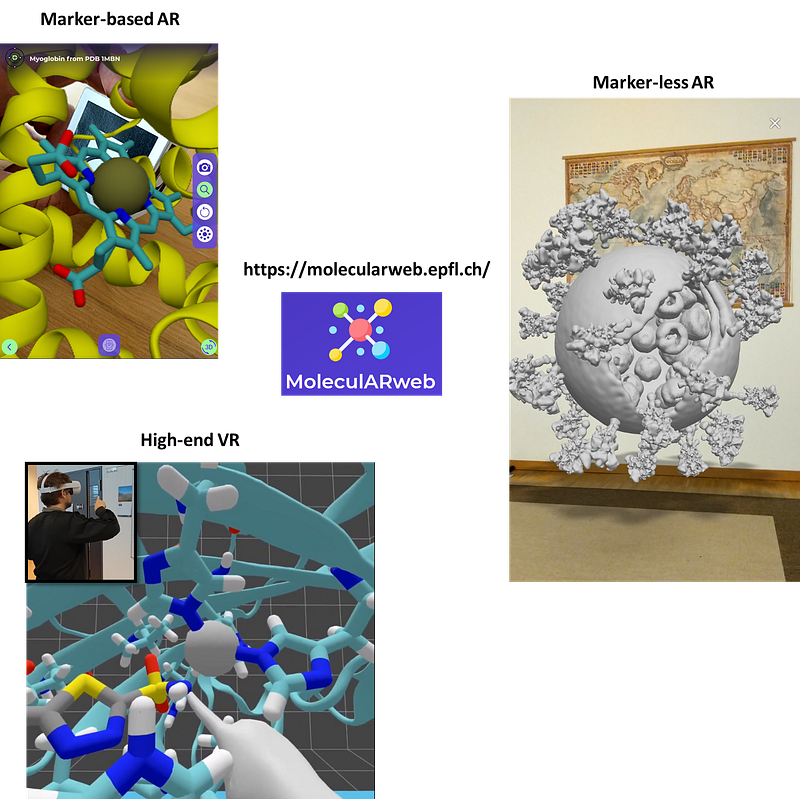
Now, the Journal of Molecular Graphics and Modelling just published our peer-reviewed article describing our new tool to create AR and VR scenes from atomic coordinates and volumetric data. Starting with atom coordinates, you can describe any molecule, from the smallest compounds to the largest biomolecular assemblies ever solved such as ribosomes; while starting from volumetric data you can get to see from large biomolecular assemblies observed by low-resolution cryo-electron microscopy to whole particles such as viruses reconstructed by cryo-electron tomography.
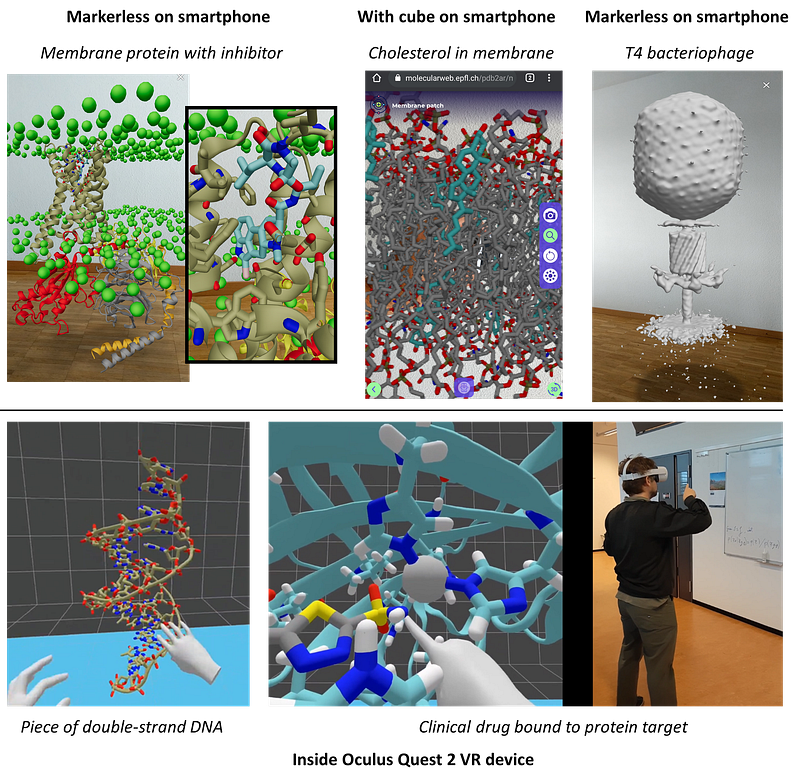
Top: various augmented reality views generated with the tool. Bottom: Two virtual reality views, one also showing a user from outside. This person is the author.

Starting from atomic coordinates, the tool automatically grabs PDB files from the Protein Data Bank or from AlphaFold-EBI’s database, and prepares them as AR/VR objects.

The alternative is to start with objects already exported by the user from the VMD program. This can include everything from VMD’s own representations of atomic coordinates to isosurfaces depicting pieces of volumetric data from cryo-electron microscopy or tomography, atomic or molecular orbitals, electron densities, molecular surfaces, etc.
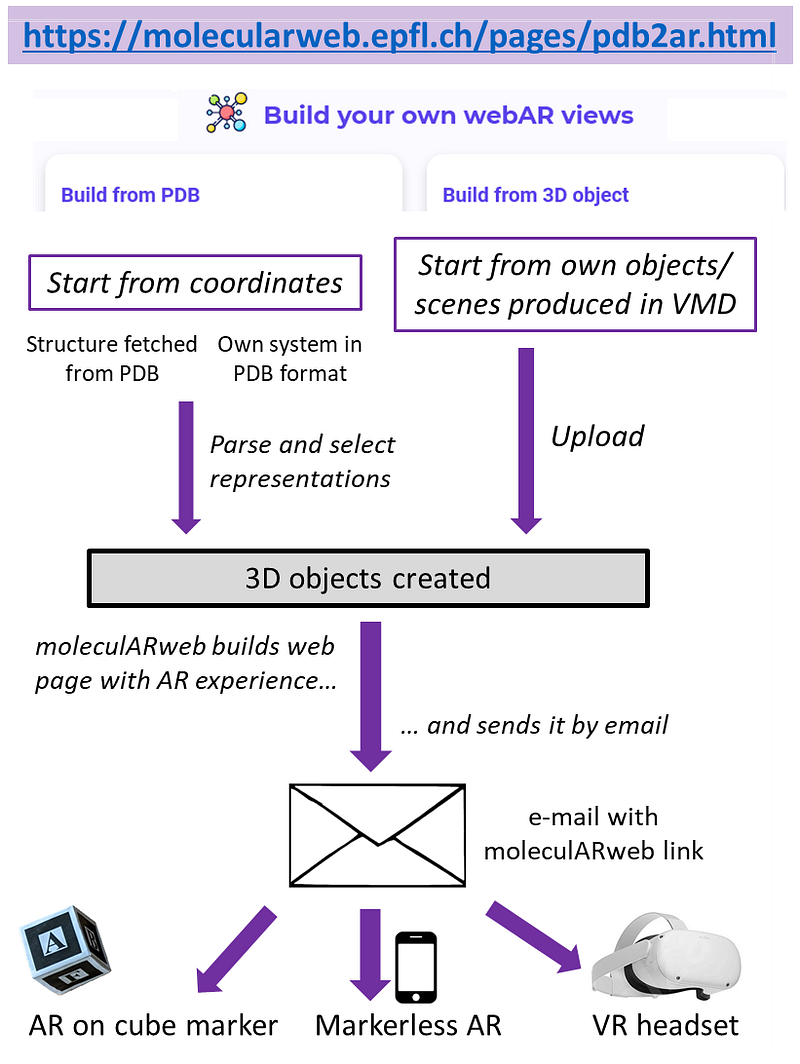
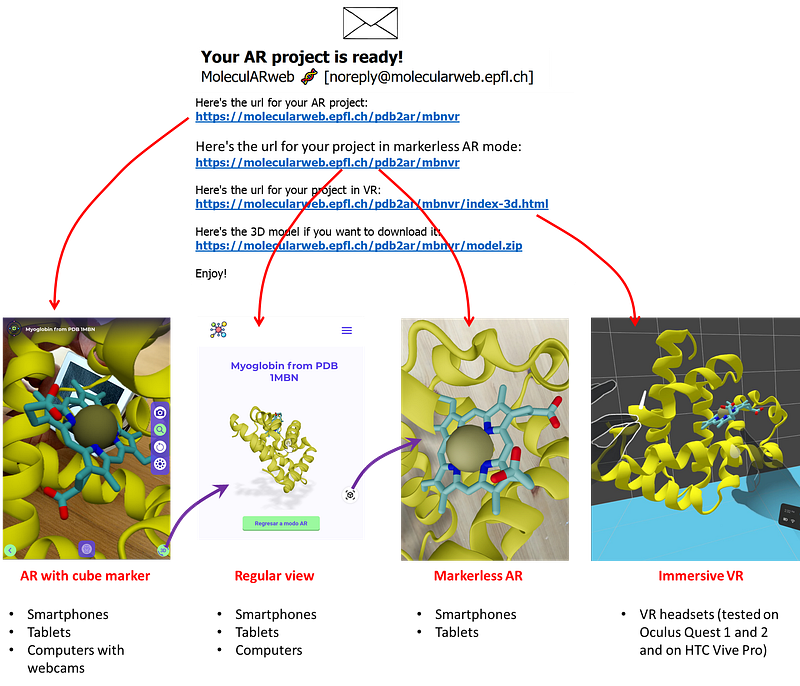
After submitting your coordinates or VMD-exported objects through the web interface, you’ll get an e-mail with links to its AR and VR modes. You can open all of them on your regular device (tablet, smartphone, laptop or desktop computer) or even in the web browsers of modern VR headsets. In the latter, you can manipulate the objects with your bare hands or with the device’s controls. It’s a very neat experience that you should try out!
The web tool and paper are both for free

The tool is freely accessible at no cost and without registration here:

The paper is free to read on Open Access. It includes several pictures displaying the various kinds of visualization available, and several links for you to try right away on the web browser of your smartphone, tablet, computer, or VR headset.

Interested in the programming of this?

We made the code available on GitHub on an AGPL-3 license:

For more, you can contact me or the talented programmer behind all this, Fabio Cortes.

The development of this tool was funded by the Swiss National Science Foundation and the Hasler Foundation.

www.lucianoabriata.com I write and photoshoot about everything that lies in my broad sphere of interests: nature, science, technology, programming, etc. Become a Medium member to access all its stories (affiliate links of the platform for which I get small revenues without cost to you) and subscribe to get my new stories by email. To consult about small jobs check my services page here. You can contact me here.

Science
Education
Virtual Reality
Technology
Programming
Recommended from ReadMedium