avatarLucianoSphere (Luciano Abriata, PhD)

Free AI web copilot to create summaries, insights and extended knowledge, download it at here

3709

Abstract

ECQ.png"><figcaption>Figure by author based on data available at <a href="https://clustrmaps.com/site/1ar2f">https://clustrmaps.com/site/1ar2f</a> by Feb 22nd, 2022.</figcaption></figure><p id="0c36">For a more detailed introduction to moleculARweb you can check this article:</p><div id="4f67" class="link-block"> <a href="https://lucianosphere.medium.com/molecularweb-a-brief-practical-introduction-5738771b224d"> <div> <div> <h2>moleculARweb: A brief practical introduction</h2> <div><h3>PART OF A SERIES. Here: how the activities are organized + general directions on how to run them</h3></div> <div><p>lucianosphere.medium.com</p></div> </div> <div> <div style="background-image: url(https://miro.readmedium.com/v2/resize:fit:320/1*CXeipZFR5kloxSLiBgiWEA.png)"></div> </div> </div> </a> </div><h2 id="3cb1">moleculARweb’s new Virtual Modeling Kits</h2><p id="5f76">The most used tool inside moleculARweb was its “Virtual Modeling Kit”, with which users could load a molecule from a preset list (or copy-paste any molecule from another program) and view it in augmented reality, handling it with a cube marker to rotate and move it around. This was <i>per se</i> useful to understand molecular structures in 3D and all the concepts associated to it, such as those about chirality and enantiomerism. The tool also included some elementary physics that simulated temperature, i.e. atomic motions which propagated and coupled throughout the molecule resulting in quite realistic molecular dynamics. With such feature users could for example explore torsional angles around single bonds, or the rigidity of aromatic systems.</p><p id="1a8f">The new virtual modeling kits, called VMK2 and VMK3, incorporate several additions: first, the physics are more complex and include non-covalent interactions between two or more molecules, such as clashes and hydrogen bonding. This extension of the physics engine is important because the new modeling kits can display multiple molecules at the same time!</p><p id="37c1">In the VMK2, the user holds 2 different cube markers, displaying one molecule or molecular system on each cube. The molecules from the two cubes can then interact with each other, allowing the exploration for example of hydrogen bonding, clashes, etc. Users can also selectively invert the molecules in one cube but not on the other, enabling easier 3D comparisons.</p><figure id="9d98"><img src="https://cdn-images-1.readmedium.com/v2/resize:fit:800/1*MwCQNfu1niydLM-qEEglnQ.png"><figcaption>Example using the VMK 2 to study chirality: on the left, both cubes display L-alanine; on the right, the alanine on the top has been inverted to R-alanine. By rotating the cubes the user can verify that the molecules are no longer superimposable. This and all other figures by author Luciano Abriata.</figcaption></figure><p id="ab0f">In the VMK3 there is no cube marker at all. Rather, there is a simulation box in which the user can load as many molecules as wanted. The molecules then undergo “natural” physics, that the user can tune to explore different phenomena. For example, by switching on hydrogen bonding one can explore how polar and non-polar molecules phase-separate. By activating gravity one can see a liquid adopting the shape of the box. By raising temperature one can see entropy increase, and eventually phase separations and phase changes, such as the boiling of a liquid.</p><figure id="6605"><img src="https://cdn-images-1.readmedium.com/v2/resize:fit:800/1*uuWuk5AFfZ7ak-HSMPSD_g.png"><figcaption>Example us

Options

ing the VMK 3 to show how polar forces lead to phase separation. In the top, some water and butane molecules are mixed because hydrogen bonding is deactivated. Bottom: when hydrogen bonding is activated, the molecules naturally separate into water and butane phases.</figcaption></figure><p id="26e2">moleculARweb’s new modeling kits also present new ways to prepare molecules. In fact, users can draw molecules themselves, or fetch them from the large database of molecules provided by the USA’s National Cancer Institute. The following article is a tutorial that describes how to load or build any molecule for display -in the two new virtual modeling kits:</p><div id="29ac" class="link-block"> <a href="https://lucianosphere.medium.com/how-to-load-any-molecule-for-display-in-augmented-reality-on-molecularweb-5da0af4b64b2"> <div> <div> <h2>How to load any molecule for display in augmented reality on moleculARweb</h2> <div><h3>PART OF A SERIES: HERE HOW TO SEE ANY MOLECULE IN AUGMENTED REALITY</h3></div> <div><p>lucianosphere.medium.com</p></div> </div> <div> <div style="background-image: url(https://miro.readmedium.com/v2/resize:fit:320/1*83T_6Km_GDFTMfoBC4-LKQ.png)"></div> </div> </div> </a> </div><p id="ef66">The recently published article describes all these and other features of moleculARweb’s new modeling kits, with several examples that are explained in detail and accompanied by complete figures. The article is Open Access, which means you don’t have to pay to read it:</p><div id="b7bf" class="link-block"> <a href="https://chimia.ch/chimia/article/view/2022_145"> <div> <div> <h2>Visualization, Interactive Handling and Simulation of Molecules in Commodity Augmented Reality in…</h2> <div><h3>Fabio Cortes Rodriguez EPFL Matteo Dal Peraro Ecole Polytechnique Federale de Lausanne Luciano Abriata Ecole…</h3></div> <div><p>chimia.ch</p></div> </div> <div> <div style="background-image: url(https://miro.readmedium.com/v2/resize:fit:320/0*RO4dMmqzapSBav-l)"></div> </div> </div> </a> </div><p id="2b8b">For the full website, which you can use free of charge and without registration, see:</p><p id="e551"><a href="https://molecularweb.epfl.ch/"><b>https://molecularweb.epfl.ch</b></a></p><p id="6143">You will find the VMK2 and VMK3 in its first module, called “Molecular modeling kit”.</p><p id="4c1e">If you’d like a personalized tutorial on using moleculARweb, we can arrange this via Skype or Zoom. Just let me know by <a href="https://lucianoabriata.altervista.org/office/contact.html">contacting me here</a>.</p><p id="1269"><a href="https://www.lucianoabriata.com/"><b><i>www.lucianoabriata.com</i></b></a><i> I write and photoshoot about everything that lies in my broad sphere of interests: nature, science, technology, programming, etc. <a href="https://lucianosphere.medium.com/membership"><b>Become a Medium member</b></a> to access all its stories (affiliate links of the platform for which I get small revenues without cost to you) and <a href="https://lucianosphere.medium.com/subscribe"><b>subscribe to get my new stories</b></a><b> by email</b>. To <b>consult about small jobs</b> check my <a href="https://lucianoabriata.altervista.org/services/index.html"><b>services page here</b></a>. You can <a href="https://lucianoabriata.altervista.org/office/contact.html"><b>contact me here</b></a><b>.</b></i></p></article></body>

Perfect to teach and study, and for free!

Molecular graphics and simulations in augmented reality on your web browser

Chimia, the Swiss journal of chemistry, just published our peer-reviewed article describing the latest additions to our free moleculARweb site for chemistry education. Learn how to view, handle and simulate molecules in augmented reality just in the web browser of your smartphone, tablet, or laptop.

You probably saw earlier my articles on moleculARweb and other technologies that use commodity augmented reality to help teachers teach and students learn about chemistry and biology:

We just published a peer-reviewed article describing the latest tools released by moleculARweb: Web-based apps in which users can build and view molecules in 3D in augmented reality, and even explore how they move and interact with each other. Such visualizations enable seamless analysis of molecular structures in 3D space with very intuitive manipulation of the molecules, facilitating also their comparison because users can handle two molecules in space at the same time. Furthermore, the simulations facilitate the explanation and understanding of concepts such as conformational changes, phase transitions, phase separation and mixing, polarity, etc.

moleculARweb

moleculARweb (https://molecularweb.epfl.ch/) is a website for chemistry and structural biology education through augmented reality that works on consumer devices such as smartphones, tablets and laptops. The website provides several web apps with which students and educators can manipulate virtual molecules and other chemistry-related entities such as electronic orbitals, density maps, etc. in 3D space by showing paper-printed fiducial markers to the webcams of their devices. Each app inside moleculARweb is delivered as a regular webpage, so users do not need to install any programs to use them. This makes the tools widely available all around the world with a minimal usage barrier:
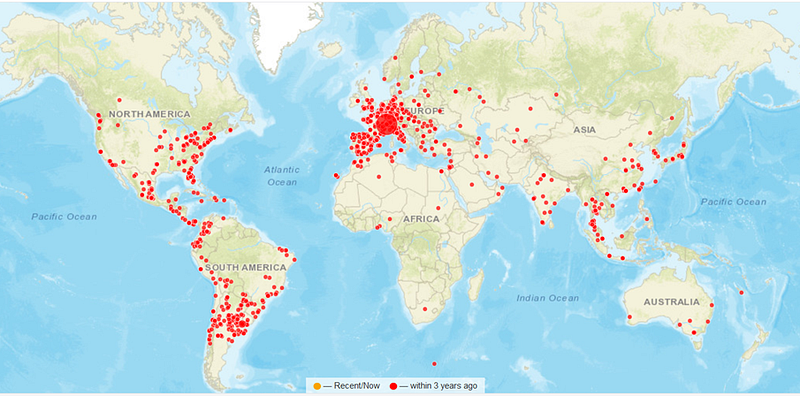
Figure by author based on data available at https://clustrmaps.com/site/1ar2f by Feb 22nd, 2022.

For a more detailed introduction to moleculARweb you can check this article:

moleculARweb’s new Virtual Modeling Kits

The most used tool inside moleculARweb was its “Virtual Modeling Kit”, with which users could load a molecule from a preset list (or copy-paste any molecule from another program) and view it in augmented reality, handling it with a cube marker to rotate and move it around. This was per se useful to understand molecular structures in 3D and all the concepts associated to it, such as those about chirality and enantiomerism. The tool also included some elementary physics that simulated temperature, i.e. atomic motions which propagated and coupled throughout the molecule resulting in quite realistic molecular dynamics. With such feature users could for example explore torsional angles around single bonds, or the rigidity of aromatic systems.

The new virtual modeling kits, called VMK2 and VMK3, incorporate several additions: first, the physics are more complex and include non-covalent interactions between two or more molecules, such as clashes and hydrogen bonding. This extension of the physics engine is important because the new modeling kits can display multiple molecules at the same time!

In the VMK2, the user holds 2 different cube markers, displaying one molecule or molecular system on each cube. The molecules from the two cubes can then interact with each other, allowing the exploration for example of hydrogen bonding, clashes, etc. Users can also selectively invert the molecules in one cube but not on the other, enabling easier 3D comparisons.
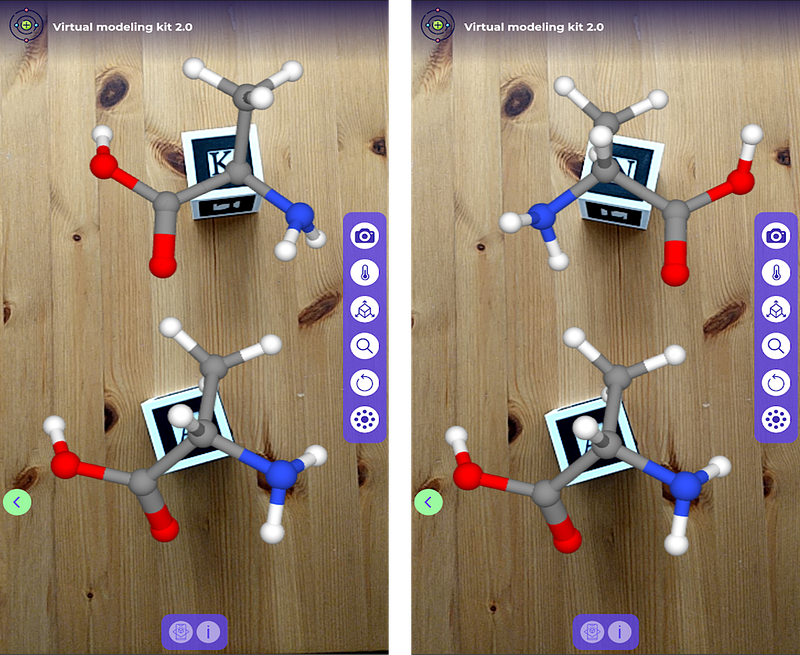
Example using the VMK 2 to study chirality: on the left, both cubes display L-alanine; on the right, the alanine on the top has been inverted to R-alanine. By rotating the cubes the user can verify that the molecules are no longer superimposable. This and all other figures by author Luciano Abriata.

In the VMK3 there is no cube marker at all. Rather, there is a simulation box in which the user can load as many molecules as wanted. The molecules then undergo “natural” physics, that the user can tune to explore different phenomena. For example, by switching on hydrogen bonding one can explore how polar and non-polar molecules phase-separate. By activating gravity one can see a liquid adopting the shape of the box. By raising temperature one can see entropy increase, and eventually phase separations and phase changes, such as the boiling of a liquid.
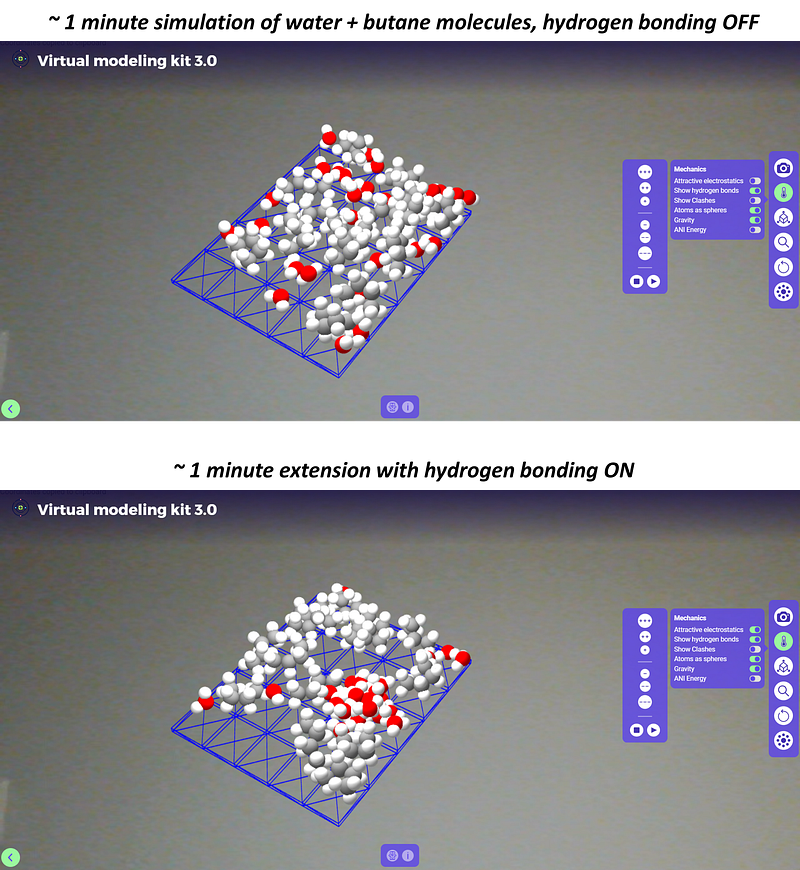
Example using the VMK 3 to show how polar forces lead to phase separation. In the top, some water and butane molecules are mixed because hydrogen bonding is deactivated. Bottom: when hydrogen bonding is activated, the molecules naturally separate into water and butane phases.

moleculARweb’s new modeling kits also present new ways to prepare molecules. In fact, users can draw molecules themselves, or fetch them from the large database of molecules provided by the USA’s National Cancer Institute. The following article is a tutorial that describes how to load or build any molecule for display -in the two new virtual modeling kits:

The recently published article describes all these and other features of moleculARweb’s new modeling kits, with several examples that are explained in detail and accompanied by complete figures. The article is Open Access, which means you don’t have to pay to read it:

For the full website, which you can use free of charge and without registration, see:

https://molecularweb.epfl.ch

You will find the VMK2 and VMK3 in its first module, called “Molecular modeling kit”.

If you’d like a personalized tutorial on using moleculARweb, we can arrange this via Skype or Zoom. Just let me know by contacting me here.

www.lucianoabriata.com I write and photoshoot about everything that lies in my broad sphere of interests: nature, science, technology, programming, etc. Become a Medium member to access all its stories (affiliate links of the platform for which I get small revenues without cost to you) and subscribe to get my new stories by email. To consult about small jobs check my services page here. You can contact me here.

Chemistry
Education
Technology
Augmented Reality
JavaScript
Recommended from ReadMedium