
How I Grew My Medium Earnings by 300%
Marketing, writing, and SEO: it had to be a combination of all of them

Writing for Medium and earning through the platform is a whole new ball game as compared to ad revenue from blogs. Essentially, you’re limited by your SEO choices while enjoying the vast audience that Medium enjoys. Yet, you’ve probably seen articles on Medium talking about how they earned loads of cash from writing, which means there’s definitely potential through the Medium Partner Program. Definitely, you would need an array of techniques and writing skills to do so.
The question is, how?
I started writing on Medium in August, scoring my first income in the triple digits when Medium’s in-house publication, Marker, contacted me to write this piece when they first launched not long ago.
Unfortunately, that high soon fell and stayed that way for the next two months, leaving me with what I initially thought was not a viable income stream.
Instead of losing steam, I decided to go back to the drawing board and improve some of the processes I had. I wrote furiously and fervently, publishing almost daily. At times, I even published three to four articles in a single day.
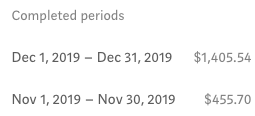
In November, my income picked up again, but it was not satisfactory. I doubled down on what worked and left out those that did not.
In December, I managed to hit 4 figures.
In this guide, I’ll be talking about the marketing tactics and writing habits I used to make this growth happen.
Trends Matter, but They Must Be in Your Niche
Being a former startup co-founder and still being plugged into the startup scene, I frequently commented on recent startup events such as fundraising and IPOs. Hence, I established my “domain expertise” in startup topics (I’m glad to also have people like SumoVentures founder, Alexander Muse, reading some of them), and thus I’m able to leverage on that when there are trending topics.
For instance, the biggest event in the startup world thus far is arguably WeWork’s downfall. Since it was trending at the time, many readers would be reading the latest updates and commentaries.
However, writing just about WeWork is not enough. Essentially, I broke down each part of the event, extended an olive branch, and covered more topics while remaining relevant:
- I wrote about WeWork’s state of affairs, from their initial implosion to their current financial state;
- I wrote about all the major stakeholders in WeWork after their founder was given a billion-dollar exit package;
- I wrote about other portfolio companies like Oyo, which is drawing scrutiny on their business model;
- I commented on Uber’s current state of affairs and how they need to avoid the fate of WeWork;
- I wrote about how Airbnb will succeed in the public markets since they do not have the same problems as WeWork, Oyo, and Uber does;
- I wrapped up with a commentary on recent startup affairs, particularly in big tech firms and how they are trying to become banks
That gave me seven articles to write and in total, they account for about 48% of this month’s income.
Hence, when you see a trend, you need to be aware and start doing the following things:
- Predict the lifespan of the trend. If the story is going to pan out further and you think its lifespan is long, follow the story. Jump on it immediately and offer new perspectives. Set a notification alert of any news related to the trend so you can do the same when there are huge changes. For WeWork’s example, it was the exit package that created a lot of controversies, thus pivoting the story.
- Break down the trend. What is the trend focused on? What are the topics related to it? Is it possible to write about the rest as well? WeWork is a Softbank portfolio company just like Uber and Oyo. The fact that all of them are unprofitable and aggressively expanding created an important similarity that can be written about. I also focused on positive startup examples like Airbnb.
- Use the trend to establish domain authority. With each post about it, you establish more authority in that area. Go further than the trend and write about other things related to it. For instance, I even gave a short prediction about the new wave of entrepreneurs in 2020.
- Never miss an update. Since you started writing about the trend, you need to also look out for recent changes. Scouring the net led me to discover that there’s a blog post about WeWork overcharging for the replacement of a glass whiteboard.
Evergreen Articles Generate Income Over Time
Evergreen articles are posts that remain relevant throughout time. For instance, writing about methods to give feedback, as compared to the WeWork saga.
- Be patient with evergreen articles. Such articles take time to bloom. Initially, evergreen articles gain traction slowly. However, they can generate a substantial income over time. There will be times where they will go viral. Otherwise, their lifespan is usually quite long.
- Compound with quantity. For instance, one of my articles generates $30 a month. It sounds small — until you realize that I have 30 more articles that generate similar amounts. Do the math — keep writing evergreen articles and publish them on different publications.
Grow Your Publication
Owning a publication is equivalent to possessing an asset. In my case, I had a leadership-focused publication that I could constantly write on. When you have a publication, you get to enjoy the following benefits:
- Having a huge follower count meant you’re guaranteed a certain number of views. To Medium’s recently updated view-focused model, that’s good news. Publications like The Startup, Towards Data Science, and Muzli boast hundreds of thousands of followers. Even if only 1% of their followers read your article, that’s still at least 1K.
- The demographic of followers matters. One weakness of The Startup is that it is an open publication. Though it has half a million followers, not all their followers read The Startup for the same objective. Some read it for business topics. Others specifically focus on entrepreneurship. When you consolidate your followers and ensure your publication has a single voice and brand, you can determine the demographics of your followers. Thus, they would always return to your publication, since your articles resonate with them at least 9 out of 10 times. (i.e. rather than 100 people who “sort of” like you, find 10 people that “love” you).
- You can get followers on your profile. I had success with this: followers on my publication also follow my profile, which means they also read other stories that I write outside of my publication.
If you don’t have your own publication, contribute to other publications on Medium. Exposing your work on other publications can help you gain followers and view counts, which will contribute to your earnings.
Contribute Outside of Medium
Typically, what I do is find a high-performing article on my profile and contribute to a relevant publication. For instance, I wrote about cryptocurrency on Hackernoon. I wrote about leadership tactics on e27.
In those guest contributions, I also included relevant backlinks to my articles on Medium. When you do guest posting, you will realize that not all topics have the same weight around the web.
Just because Medium readers were not attracted to your article does not mean they are not worth reading at all. One of my articles on mental health performed poorly on Medium but garnered almost 10K views on e27.
Market Your Articles
Social media matters and you need to find one that works. Some writers may have flourishing Instagram profiles. For me, I had Twitter and it flourished for a few reasons:
- Other users will share your articles on your page. Some of them are just profiles riddled with shares and retweets, but they can still create traffic. Others will include insightful comments and relevant hashtags.
- Share your articles every time. Never miss a single article: make it a habit to publish across every social media profile you have. I typically use Buffer to schedule my posts. For instance, if I knew that I would publish this tomorrow at 8 p.m., I’ll schedule my social media posts around the same time too (you would need the link of your story to direct others there).
- And re-share them too. Bring up old posts that your new followers may have missed.
- Have an authentic social media personality. You may know a lot to write articles, but you do not know everything. On social media, there are other profiles out there that have more domain expertise and authority than yourself. Stay authentic and focus on your personal brand.
SEO Matters, Optimise Them
SEO is what you do to help Google index your article when someone googles something similar to your article. For instance, if you’re writing about traveling in Indonesia, you would your article to come up on the first page of Google when someone enters “Top places to go in Indonesia”.
This works through keyword searches.
Google recognizes “Top places to go in Indonesia” using their algorithm. They’ll parse it and understand it so that they can search the web. An example keyword here can be “places to go in Indonesia”.
You don’t have to be an SEO whiz (for starters, you can go to Backlinko for their SEO Marketing Hub) to understand how SEO on Medium works. Medium has watered down what you can do. Before publishing, hit the advanced settings and you’ll get this:
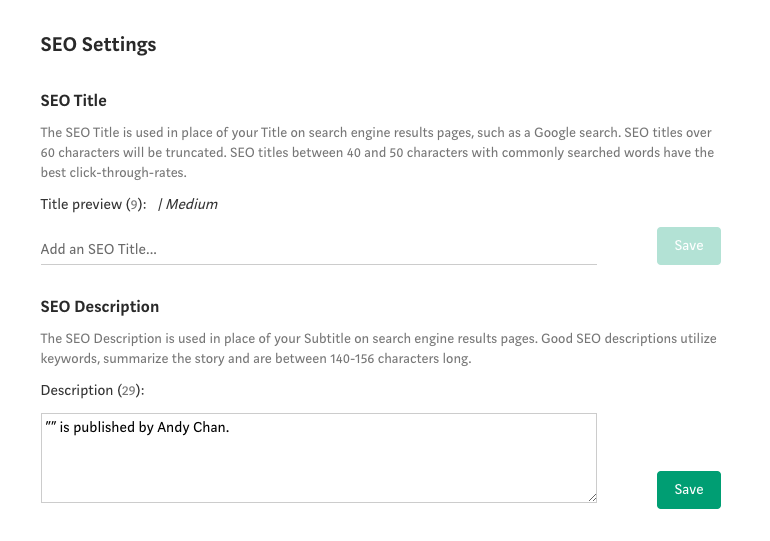
- You can edit your SEO title, which essentially means what Google will display it as your title when they list your article. While this does not heavily impact your Google page ranking opportunity, it is what Google displays to the people doing their searches. This SEO title can be different from your blog title (which it should be). Your keywords must be in the SEO title.
- You can edit your SEO description. Most of your keywords must be in the description. Include LSI keywords as well (i.e. keywords that are related to your content; if you’re writing about Indonesia, traveling is an LSI keyword).
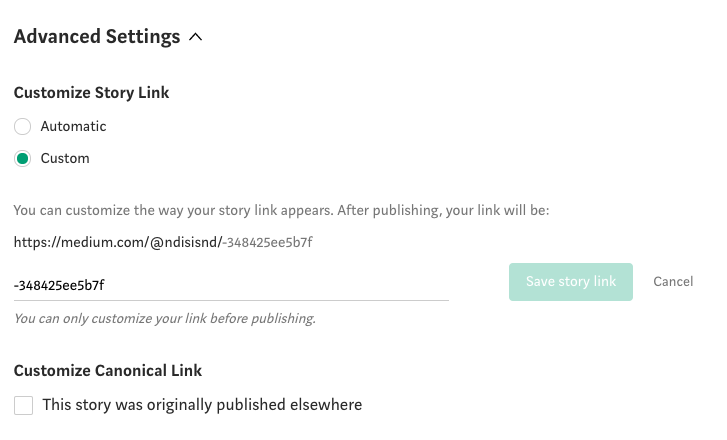
- You can customize your story link. Essentially, it’s the URL of the article that will be displayed in the address bar. This should also contain keywords. For example, “…/places-to-travel-in-Indonesia”. Make it concise and succinct.
Here you might find something unfamiliar: canonical links.
What is that?
This is especially important for bloggers who republish or repurpose their content for Medium audiences. Consider the Medium Partner Program as an income stream diversification, as bloggers can earn money through Medium and through ad revenue on their blog.
However, Google penalizes for duplicate content.
- If your story is published elsewhere, enable the canonical link. This is so that when someone searches for your article, Google will list the original one on your blog/website rather than the one on Medium. This is to ensure that a single source of content is the ultimate authority. Insert the original link from your blog/website so that Google will ignore your Medium article and display the one on your blog. That way, your article will only appear to Medium audiences.
These are the tactics that I used to grow my Medium earnings. At the end of each month, I do a review and see how I can improve my current processes. You can also use productivity tools like Trello and Asana to help you organize your work so you know what to focus on for the day.
Like all guides, there are always bound to variations. Individual contexts matter and it might not apply to all writers. Look at tactics as part of your toolbox and keep them fluid — what may work today may not work 24 hours later.


