
How to Optimize Your SEO on Medium
A guide on how you can get sweet SEO juice

Compared to having your own blog, Medium’s SEO works differently. Optimizing your SEO on Medium is much easier and less complicated than if you’re doing it on Wordpress or on your own website.
Here’s the difference: essentially, you’re only given a set number of things to customize and edit to ensure that your article gets ranked by the Google search engine—or not, if that’s your intention.
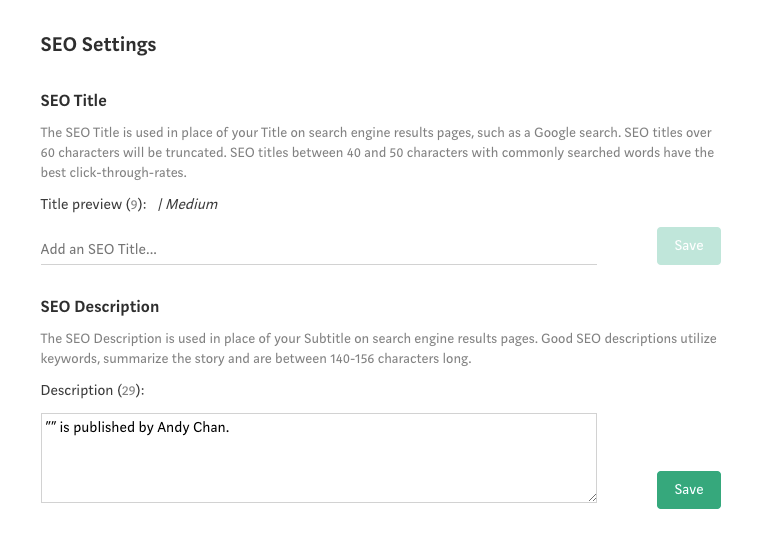
Zooming in on SEO only gives us two things, which essentially form your metadata. To optimize them, you need to focus on keywords and relevance. However, before relying on Medium as a means to drive domain authority, you must first understand what Medium will do to your blog and content:
- Medium articles may not contribute to your domain authority, despite Medium having a domain rating of 94, according to Ahrefs. This is because of their “nofollow” in your article, which means that none of the SEO juice you can potentially get will flow to your account. Unless you’re featured, this might be the case;
- Medium is all about quality: you can’t publish bullsh*t, sprinkle it with SEO and then monitor your SEO tool to see how it can contribute to your domain authority. The audience here is different. You need to write quality content for Medium’s algorithm to recommend to their readers;
With that, how can we optimize the SEO on Medium itself then?
- Focus on keywords. The SEO title is the title that Google will display after you run a search. It needs to contain the keywords that people will typically search for. For instance, if you’re writing about a guide to building a successful startup, you can tailor your title according to popular searches and AnswerThePublic questions. If you don’t customize them, Medium will automatically use your Medium article title;
- Always have the keywords you want in your description. If you want to be indexed for ‘startups’, add it into the first paragraph of your description. You only have up to 160 characters, so make it count;
After we do the bare minimum for the SEO on Medium, there’s still one thing: how can we ensure that we actually get SEO or not hurt our SEO on our blog?
This is especially important for bloggers who republish or repurpose their content for Medium audiences. Consider the Medium Partner Program as an income stream diversification as bloggers can earn money through Medium and through ad revenue on their blog.
However, Google penalizes for duplicate content.
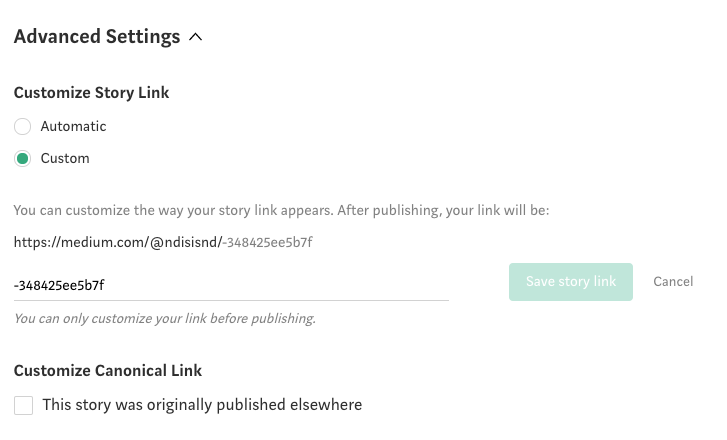
Here’s how we can prevent it under Advanced Settings:
- If your story is exclusive to Medium, customize your story link. Your intention is for Google to list your article as a search result so that you can drive traffic to your article;
- If your story is published elsewhere, enable the canonical link. This is so that when someone searches for your article, Google will list the original one on your blog/website rather than the one on Medium. This is to ensure that a single source of content is the ultimate authority;
However, the best option for any blogger is to treat Medium as a separate social publishing platform, with its own audience. What performs well on the website may not perform well on Medium, especially when the platform focuses very much on quality. The best boost would be curation, in which authors depend a lot on should they not have their own band of followers.


