
The End Is Nigh — Can Collapse Be Avoided?
Part 5: Addicted To Hopium
Modern civilization is facing its most challenging time yet, with resources dwindling, climate changing, and societal pressures increasing. It’s only a matter of time before society needs to feed on itself to maintain some modicum of quality of life.
In my last post (part 4), I argued that collapse will take the form of a slow, grueling, crumbling of society, as ‘prophesied’ by T. S. Eliot: “This is the way the world ends. Not with a bang but a whimper.”
But are we doomed to battle it out in the Thunderdome or hunt and forage for food like our ancestors? Might we fix our sinking ship? Is there hope?
In this series, I explore the collapse of modern civilization. - What is collapse? - Why collapse is inevitable - When will society collapse? - How society will collapse - Can collapse be avoided? [you are here] - What to do in the face of collapse? - Summary - Appendix: Bonus content and links

“The birds of hope are everwhere, listen to them sing.” Terri Guillemets
Societal collapse is rather depressing. Some, when faced with the information presented here (and better elsewhere, see the end of this post) deny the possibility or gravity of such predictions.
Others don’t care, believing — in ignorance — that the coming storm won’t affect them.
Some might understand collapse rationally, but not taking it to heart.
Others still are hopeful. We got this. Human ingenuity to the rescue. We’ll come together in the eleventh hour like we’ve learned from countless disaster movies.
That’s why I like the above quote by Terri Guillemets; to a drowning man, hope can’t lift him out of the water [not the original meaning].
Collapseniks call this “hopium”, a self-administered drug to help us avoid staring into the abyss.
But the end has been announced many times, yet here we are. For example, in 1798, Thomas Malthus (of Malthusian fame) argued that if our population continued to grow as it had the last century, we would face a collapse due to lack of food. Then came the Haber-Bosch process (an essential step in the production of fertilizer) along with the industrial revolution.
So it is natural to believe we can pull another rabbit out of our hat.
Let us go through some hopes many currently cling to, and why they’re hopium rather than our saving grace.
Renewable Energy
While renewables and nuclear can handle electricity generation, in principle, we still require portable and high-density fuel. We also rely on plastics and other oil derived products, which are byproducts of the oil (and natural gas) refining process. That means that without oil as a fuel, extracting and refining oil is a much more costly affair.
Some alternatives exist, though, like biofuel or plastic made from mushrooms. However, these alternatives won’t be competitive before we stop burning oil for energy.
Then there are emissions from agriculture, carbon released from degrading soil and forests and marshes. There’s cement and asphalt production, industrial emissions, and so forth. Switching the transport and power generation sectors to renewables will net us only a ~40% decrease. In other words, renewables and electric transportation alone won’t be enough, even if we ignore the construction costs of transitioning.
If that wasn’t enough, all our renewable energy to date has only added to the system, not replaced fossil fuel based energy generation:
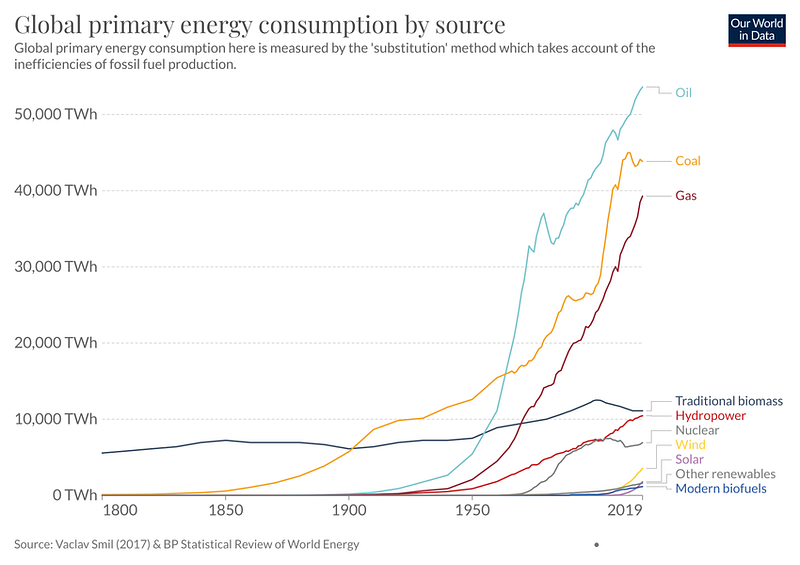
While some are optimistic that we can stop our fossil fuel dependence, the resources needed are staggering.
Battery Technology
Take, for example, batteries. Batteries can serve as an energy carrier and storage like fossil fuels does currently, for both the transportation and power sectors. Annually, we produce over 60 million fossil fuel cars. In terms of batteries, we’d need over 240m kg of lithium if those cars were to be electric. With about 14m tons of known lithium reserves, worldwide, that’s about 50 years worth of production. Then consider the replacement of ~25.000 aircraft and some 30 million boats, and that batteries account for only ~40% of lithium usage, we’re fighting an uphill battle. While recycling and new technology can reduce the need for lithium, and new discoveries can be made (e.g. extracting lithium from salt water), that’s only considering one mineral.
Copper is another example. Copper is an excellent conductor of electricity, and it’s of major importance in solar panels and wind turbines, and most everything else that uses electricity. It’s predicted that we’ll be in an annual supply deficit of around 10m tons of copper by 2030, if mining isn’t ramped up at a large scale. That means prices will increase, which will slow down the renewable transition.
The question is, while we could do it, will we do so in time? While we’re working on this, however, we’ll have to continue burning fossil fuels. And as I’ve laid out in earlier posts, the cost of oil and gas will increase as extraction gets more expensive. One can only look at how rising gas prices in Britain today are predicted to have quite severe consequences. What we need then, is massive amounts of power.
Fusion Power
Fusion is perhaps the only technology that has a chance in hell. Limitless energy in abundance, if we can get it to work. While fusion has been 20 years away, every year, for 50 years now, it finally seems like we’re making headway. The first commercial plants are expected to come online by 2040. However, the time it’ll take to get fusion rolled out globally will take decades more. Again, do we have time to wait? If we do, though, fusion might provide us enough energy to do what we want and thus fix almost any problem we face, such as massive carbon sequestration.
Carbon capture
Carbon capture means sucking carbon dioxide out of the atmosphere. The scale at which we need to extract carbon from the atmosphere, however, is simply profound. Recently, Iceland opened the world’s currently largest carbon capture plant which can extract about 4000 tons of carbon a year. However, we currently release around 43 billion tons of carbon. I leave you to do the math.
We could also plant trees. While this seems an attractive idea, we’d need to plant an area the equivalent of the US and Canada to extract 25% of our emissions from 1960. Better than nothing, but it’s a massive undertaking that ignores how we’re already using the land for agriculture, among other. Then there’s kelp, limestone, and other fancy projects. In theory, planting trees and growing kelp, en masse, could work. But the share scale of it begs the question: Do we have time?
Considering the political climate, and how it’ll likely change given increasing stress from climate change and supply shortages, among other, I believe the answer is no. The global pandemic has quite clearly shown us that we can’t mount a global cooperative effort. After all, if we had just closed down the world for a couple of weeks, Covid19 would be a thing of the past. Some put their trust in capitalism. Eventually, fixing our biosphere will be the profitable thing to do, but the invisible hand of the market is taking its bloody good time.
Rewilding, another popular solution, faces similar issues. Scientists estimate that if we can return 1/7th of our total land surface to nature (ignoring mountains and deserts), or 50% as others argue, we can negate a lot of the damage we have done while sequestering somewhere between our annual carbon emissions to most that we have released up to now. But rewilding takes time and effort. It also requires protecting ecosystems from mining (which we need if we’re transitioning to renewables), from housing, agriculture, leisure, and everything else.
To me, such large-scale projects seem infeasible. Rooting up established infrastructure and forcing people and industries to move is simply not a winning ticket during election season. But starting this process might buy us some time, along with other more fanciful projects.
Geoengineering
As politicians start to understand that we can’t, or won’t, do what’s necessary to safeguard our future from climate change (if they don’t already know that), easy fixes will be more tantalizing.
Stratospheric aerosol injection, dumping iron in the ocean, solar shades in space, distributing crushed olivine along our beaches, and many other proposed projects might help. At best, they’ll give us a break we sorely need. At worst, they’ll fuck up the environment even more. For projects of this size and scale (if they’re to have an actual impact), we don’t know the consequences and many fear employing them, rightly so.
Geoengineering might also instill a sense of laissez-faires attitude, which might only lead to kicking the can further down the road. However, if we’re willing to risk it, it might buy is the most crucial of resources; time.
Efficiency and recycling
More time would not only allow more windmills to be built, but also more research to be done. With increasing scientific and technological development comes gains in efficiency and new avenues of recycling. While such developments will certainly help us extend what limited resources we have left and keep prices in check, there’s Jevon’s paradox to contend with.
Jevon’s paradox states that when efficiency increases, use increases. For example, with engines that use less gas we end up driving more. In the end, we use more gasoline than before!
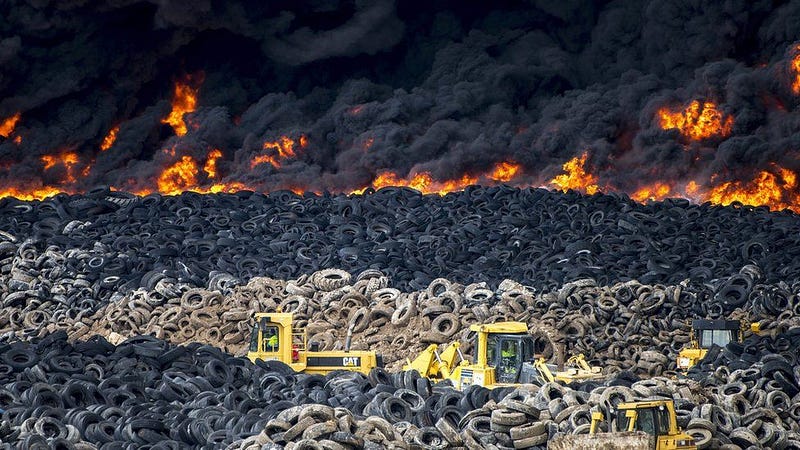
Recycling too faces drawbacks as it is an extremely complicated process to extract materials from integrated products, as well as collecting all the garbage. This requires energy, machines, and resources too. While possible, in principle, no society can be a 100% sustainable (ultimately, the second law of thermodynamics will ensure that). But even simple products like tires are merely discarded in endless fields of rubber, with disastrous local consequences:
Currently, in the US, about 22% of the total waste stream is recycled, which is not terrible, and on par with the global average. But, with humans dumping around 2 billion tons of waste a year, and at least 33% of that not handled in an environmentally friendly way, we got a big problem, but also a big opportunity.
If we don’t focus on it, we might need to go where few have gone before.
Space mining
“Space, the final frontier” says the intro to Star Trek. For good reason. Out there is an abundance of resources our minds can’t really grasp. A single asteroid could crash the global market of precious metals by sheer quantity of supply, if we could only get to it, and get it back again.
Space mining at any scale is, however, at least 50 years out. The logistics, technical challenges, and enormous costs associated with space flight, renders this prospect unfeasible to help us with our current predicaments.
However, if we somehow got 50 more years, perhaps we can get all the resources we need from space. But at present, it seems like a pie in the sky.
Pollution cleanup
Resources and energy aren’t the only issues we face, although fixing them might give us the surplus we need to tackle other issues, such as pollution.
In the last years, pictures of birds or whales with their stomachs full of plastic have circulated throughout social and classical media. We’ve made some progress by banning plastic straws and some other single use plastics, but that’s a drop in the bucket towards the 12 million metric tons of plastic pollution expected by 2050. Plastic breaks down to microplastics, and even nanoplastics, over time. As a result, we find microplastics, phthalates, and other related toxins, pretty much everywhere we look, from breastmilk and infants to the arctic seafloor and the bottom of the Mariana trench.
And plastic is only one of many pollutants we’re all too happy to let into the world. There’s agricultural runoff ruining our water, pesticides killing our bees and possibly damaging us humans, there’s soil degradation from poor farming practices, noise and light pollution killing insects, and endless landfills with waste which pollutes the ground for decades or even centuries.
While we’re making some progress, is it fast enough? Is there hope?
And now for the bad news
Carbon emissions are still increasing, plastic waste amassing, easy access to phosphor is running low along with many other minerals, our supply chains are less resistant than ever (some are already crumbling), and politics seems to grow ever more decisive.
When you consider that we’re most likely already locked in to over 2* of warming (delayed effects), that fresh water is running out in many regions, and our response to this is mostly bickering and conflict? I’d summarize our chances as somewhere between a snowman in hell, and doable if we could all cooperate.
The COP26, an annual meeting of world leaders to discuss climate change mitigation, is coming up in November. If previous meetings is anything to go by, there’ll be big talk but little action. Most countries have ratified the Paris climate accords, yet few are set to meet their ambitions of cutting carbon emissions. China, for example, has promised to peak emissions by 2030!
“It is difficult to get a man to understand something, when his salary depends on his not understanding it.” Upton Sinclair
What we need is for leaders to realize the predicament we’re in and cooperate. But, if the pandemic has shown us anything, it’s that we can’t cooperate for shit. Further, growth fuels our modern economy and it’s the one thing those in charge won’t challenge. Politicians who promise that they’ll provide a better life for people, right now, get the job. Dictators don’t face that particular limitation, but they are easily toppled if those underneath don’t get what they think they deserve.
Crashing the economy for the sake of large-scale collaborative projects to safeguard cities or transition our energy grid or rewild the planet will be met with massive protests. Our economy requires growth. Without it, hard times will follow.
Thus, we won’t do anything until the eleventh hour. However, we’re arguably past midnight. We should have started 50 years ago, and we were really close to in the 1980s, but the entrenched defenders of the status quo wouldn’t go down without a fight. Considering the current state of affairs of climate action, it looks like the defense is working.
So, no, there is no realistic hope. But, if one is to dream, there is one thing we need more than anything else; energy.
With enough power, anything becomes possible: indoor farming, space mining, deep sea drilling, recycling, carbon sequestration, and so on. Modern society is built on the back of agriculture, which again is only possible with predictable weather. But moving our breadbaskets further north to avoid warming weather is not necessarily an easy option as the soil quality and the shorter growing season might not facilitate the agricultural scale we need to feed 8 billion plus humans. We also don’t know how the more erratic weather patterns global warming is causing will manifest in the tundra and taiga of the world. To account for this, we need to get inside with lab-grown meat, hydroponics, and so on. This is energy intensive, but otherwise feasible.
In other words, we need to build lots and lots of nuclear power plants (10% increase annually), renewable energy, and of course, bet big on fusion. This will require an enormous amount of resources, however, but extracting resources will become harder and harder as yields decrease. There’s simply no way out of it besides extremely efficient recycling and ever more expensive mining operations. Thus, we need to expand our environment, to find more nature to destroy. The arctic seabed and Antarctic lands (once the ice disappears) is one unpopular avenue, if we ignore how an ice free north and south pole would be really bad news. The other is space.
But again, and sorry for repeating this ad nauseum, we won’t have time to reach the glorious futures envisioned by the bright eyed idealists. As all the problems we face only increase in magnitude in the coming years, it’s natural to protect numero uno first. Global cooperation will be a thing of the past as nations either isolate or become aggressive. Meanwhile, things will slowly crumble for the rest of us.
We could do it, but currently we’re not.
Which leaves us with the final hope (or hopium): adaption.
Bunkers, deep adaptation, domed cities
Perhaps the best we can hope for is a cyberpunk styled future in which some regions or cities can reach a level of adaption that life within the borders is somewhat affluent with science and technology thriving. For everyone outside, however, life will be destitute.
The same goes for massive bunker complexes, where the rich or skilled can live out the more turbulent years before coming out to repopulate the ashes.
Alternatively, we could build deeply adapted communities, ranging from passively climate controlled settlements to solarpunk cities.
The thing to remember is that with climate change, we’re less and less likely to have stable weather patterns that are so necessary for agriculture. Considering that humans only kicked off in the last 20.000 years, during a period of exceptional regularity in weather and seasons, we will have to rely on other ways of producing food, like hydroponics. Again, this requires resources, energy, and advanced supply chains, which isolated communities don’t have.
Also, the crumbling of society will take place over a long time, and meanwhile things crumble, there will still be a lot of power distributed among those who are not interested in you and your friends setting up a community outside of what they control. Perhaps a bunker or a domed city could survive isolated for many years, but any isolated community will eventually run out of working components as machinery wears itself out. The only option then is some surviving medieval or neolithical level settlements in the new habitable and stable zones on Earth.
Not so bad perhaps, but the path there will be hard with most of earth’s population succumbing to poverty and famine.
At best, some core of civilization remains and continues our great journey. At worst, we will collapse hard and in the ensuing panic, all our technological progress will be lost. In such a scenario, even if humanity survives, we will probably repeat the same mistakes again if we manage to crawl our way up the technological ladder.
Summary
There’s plenty of technological solutions to our present problems. However, they are unfeasible/unstable, too far out, or require a level of cooperation the global community has never shown before (except for war).
The only hope, in my opinion, is a combination of fusion power and space mining. Throw in some advanced robots, we could live comfortably in sheltered communities while our robotic slaves mine what’s left of nature. The alternative, stopping pollution and fixing our environment, doesn’t look like it’s on the cards.
Thus, in my view, the prime directive is to safeguard the human colossus (our scientific and technological progress). However, for most people and species, it’ll be collapse in every sense of the word.
If one is to dream though, I’d dream of aliens or general artificial intelligence saving the day. Perhaps they’ll show some mercy on us children and put us back in kindergarten where we belong.
In summary, collapse is inevitable, and it’s coming sooner than expected. There’s little hope for a remedy. If you’re with me so far, you might ask, what now? What does it mean for me? Part 5: What To Do In The Face Of Collapse tries to answer these questions.


