
15 Fascinating Facts about Relationships That You Probably Didn’t Know
Men have more sexual affairs, women have more emotional affairs, married people live longer, the LGBTQ community has the lowest breakup rate, and much more

The world is driven by relationships, here are 15 facts about them that you probably didn’t know.
Married men and women both live longer than unmarried individuals
It’s popular to argue that single people are happier and live more stress-free lives than married ones; however, the evidence does not support this. Quite the opposite in fact. Married people, whether male or female, typically live longer than their unmarried fellow citizens. Married men typically live 2.4 years longer than their unmarried counterparts, and married women typically live 2 years longer than their unmarried counterparts.
The slighter shorter increase in women’s life expectancies is believed to be linked to the fact that they are more likely to be widowed, but also, women’s life expectancy is 5 years longer than men’s.
This makes any life-boosting dividends women get from anywhere always a little less impactful than men’s i.e. it’s much easier to extend the life of a person expected to die in their 70s than it is someone in their 80s.
In terms of why unmarried people — both the never-married kinds and the divorced — don’t live as long, it is believed to be down to a mixture of factors. For example, unmarried people are more likely to suffer extreme loneliness — especially in old age.
Also, single people are more likely to have trauma — either through a past relationship or their inability to find one — which is why they are single, further shortening their lifespans.
On top of that, marriage inspires people to live healthier lives through making better choices i.e. couples benefit each other by pushing each other to look after themselves and motivating each other to look after themselves. Also, there is a sex dividend, sex lowers stress as does intimacy.
So, all in all, married people typically live less stressful lives and are more likely to look after themselves than single people — on average.
Note: it should be noted that staying in an unhappy marriage can be equally as ruinous to life expectancy as being single or divorced — if not more so. So, the marriage dividend only works when it’s at the least a functional marriage i.e. one that doesn’t cause endless stress.
One-third of the adult population has never been married or cohabited with a partner
Data across the Western world has shown that 30 and 40 percent of people over the age of 16 have never been married or cohabited with a partner. It should be noted this does not mean that they have never had a relationship, it just means that they have never had a relationship that has progressed to living together or marriage.
It’s believed that the reason for this is down to the difficulty of modern world dating, and the factors that now exist that can disrupt relationships and make it hard to maintain them. Factors like for example, erratic work patterns, difficulties meeting people, and the endless and increasing societal discrimination that dictates to people who they should and should not date.
This is why it is believed that typically around 30 percent of the Western population are single at any one point, the majority not per se by choice but due to the difficulty of finding and maintaining a relationship.
That means if you’re single, and you don’t really want to be, don’t worry, you are far from alone.
Unlike popular belief, age gaps don’t per se influence how long you live
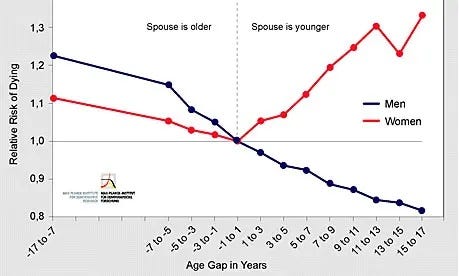
It’s popular to say that women who marry men the same age as them live the longest followed by men who marry younger women, it’s also popular to say that women who marry younger men live shorter life spans than in all other relationship types.
However, the data is showing something completely different than what people think. The majority of women who marry a partner of the same age have married their childhood sweethearts. When women marry their childhood sweethearts, they typically avoid more stress over their lifetime than all other people. That’s why they live longer.
The reason men who marry younger women typically come second is not that they marry younger women per se, it is because many who marry younger women typically have money.
Yep, money. Money typically leads to a less stressful life — especially for men — meaning men who have money live longer. In terms of why women who marry younger men typically die sooner, it is because typically women who marry younger men have lived more stressful lives prior to the relationship i.e. they typically have serious relationship baggage.
Also, it has been shown frequently that women who marry younger men typically are more willing to take risks than the average woman, they are also more likely to be of the sort that likes to live well i.e. they have a live hard and die young attitude.
So, it has nothing to do with the age gap. Meaning age gaps truly don’t influence how long we live, how much stress we have in our lives does. Women who marry their childhood sweethearts followed by men who have money typically lead the least stressful lives, so they live the longest.
People cheat — a lot
Various studies have shown that when it comes to sexual infidelity in the Western world, upwards of 60 percent of men report having committed at least one sexual act of infidelity over their lifetime, while upwards of 50 percent of women have.
To go with this, when it comes to emotional affairs numerous studies have shown that upwards of 90 percent of women have admitted to having had at least one emotional affair over their lifetime, and upwards of 80 percent of men have.
Yep, damning statistics right there.
Monogamy is still the most popular relationship type
Despite the fact that there is a lot of cheating going on, many of us still seem to favour monogamous relationships — or at least claim to. Only 5 to 10 percent of relationships are believed to be open and when it comes to marriages it’s believed that only 1 percent of couples are in an open marriage — open marriages have a 92 percent failure rate, so the low lumber is not surprising.
However, 20 percent of couples have experimented with a form of consensual non-monogamy and this number is rising. There is a correlation also in couples who are willing to experiment a little bit and an increased likelihood of relationship success. Also, increasing numbers of couples are becoming increasingly more likely to turn a blind eye to certain low-level forms of infidelity.
This means the majority of couples don’t want an open relationship per se, but increasingly they don’t want absolute monogamy per se either i.e. it seems we want a relationship that’s open to and tolerant of a small amount of outside fun but not much. Yet, at the same time, we don’t.
Yep, no wonder the relationship scene is so chaotic, ever greater numbers of us cannot work out what we truly want our relationships to look like.
Adultery is not the most common cause of divorce
Surprisingly, considering how widespread it is, infidelity is not the most common cause for the breakdown of a marriage, despite it being believed to be behind 20 to 40 percent of marriage breakdowns — the wide variation is down to the fact that many contest that the infidelity took place, and many use infidelity as an excuse for the divorce for various reasons. These factors added to many more make it hard to know the true numbers where it was the main cause.
Regardless, it is a big cause, but not the biggest. In fact, above infidelity is financial problems. Yep, couples complaining of financial incompatibility or financial problems caused by their partner report those problems as one of the main causes in upwards of 45 percent of divorces.
But that still is not the biggest cause. Even a lack of communication which leads to constant arguing is not listed as the biggest cause, despite it being reported in upwards of 60 percent of divorces. Surprisingly, or unsurprisingly depending on your perspective, over 75 percent of couples state in divorce papers that being unprepared for marriage was the main factor behind the marriage breakdown.
That means being unprepared for marriage is the biggest reason for marriage breakdowns.
Having a degree literally improves your chances of dating success — for both men and women
Evidence shows that almost a third of adult single men live with a parent, and those men are far more likely to be unemployed and lack a degree than those with a partner. So, they earn less and have lower levels of education, and are more likely to be either unemployed or working class.
Similar trends are shown for women, with countless evidence showing that upwards of 40 to 45 percent of married women have completed degrees whereas only 30 percent of single women have. What this shows is that people who have degrees are more likely to be in relationships whereas people who don’t are more likely to be single.
Researchers argue that there are two reasons for this, firstly, people with degrees are more likely to earn more money, and, secondly, they are more likely to have more liberal style mindsets meaning they are more open to more modern style relationships.
So, money and a liberal mindset seem to be key to a successful relationship in the modern world, degrees give people a better chance of having both of those. Hence, why having a degree increases your chances of succeeding in the world of dating — regardless of gender.
Married men and women have seen their earnings rise more rapidly than single people — but all is not what it seems
Married men and women are more likely to earn more money and have seen their earnings grow more rapidly over the previous decades. For example, married women now earn 50 percent more than they did in 1990, whereas single women have seen no change. Married men have also seen their earnings rise whereas single men have actually seen their earnings regress.
But all is not what it seems. It’s not per se because married people now earn more money, it is because people are not getting married unless both parties have money. Yup, researchers have concluded that the data shows that people are most attracted to a partner who is financially stable, and who has a similar education level, and this counts for both men and women.
So, men are increasingly demanding that women be financially stable just as women typically do with men. But there is a caveat, research shows that both men and women appear reluctant to get married or commit fully to a relationship unless they themselves are already economically advantaged.
That means we don’t just want a financially stable partner, we want to be financially stable ourselves before getting with that partner. This desire is felt far stronger by women than men, which is one of the reasons why fewer women are looking for partners than men i.e. women feel a stronger desire to need to feel ready for a relationship before having one than men do. At least this is what the evidence seems to show.
Note: the reluctance and difficulty of finding a partner if you are not financially stable is believed to be one of the reasons why unmarried people die younger. It’s not per se just because they have not been married, it is because of the reason why they have not. So, the financial stress over their lifetime has led them to lead an overall less healthy and successful life and so they die younger.
Women are way more likely to initiate divorce than men — not for the reasons you think
80 percent of divorces are initiated by women, this is despite the fact that when it comes to relationship breakups outside marriage, the gender divide when it comes to breakups is 50–50.
In terms of why divorces are more likely to be initiated by women, it is believed to be down to two factors, finances and more importantly parental rights.
Firstly, because men typically make more money than women, in a divorce, they are more likely to have to pay alimony along with other kinds of payments like child support et cetera i.e. so they are more likely to be left literally paying for their marriage for years to come.
Secondly, and far more importantly, when it comes to parental rights women are typically heavily favoured in divorces. This is believed to be the prime reason why women are far more likely to initiate divorces than men.
Men’s higher likelihood of losing primary access to children in divorce often leads to them, even if they have initiated the breakup, still being substantially less likely to initiate the divorce proceedings because if they stay married, they retain full access to the children.
Yep, that means the reason women are more likely to file for divorce is not that women are more likely to want out of a marriage, it is simply because, despite how costly divorce is for women, it is typically more costly for men — especially if there are children involved.
Note: this is why many are calling for a complete shakeup of divorce laws to right the inequality when it comes to parental rights. It is believed that if this happened, the gender divide when it comes to divorces would more closely match the breakup rate for non-marriage-based relationships.
Men are typically older than women in relationships — for an entirely logical reason but not the one you’re thinking
A study by Facebook Data Science found that in 67% of relationships, the male is older than the female, in 20% the female is older and only in 13% are the partners of the same age. The reason why the man is typically older is believed to be linked to the growth trajectories of men versus women.
Basically, women go through puberty on average a couple of years sooner than men and the process lasts a shorter length of time, their brains also develop much sooner — brain activity in girls is usually fully optimised by the ages of 10 to 12 but in males the same doesn’t happen until they are 15 to 20. Also, women’s peak fertility occurs between the ages of 20 and 25, whereas in men it is between the ages of 30 and 35.
So, basically due to women growing and maturing much quicker than men on all levels inevitably they are more likely to connect relationship-wise on average with an older man, the same as an older man is more likely to connect with a younger woman.
That means what age gap data actually shows is not that men like younger women and women like older men per se, but that women develop faster than men and that men and women alike prefer a partner on the same page as them. These factors lead to age gaps typically being in men’s favour.
Note: some even argue that women have evolved to go through puberty sooner and develop faster not just to prepare them for pregnancy, but to help them to avoid matching with a male of the same age i.e. the argument is women may develop especially faster specifically so as to make it more likely they will get with a more developed and capable male who is better able to protect and provide for them i.e. an older man.
Age-gap relationships are becoming increasingly taboo — especially in heterosexual relationships
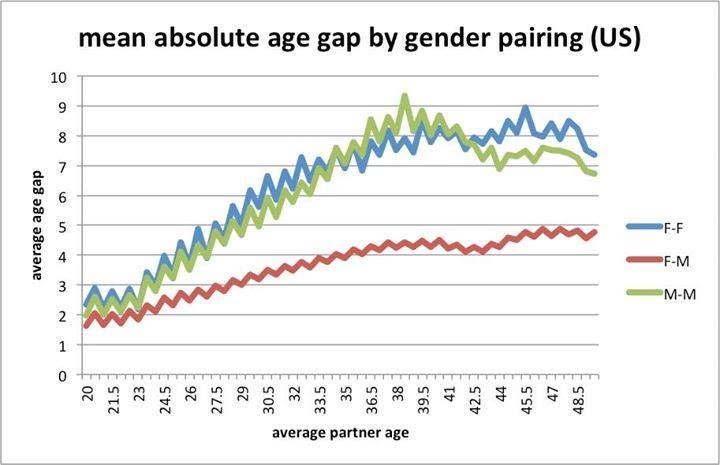
Age gaps are becoming increasingly taboo, but only in heterosexual relationships and mainly amongst the young. This is why on the heterosexual scene, the average age gap in relationships is now down to 3 years in men’s favour, with only 8 percent being in a relationship with an age gap of upwards of 10 years.
However, on the LGBTQ scene, where there is less age gap persecution, things are different. In male-male unions over 25 percent of couples have an age gap of 10 years over, and on the female scene, it is 15 percent.
Note: It should be noted though that even on the LGBTQ scene there is still increasing persecution of age gaps, especially between male-male couples. It just seems that they care less about what society thinks most likely because they have had to overcome societal discrimination even to start dating a person of the same sex.
Age gaps do not per se lead to a higher chance of exploitation, it’s more complex than that
One of the reasons age gaps are becoming increasingly taboo is that they have been linked to the exploitation of women by older men. However, the evidence shows that in the wider public those in age gap relationships are no more likely to be exploited than those in any other form of relationship.
In fact, those with age gaps between 4 and 10 years typically have the happiest relationships — especially in the early years — and 6-year age gaps are typically called the most successful age gaps.
So, age is not the biggest factor per se in your likelihood of being exploited — despite public perception otherwise.
What typically leads to exploitation is a person who gains power over a partner and who uses that power to abuse them. The person does not even need to be wealthy to gain power, which is why abuse is ripe all across society.
Many argue this is an important point to acknowledge simply because we are more cautious when our partner is older and/or if there is a wealth imbalance, but less cautious when a partner is the same age or near enough and there is not — we are even less cautious when the wealth imbalance is in our favour and/or our partner is younger.
This is always a mistake. Treat everyone the same no matter what. Always.
Note: the only reason wealthy people tend to be more exploitative on average than non-wealthy people, is because they have more access to people to exploit than those amongst the less wealthy who would happily do the same. That means there are always a lot more people who don’t have wealth willing to exploit people than those who do, simply because there are a lot more people who don’t have wealth than those that do.
Wealth imbalances can be troublesome but only if one party could not survive on their own
The older men and younger women link of exploitation is not actually due to one being older and the other younger, it is because one party had extreme wealth and power and decided to use it to exploit the other party, who had neither.
Many argue that this is important to acknowledge simply because younger people with wealth and power are believed to be even more likely to use that wealth and power to exploit people sexually than older people.
This is why many argue that the best way for a person to protect themselves from exploitation is not by avoiding people with more money than them, but by becoming financially stable themselves.
The reason, the evidence seems to show that when two people are financially stable, even if one earns a lot more than the other, the odds of exploitation are substantially less than if one party could not survive financially on their own.
Note: this is why many argue that both men and women alike are avoiding dating unless they are themselves financially stable. Personal financial stability gives us a level of security against being exploited that is second to none.
One style of age gap relationship is on the rise
Despite the increasing persecution of age gap relationships, one kind of age gap is on the rise and has been since the 1960s. The woman being older.
For example, in the UK in the 1960s, 15 percent of brides were older than their grooms. However, by 1998 that had risen to 26 percent.
Of further note, in the 1970s only 3 percent of marriages saw the woman 5 or more years older, but by the 2000s this had doubled.
The LGBTQ scene has a much lower breakup rate than the heterosexual one
Age discrimination, race discrimination, wealth discrimination, education discrimination, cultural discrimination, and countless more levels of discrimination are massively prevalent on the heterosexual scene at far higher levels than on the LGBTQ scene.
Some argue that they are so high, that even people the most liberal-minded likely unwittingly discriminate to a high level. It’s believed all this discrimination is why the breakup rate on the heterosexual scene is much higher than on the LGBTQ.
So, because on the heterosexual scene, people are more likely to reject people that they like and would prefer to date, because of things like age, race, wealth, and more, they are less likely to find a person they properly connect with.
Yep, when it comes to dating, the only thing that matters is whether you connect with the person, not the age gap, the race, the cultural differences and much more. The LGBTQ community appears to understand this completely, and date who they want regardless of what society thinks, the heterosexual one seems to be further away from understanding this than ever.
Wealth added to looks and age create the most powerful mix for dating power
Good-looking men in their 30s and 40s who have wealth along with good-looking women in their 20s and 30s who have wealth are believed to be the most powerful people on the dating scene.
However, a woman’s looks are powerful enough to overcome a lack of wealth and allow her to succeed on the dating scene, but the same is not true for men. When it comes to looks for men, if they don’t get wealth to go with it by their 30s then dating will likely start to become a struggle — though not as much as for men who don’t even have looks.
Wealth and success on the other hand are powerful enough to give men in their 30s and 40s a boost that helps them overcome a lack of good looks. So, wealth, looks and age influence all of our abilities on the dating scene, but in slightly different ways and at slightly different times for men versus women.
Yup, that means whether we like it or not, the evidence shows that we are all still — at least on some levels — quite superficial when it comes to dating.
Older age makes us all much less superficial when it comes to dating
The young for countless reasons are a lot pickier but in a superficial way. Older people on the other hand are different, fuelled by experience born through the realisation that superficial things fade and so are not that special, they tend to favour a person for who they are rather than anything else.
So, older people become picky in regards to the important things, but not picky in regards to the unimportant.
This is why many say that those who find themselves dating in their 50s tend to be much more successful at finding fulfilling relationships — even if it is harder to find dates.
That means for all those who have not managed to get that lifelong relationship by their 50s, all is not lost. It is likely all those failures will lead you to finding what you have been looking for. A long-lasting and fulfilling relationship. It’s just it will be with a person who is likely not like any person you imagined they would be. That’s why you will finally find them.
That’s all from me, thanks for reading! If you enjoyed this post, you may also enjoy the following:
Six Psychological Reasons Why The Majority Of Modern Relationships Fail
The Real Reason Why Nice Guys Struggle To Get the Girl
30 of the Best Sex Jokes To Spice Up Your Day
To learn more about me see this link, to support me click the link below:


