
We Are All Having Fewer Children Than Ever — That’s Not a Good Thing
Dwindling birth rates are starting to pose a serious threat to the developed world

Everybody knows about overpopulation; everybody also knows how the global birth rate is falling gradually. It was 5 per woman in 1960 and was down to 2.4 by 2019. That’s still high, for a sustainable population we require a birth rate of about 2.1 children per woman.
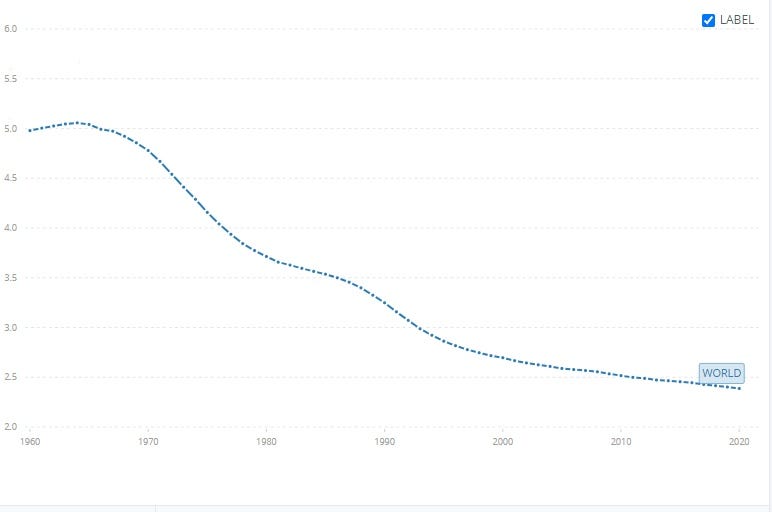
So, it would seem like it’s a good thing that we are all having fewer children, and it would seem like we still need to reduce the number of children we are all having. But the devil is in the detail. For example, in 2020, Niger had a birth rate of 6.7 per woman which is the highest in the world, and the majority of African countries as of 2020 still had a birth rate above 4 with the average being 4.5 per woman. This is why the populations in these countries are booming.
In developed countries, the opposite is happening. For example, in 2020 France had the highest birth rate in the Western world, but it only had 1.8 children per woman and that number is falling. The US along with the UK, Australia, Canada, and New Zealand in the same year had a birth rate of 1.6 per woman, and those numbers are falling. Japan was down at 1.3 and falling, Italy and Spain were down at 1.2 and falling. Hong Kong was done at 0.9 and falling, South Korea was down at 0.8 — the lowest in the world — and still falling.
Both the booming populations and the dwindling populations are bad. What is actually needed is sustainable populations, the reason being that booming populations typically lead to increasing levels of poverty, and dwindling populations do the same.
Why some countries are seeing their populations explode while others are seeing them dwindle
It would be easy to read all of the above figures and link poverty to booming populations, and wealth to dwindling ones, but it’s a lot more complex than that. Poverty does not per se equal people having lots more children, nor does wealth per se equal dwindling ones.
In terms of what’s actually going on, it’s complex. Firstly, one of the most guaranteed ways to see a population have a lot of children is a high child mortality rate. If a society has a high child mortality rate, the result is always the same. Large numbers of pregnancies and thus large numbers of children.
This is why since the dawn of humanity human survival had always been reliant upon women getting pregnant as many times over their lives as possible, and men and women would always get together as young as they could to start making those babies. It is also why we evolved the culture of the men being the breadwinners and the women the baby makers and housekeepers. It had to be this way. We would not exist today if it had not been this way.
So, a key rule for any society is that the more children are expected to die, the greater the necessity for promoting as many pregnancies as possible. On the flipside, that means also that the more children are expected to live, the more obsessed that society becomes with family planning — of the modern kind.
The reason developing countries are seeing their populations boom is that the child mortality rate is still so high that their cultures are still promoting as many potential pregnancies as possible. The reason in developed countries the population is falling is because their societies have become heavily focussed on modern-style family planning.
But this begs the question, if societies have always historically promoted as many potential pregnancies as possible, why is this causing populations in the developing world to suddenly boom?
Transitioning societies see population swings
When a society begins transitioning from one where children are expected to die to one where they are expected to live, population booms happen. This effect was most seen during the Industrial Revolution and the Victorian era — the UK in the year 1800 went from a population of 4 million to a one of 40 million by the year 1900.
So, paradoxically, in cultures where children have a high mortality rate, if you start improving those mortality rates, you get explosive population booms. This is what is happening in developing countries i.e. they have not yet adjusted to a lower child mortality rate.
However, in developed countries the opposite is happening, we are now transitioning into a society with modern-style family planning. But that transition has now gone too far which has led us to a dwindling population i.e. we have not yet properly adjusted to a society of family planning.
That means the developed world has become too good at getting people to stop having children.
What is the solution — to both problems
For the developing world, the solution is development. Right now every developing nation on earth is currently undergoing this process, the difficulty is many are trapped in the early stages of it and cannot get out of those stages.
This is why they are struggling to get their populations under control, because children still die in such large numbers that the best tactic for survival is still to have as many children as possible and hope that at least some of them may live.
This is why pushing hard to try to help these countries develop, investing in infrastructure, in healthcare, in education, basically helping these countries to develop so that they can have enough certainty that children will live, that developed world style family planning can become a part of their culture.
In the developed world, the solution is simple, people need to start having more children so that we can get the birth rate back up to 2.1 per woman — the number required for a sustainable population.
Why it is so important that we do this
Who pays for our retirement? Many will say that they themselves pay for their retirement by working throughout their life. However, that is not technically true per se. Our children — or other people's children if you don’t have any — technically pay for our retirement just as we pay for our parents’ retirements.
To explain, when we retire who is it that makes up the workforce? It is the younger generation. It is their contribution to society and their taxes that continue to fuel society. It is them working in the hospitals, in the supermarkets, in the police, in the army, in all the jobs that keep society functioning.
This is why it is so important that the younger generations are as large in number as the previous one — or as close to it as possible. If they are not the younger generations will be asked to pay a far higher price than the one before had to pay. So, higher taxes, fewer opportunities, lower pay, less housing availability et cetera et cetera.
This is obviously bad for everyone. Not just in the way you think, if we don’t increase birth rates, it could cause society as we know it to collapse. That may seem an exaggeration, but it’s not.
Falling birth rates could cause the developed world model to collapse
The developed world model is basically a giant Ponzi scheme, with the current generation always the new members who are needed to keep the scheme going.
If the current generation keeps shrinking, then they keep being ever more stretched financially due to the strain of having to pay ever more to keep the scheme going.
This is currently what is happening in developed countries and is the reason why living standards are continuing to fall, and retirement ages are continuing to go up. It isn’t just because people are living longer, it’s because there are increasingly fewer young to sustain the old. This is because the old didn’t have enough kids.
If this continues to happen, then eventually the Ponzi scheme that is the developed world model will inevitably collapse, just like any Ponzi scheme collapses once the new members are not numerous enough to pay for the older anymore.
Technological advancement can mask the effects of dwindling population numbers
The effects of a dwindling population can be masked to an extent through rapid technological advancement, and the increasing levels of productivity that rapid technological advancement can give.
But that means that the entire future prosperity of modern society is presently completely and entirely reliant upon the continuation of increased productivity through technological advancement. The reality is though, this is starting to dwindle which is why there are more people employed than ever and there are more jobs available than ever.
That means being close to full employment is actually a sign of a dwindling population with stagnating productivity that is struggling to produce enough workers to sustain itself.
This is why increasingly people are having to work well past the point where they would have previously been able to retire. It’s likely that this trend will continue so long as the birthrate remains low, with many believing it is likely that most people will find themselves working till the day they die and being taxed heavily for the right to do so.
How to increase the birth rate
The most proven successful tactic for increasing birth rates was employed by the Soviets, they created a childless tax. So, basically, those who did not have children or who only had one child paid a higher tax rate. Unsurprisingly this worked extremely well in getting people to have children.
Some argue that such a tax would be fair i.e. because the childless have not paid for children because they haven’t had any they are contributing less to their retirement than those who do have children.
However, despite the logic being somewhat sound, it is unlikely such a move would ever go down well in any developed country for obvious reasons, and personally, I’m not a fan of the idea — admittedly, perhaps because I’m presently childless. A better solution is to look at the reasons why people are having fewer children.
Why people in developed countries are having fewer children
There are many reasons people give for why they haven’t had children, for example, difficulty finding a lifelong relationship, not enough support at work (especially for women but also for men who want a family), worries about overpopulation, a desire not to sacrifice a lifestyle.
None of these problems is the biggest problem. The biggest problem is cost. Literally, having a child these days is more expensive than ever simply because the more advanced technologically a society becomes, the more time and resources that are required to be spent on children.
In a way it is like the paradox of development, the more developed a society becomes, the more effort that needs to be put into the children so that they can become fully-fledged parts of that society.
This puts us in a hell of a quandary where it seems the more developed and advanced a society becomes the more difficult and expensive it becomes to both live and by default raise children. Inevitably, this is a big problem and explains why even those with wealth and happy relationships are not having that many children, because raising them in this modern world we have created is so damn expensive — and in more ways than one.
So, despite us all in the developed world being technically wealthier than ever, even the poor, it is actually more difficult to have children because children cost more than ever and living costs more than ever.
Is there a solution?
There are a few easy solutions that could help us increase the birth rate. For example, the easiest of all is highlighting how in developed countries the problem is not overpopulation but a dwindling birth rate.
If we did this, and more people were aware of the problem it could inspire more people to have children, or at the least fewer people to not have children due to fears of overpopulation.
We also could create a society that is more tolerant of co-parenting type arrangements. So, two people who are not in a relationship — perhaps because they have been unable to find one — agreeing to have children together.
We also could start pushing back harder against extreme elements of the gender war, so the extreme feminist movements and the extreme incel movements, and begin working harder to bridge the growing divide that such extremism has created between men and women.
On top of that, we could try to end the inequality that is born through physiological differences in the gay scene, where lesbian couples can — by comparison — easily have children, but for male couples, it is extremely difficult and costly because they have to find a surrogate. Pushing for more co-parenting type parenthood would like to help with this. It would have the same effect on single men who are greatly disadvantaged compared to single women when it comes to having children for the same reasons.
But the reality is we will not be able to make a big dent into this problem until we find a way to both lower living costs and make having children not be so costly. That means we need to find a way to provide more support to those who want to have children so that they can, and the way we do that is by finding a way to lower living costs. Until we do that, the problem is likely only going to get worse.
The problem is, of course, the ultimate paradox, the more advanced our society becomes technologically, the more expensive living costs and thus having children becomes. If we are to save our retirements and future prosperity, this has to change.
That means to save our societies, we have to start creating a world where living costs and having children become increasingly less expensive, not more. The challenge of doing that, without giving up technology and the lives we all seem to want to live, is the challenge of this century and perhaps even the next.
Final words
One of the greatest paradoxes of technological advancement is the fact that it has made having children, the most important thing any of us can do, so damn expensive that so many of us simply do not have children — even if we want to. The reason, too many can barely afford to sustain themselves, let alone children.
Changing this is imperative, the best thing about it, if we do change it, it will lead to creaking healthcare systems ceasing to creak so much, lower taxes, lower retirement ages, and an all-around better functioning society.
That’s all for me, thanks for reading! If you enjoyed this post, you may also enjoy the following:
The Three Main Reasons Why Modern Relationships Have Become Expendable
Consumer Activism Is Screwing Up Society and Society Needs to Fight Back
Dr. Oh Eun Young shares why South Korea suffers from such low birth-rates
To learn more about me see this link, to support me click the link below:


