
Is LEGO Really A Better Investment Than Gold Or Crypto?
Or, heck, even stocks. A closer look at a non-traditional investment opportunity.
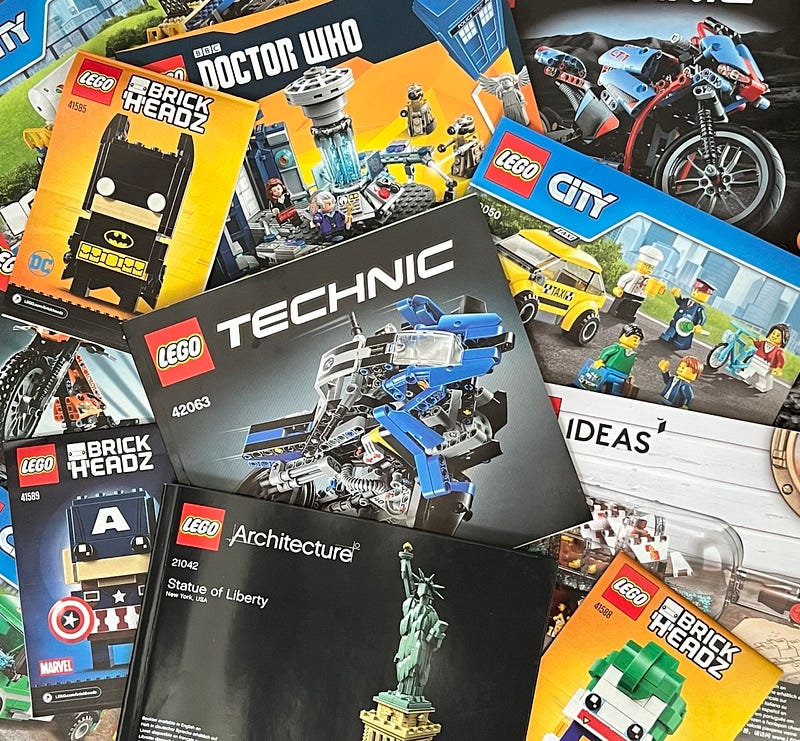
Recession is something on everyone’s mind right now, unless you’re maybe a hippie who just relies on “Mother Earth” magically providing as you’re swaying yourself from left to right in the middle of a field. But hey, I won’t judge. Your life, your choices, your dance moves. The rest of us however can’t entirely ignore what’s going on in today’s economic climate, as one way or another it will surely affect all of us. Just having to read all these news is already something that our brains get bombarded with daily. That surely can’t be good. The upside of it all, though, is that some folks will start getting creative about their purchase decisions, some may learn to live a more moderate life, while others simply make better and less risky investments. On that note, let’s look at LEGO, which has repeatedly been touted as one of the best investments one can make. So, is that really the case?
What the studies say
I presume I’m not the one breaking the news to you that crypto finally flopped and got proven as a pretty bad investment. That goes for NFTs as well. Moreover, in a world struggling with energy resources, crypto just starts feeling more and more like an irresponsible investment both on a personal and environmental level.
Then of course there’s gold. Gold was always considered a safe investment. Beats me why, it’s just some shiny metal, but I guess humans have not yet evolved enough not to grin like monkeys when seeing something shiny, so its value stays. Similarly to gold, there’s also art, but then again, art just doesn’t feel like the most accessible investment opportunity.
Which brings me to good ol’ LEGO bricks. Plastic. Yeah. Who would have thought? Studies — yeah, actual research — show though that LEGO, over time, appreciates better than gold itself! While it might sound ludicrous to many, there is actually an excellent reason for that. There is no evergreen LEGO set, even the Classic sets — which I, for one, love — went through iterations over the years, making even the non-limited edition sets essentially very limited.
Let’s not forget, LEGO very rarely keeps around a set for more than 3 years. Many become hard to find within a year, and some get retired after just two or so years. At that point, anyone who has a sealed set is sitting on a gold-mine. Those with opened sets are also in a pretty good position, as they will still be able to sell the set later for more than the original retail price, and that’s accounting for inflation.
What I think after 29 years of collecting LEGO
Rounding up, that’s three decades. That makes me feel both old and young at the same time. Knowing that I have been building LEGO for three decades does show my age, however, the fact that I’ve been playing with LEGO for 30 years also shows how young at heart I still am. Between you and me, I don’t feel a day over 20, and I doubt I ever will. I recently discovered thanks to a Korean show, a cover of one of my favourite songs, will just drop it here, while I’m at it.
While I can’t claim the same amount of first-hand historical insight and wisdom into LEGO as my fellow LEGO fan and writer Skyring, looking back at the 30 years of LEGO purchases, many of which I made from pocket money I had working odd weekend jobs as a 10–12 year-old, I have to mostly agree with the researchers. Mostly and not entirely because there are a couple of things to keep in mind.
- Each LEGO set will have a peak and a resurgence in terms of value. Right now 40 and 50-year-olds are gobbling up 10, 20 and even 30 or 40-year-old sets, because of their huge nostalgia value. This cannot necessarily be expected to last infinitely though, so similarly to vinyl records, there will be a dip in sales values at some point. It remains to be seen when. Then, inevitably those who still hang on to their sets, will see another spike which could hold much longer, perhaps a couple of decades, especially if LEGO stay in business, when many of these sets will become so rare, the very few hard-core and affluent fans will be willing to hand over literal piles of cash for an originally $50 set.
- One set is not like the other. Not every set appreciates at the same rate as others. Certain themes attract more attention than others. Star Wars — which so far I have been avoiding because I don’t really care much about Star Wars in general — sets for example have a pretty high chance of selling very well a decade later. Random little City sets, however, less so. Then you have the Technic Supercars or the System Speed Champions. Again, very good bets.
- Some sets, when accounting for inflation, barely appreciate at all and selling them might just get you enough extra to cover the cost of postage to the buyer. The good news, however, is that you didn’t lose money on it.
I think the major takeaway from 30 years of LEGO is that a key distinction has to be made between new and used sets. Looking at my collection on Brickset it becomes pretty clear that if I were to sell all my used LEGO right now, I would, realistically, just about break even, ± 2% of total value, which if you ask me, is pretty good. Had I kept all of those sets unopened though… oh sweet momma… I’d be cashing in like crazy at around 4 times my initial investment. Let’s just look at the very first set I received at the age of 7 — The Dark Shark, set #6679. Its original retail price in 1991 was $7.74. Accounting for inflation, that $16.07. That set, if sealed, is currently worth 57 bucks! That’s pretty much 3 times the original price! Very similar story with my Pothole Patcher or the Search n’ Rescue set.
Technic sets being Technic, the number can get even better and much faster if it’s the right set, that is… Let’s look at my Porsche 911. Mine is used because so far, every set I bought, I also built, but I paid 280 bucks for this set in 2018; it’s now valued at 433 bucks if used! Accounting for inflation, I could already make 130 bucks on this set alone!
If you consider that LEGO is meant to be played with, years later, it’s still mind-boggling to see that it’s pretty much impossible to lose money with a large enough collection.
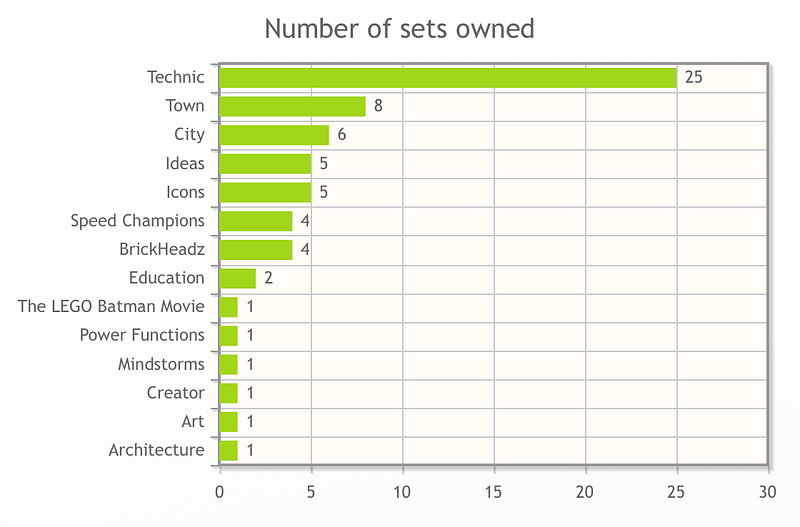
And when I say large enough, I mean 50+ sets of various sizes and across many themes, as the below illustrative diagram shows based on a fraction of my collection (I was too busy building and forgot to update 60% of the time the Brickset database).
Should you jump on the LEGO investment bandwagon?
I have no finance or accounting background. I hacked pretty much my entire life from career to personal life, development, and growth. I, therefore, advise you not to just take my word for what I’m about to suggest. This is not financial advice, you do your homework, make your own decisions, helped by my insight of 30 years of LEGO and this additional story on how to score LEGO on the cheap.
That being said, here’s where I’m at on this. I think that setting aside say $1000 a year on LEGO purchases is a good strategy. That’s 83 bucks a month you could spend on LEGO. If trends are anything to go by, and if you never open the sets you buy, you could be looking at 100–300% profit over the next three decades on these sets.
If you do decide to open them, play with them and potentially later sell them, just keep in mind that on average, you will most likely not lose money, but won’t make any significant amount either. One word of advice, though, if you want to sell opened sets later. Make sure you keep the bricks out of direct sunlight. Especially, the white bricks will yellow over time to a degree that you’ll find it hard to sell at all. While some fans might like the “aged” look, that’s not your average buyer. Used sets will still need to be in a good condition.
You can, of course, combine the two strategies, just like I am planning to. Sets I can score at less than retail price, I’ll buy two of and keep one unopened. If my calculations are correct, this will eventually cancel out the cost of buying those sets I did open and play with, while leaving me with some extra cash on the side, though don’t expect to pay off your mortgage with the remaining profits.
I find it hard not to consider LEGO a safe investment. It looks like, even in a worst-case scenario, you’ve got little or nothing to lose.
Hi there! 👋
Recently, I started a new publication — Bricks n’ Brackets — dedicated to LEGO, tech and coding. It would mean a huge deal to me if you’d follow it, though only do so, if any of those topics pique your interest. You can also read more about why I started it and what my overall goal with it is. You can also join as a writer if you’d like, as long as you submit articles around those three topics. The publication also has a YouTube, Instagram and TikTok channel. Thank you, and may the gods of creativity and success guide your day!
Attila Vago — Software Engineer improving the world one line of code at a time. Cool nerd since forever, writer of codes and blogs. Web accessibility advocate, Lego fan, vinyl record collector. Loves craft beer!


