
A Company Is Using My Face in Their Advertising For The Next 5 Years
And I only got paid 38p
Today we got an email: “Do you realise you’re being used in this advert?” an acquaintance asked my husband.
It was an ad for over 50s life insurance.
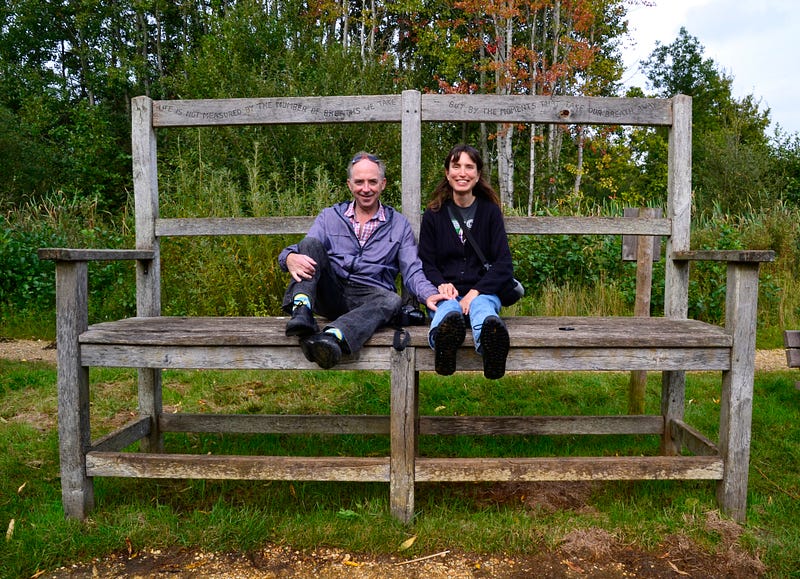
No. We hadn’t. But I knew how they’d got the pic. I do stock photography. I’d recently sold an image of myself and my husband on this ridiculous over-sized bench in a country park in Hampshire, England.
When I made the sale, I assumed it was to the Hampshire Tourist Board, promoting their fabulous park with this ridiculous bench in it.
It transpires it wasn’t. The company had cropped the image to get close ups of our faces and used our faces on their campaign for over 50s life insurance.
Now apart from the fact that I was 46 when the picture was taken, not over 50 (how rude!) they’re completely within their rights to do that, because we both signed model release forms and I uploaded the picture onto Alamy, with permission for any use. It was just an image of a giant chair, after all. We were sitting on it to show the scale!
I hadn’t expected someone to crop out our faces and place them front and centre on a marketing campaign… but I guess I should have seen that coming.
Alamy sold a licence for that pic for five years, for $1.28, which means I get about 38p. Split with my husband, that’s 19p each.
It feels a bit off. It’s not the company’s fault. I licenced it for commercial use; Alamy offered them a deal; they took it. I’ve even signed up for my pictures to be included in deals, but the experience did make me think.
If a company came and asked me to be their ‘cover girl’ in their advertising campaign for the next 5 years, I’d expect a payment in £100s or £1000s — even if it was just one pic. So why did Alamy sell that licence for $1.28?
The problem is, they don’t seem to see the added value in commercial use. And I don’t think they differentiate between a photograph like that, and a picture of a dog. If they sold a picture of a dog with a licencing agreement of 5 years, for the purpose of an advertising campaign, I wouldn’t bat an eyelid.
The experience made me acutely aware that the next ad might be for something we don’t agree with. I don’t mind life insurance. It doesn’t matter. It’s disappointing to get such a low income for that sale, but it’s no big deal.
I’ve now marked the image as ‘editorial only’ and deleted the model release forms. I don’t want to be smiling out of an ad for something embarrassing, or something I don’t like. For example, we might end up in an ad for how much we love wood burners — but I can’t stand the horrible polluting things.
That’s the thing. When you pop your photo onto a stock photography site, and licence it for anything, you lose control. Even setting it as ‘editorial only’ doesn’t prevent the image from being used in advertising, but it reduces the likelihood.
I had one image set as ‘editorial only’ in 2020, and it got used in an ‘advertorial’ for company products. I didn’t see it, so I have no idea what products they were selling, but I deleted the image completely after that, because commercial promotions was not what it was for. It was an image of life in lockdown, for editorial use only. For reporting. Not to generate sales.
It was of a picture of a person, not of me, and I didn’t have a model release form from the person in the picture.
So the moral of the story is if you don’t want to see your own face (or someone else you’ve photographed) staring back at you from an advertising campaign, don’t put it on a stock photography website. And if you do, and it’s available for commercial use, just be aware that your mug shot might be driving round on the side of a bus, advertising literally anything!
More from me…
- I’ve Made Over $3000 Selling Licences To Use My Photographs
- Make Money Writing to Market
- Vocal Media: How Blogging on Another Paying Platform is Going
- Join Medium, and read unlimited stories, using my referral link here