
Drop the Need to Be Right and You’ll Suffer Less
I could’ve been right but I’d rather write

(Non-members can read the full story through my Friend Link.)
I’ll tell you a little secret about me.
If you want to bait a rise out of me, just misinterpret my intentions or what I say.
It works every time.
However, feeling the rise internally doesn’t mean I’ll pounce on you straightaway or even at all because I’ve put together some coping tools over the years.
First, I practise the pause. I don’t do anything… yet, and try to breathe deeply and slowly. It calms my body which in turn calms my brain.
While pausing, I turn to what Buddha said about the vicissitudes of life — that no matter what we do or intend, we will experience not only pleasure, gain, praise, and fame, but also pain, loss, blame, and disrepute. They are all par for the course in this journey we call life.
To me, the underlying lesson from Buddha’s teaching is about letting go. Letting go of my need for things to be different when the experience is a difficult one.
Now there’s just the matter of putting that into practice.
I had a nagging feeling that somebody — likely a fellow mum — would benefit from reading my previous article on outcome bias.
I didn’t know who that person might be so the only way was to cast my net wide. I decided to share my article in a few WhatsApp chat groups that support parents of neurodivergent kids.
This was the first message I sent in those support groups:
Hi fellow parents,
As parents of neurodivergent kids, our parenting decisions tend to be more complex. Think schooling, socialising, attending therapies, medicating, putting in place accommodations at home and elsewhere… heck, even buying shoes and getting haircuts 😅
When our parenting decisions lead to undesired outcomes, it’s easy to fall prey to outcome bias and blame ourselves for those decisions.
I’m sharing an article I wrote about outcome bias. I hope that awareness of this cognitive bias can be a reminder to us all to be self-compassionate when our best parenting intentions don’t translate to intended outcomes.
I like to encourage people so I added this second message.
I guess that was a long way of saying: You are doing the best you can, remember to be kind to yourself 💖
Have a good long weekend ahead!
The responses to my messages were favourable.
But one response stood out. One parent — a stranger to me — wrote this in response to my second message:
We are doing the best we know how.
No thumbs-up emoji to at least acknowledge the good intention behind my encouragement. Just a re-statement, as if to add their nuance to what I wrote.
Except that I couldn’t see any nuance. As far as I was concerned, this parent got their semantics wrong.
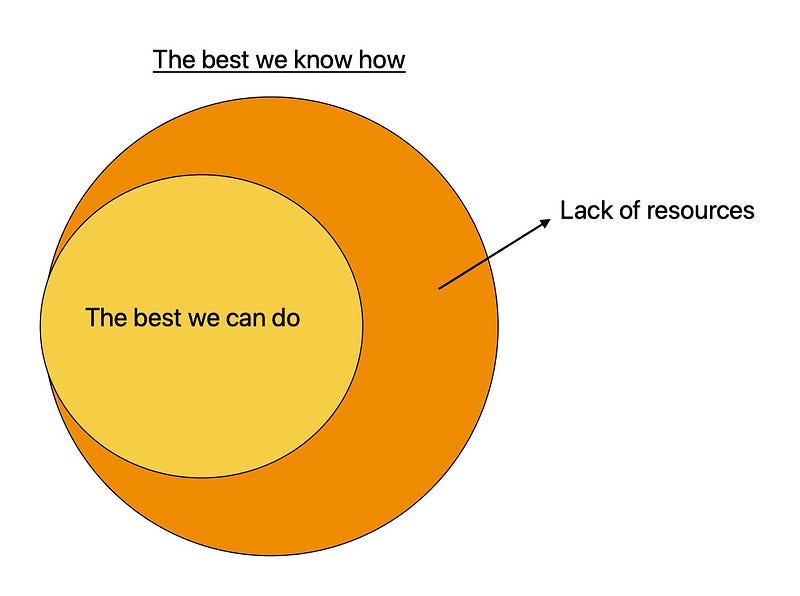
Maybe you know there are 500 different therapies out there for your child but realistically, you can only send your child to three of them. Perhaps you have financial constraint, time constraint, transportation constraint, or caregiver constraint.
Or you know that a certain sensory equipment is going to be helpful for your child but there’s no space for it at home. Or you know that gym class would be good for developing your child’s body and spatial awareness but you can’t persuade your child to go.
So you know what you can do but yet you can’t do it due to some limitation.
My point is that the-best-we-can-do is a subset of the-best-we-know-how, like what the diagram shows.
Saying “you are doing the best you can” in my second message was more fitting than saying “you are doing the best you know how”. I wouldn’t change the wording in my message if given a chance to redo it.
But when I zoomed out a bit, I realised I was experiencing a reflexive urge to correct this parent because they tried to correct me in the first place.
Compulsively correcting people when they got their facts wrong was something I used to do when I was younger. You could call it a respect for truth or an unhealthy need to be right.
What I’ve learnt over the years though was that most of the time, people are just expressing their opinions, beliefs, or biases. Those are not facts, and are not worth the peace of mind it would cost me to challenge them.
Just think back to the pandemic days and election seasons, which demonstrated over and over again how hard it is to change people’s minds.
What I’ve also learnt over the years — especially through my work as a counsellor — is that everyone’s reactions feel valid and legitimate to themselves and that people desire to be acknowledged for anything they put out in the world.
So I gave that parent’s re-statement a thumbs up to acknowledge that they responded to what I wrote. And that was my entire response.
The lesson here is this: I can acknowledge another person’s view without agreeing with it. I don’t have to assert that I’m right, certainly not with a stranger.
The outcome here was a win-win. I got to practise letting go and the other person (probably) felt acknowledged and validated.
But the lesson didn’t stop there for me.
I mentioned this situation to my highly-analytical husband. He agreed with me on the semantic front but he interpreted that parent’s response through a higher order of empathy.
He thought maybe what that parent meant was this: everything they knew could be done, they had already done. The latter was not a subset of the former; the two are exactly the same for them. And everything they had done was still not enough to achieve the outcomes they sought. (This interpretation does pre-suppose that the parent had no lack of resources in implementing all that they knew could be done for their child.)
So maybe this was a frustrated parent speaking, and responding to an encouragement that did not resonate with them.
My husband’s interpretation pulled me to his plane of empathy and I felt all negativity dissolve.
And that was the other lesson here: instead of feeling peeved with another person, we could try to actively empathise with that person to address the negativity that arises within ourselves.
It worked for me.
For what it’s worth, it turned out there was indeed a mum who needed to read my previous article about outcome bias.
It was a personal friend. She messaged me to say that my article was timely for her because she was just lamenting how her parenting efforts weren’t yielding the results she hoped for.
Glad that my intuition was working well.
Thank you for reading.
Subscribe to receive an email notification whenever I publish a new article.