avatarHCwrites

Free AI web copilot to create summaries, insights and extended knowledge, download it at here

1810

Abstract

ation.</p></blockquote><p id="8682">My husband thought it’s worth a shot.</p><p id="fc93">Our son had his own ideas though. He made half-hearted attempts to push the shopping trolley and kept abandoning it. I ended up having to shepherd both him and the shopping trolley down the supermarket aisles.</p><p id="61fc">The experiment failed.</p><p id="8f3d">By the time we were done with our shopping, we discovered that the sole cashier-manned checkout counter that was open had a long queue.</p><p id="3253">We’d usually use the express self-checkout counters and would have gone there except that those counters were meant for shoppers with a single basket.</p><p id="7cca">Our experiment failed and we ended up stuck with a long queue for nothing. That’s how my husband’s lament came about.</p><p id="eaaf">My husband had fallen under the influence of outcome bias.</p><figure id="7df5"><img src="https://cdn-images-1.readmedium.com/v2/resize:fit:800/1*XFZQrDb_EU9m8wJTRR4ksA.jpeg"><figcaption>Author’s own image showing the interplay between the quality of a decision and the quality of an outcome.</figcaption></figure><p id="bf40">Outcome bias is a seductive cognitive bias that can creep into our everyday lives. It happens when we judge the quality of a decision based on its outcome.</p><p id="a5f3">Maybe you are a chess player and made a bold but flawed move which turned out well only because your opponent was weaker. Outcome bias might make you think the bold move was sheer brilliance on your part but the truth was you got lucky.</p><p id="b02c">Or maybe you heard about the Bitcoin bull run and became crypto-curious. Despite having a conservative risk appetite, you invested some money in Bitcoin and started seeing gains because you were in the midst of a bull run orchestrated by crypto whales

Options

. The gains may mislead you into thinking that cryptocurrencies are a viable asset class. But if you were to take into account your low risk appetite for investments, putting money in cryptocurrencies was actually a poor decision.</p><p id="9438">When we use wins and losses to judge the decisions we made earlier, we do ourselves a disservice by ignoring the role of luck. There is always some element of luck when it comes to outcomes, or external events as Stoics would call them.</p><p id="15cb">The best we can do when making decisions is to try to make <i>informed</i> decisions based on the information we have at that point in time. That requires analysing the problem and understanding what we know and what we don’t know.</p><p id="6992">What I didn’t know at the point of suggesting the supermarket trolley was that my son was not ready to participate in this novel task.</p><p id="227e">I hadn’t asked him beforehand because I wrongly assumed that he would be interested in pushing a supermarket trolley around. That was projection on my part because I enjoyed pushing a supermarket trolley when <i>I</i> was a child.</p><p id="a19e">So maybe my husband was right after all. The decision <i>was</i> a mistake because I neglected to factor in a critical piece of information for the decision-making process.</p><p id="a592">I will still try to get my son to use a supermarket trolley in the future. Just that the next time I try it, I will assess my son’s readiness to participate before making a decision.</p><p id="bba2">This was a reminder to myself that mistakes can be valuable — they hold lessons for improving our future decision-making.</p><p id="cf64">Thank you for reading.</p><p id="94c7"><i>How does outcome bias creep into your life? Let me know in the comments.</i></p></article></body>

A Poor Outcome Doesn’t Mean You Made a Poor Decision

Don’t fall for the outcome bias

Author’s AI-generated image of a pre-teen abandoning a supermarket trolley that he was responsible for.

Non-members can read the full article here.

“This was a mistake.”

That was my husband’s efficiency speaking. He doesn’t like wasting time on queues.

“No, it wasn’t. Just because we don’t like the outcome doesn’t mean the decision was wrong.”

And that was my defensiveness — hiding behind a mask of objectivity — speaking.

I made the proposal for the decision and felt compelled to defend myself… no, I mean, our decision.

Our neurodivergent pre-teen was on his term break and we somehow managed to persuade the homebody to accompany us on a grocery run.

I suggested to my husband that instead of using a basket for the grocery shopping like we usually do, we could use a shopping trolley this time and let our son manage the shopping trolley under my supervision.

I shared my reasoning with my husband:

It’s heavy work activity.

It could be fun for our boy.

It would foster personal responsibility.

It would help him practise some motor coordination.

My husband thought it’s worth a shot.

Our son had his own ideas though. He made half-hearted attempts to push the shopping trolley and kept abandoning it. I ended up having to shepherd both him and the shopping trolley down the supermarket aisles.

The experiment failed.

By the time we were done with our shopping, we discovered that the sole cashier-manned checkout counter that was open had a long queue.

We’d usually use the express self-checkout counters and would have gone there except that those counters were meant for shoppers with a single basket.

Our experiment failed and we ended up stuck with a long queue for nothing. That’s how my husband’s lament came about.

My husband had fallen under the influence of outcome bias.
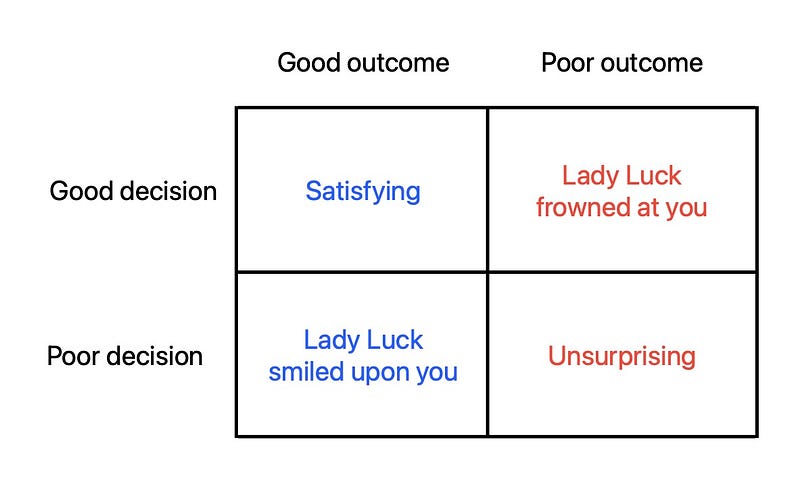
Author’s own image showing the interplay between the quality of a decision and the quality of an outcome.

Outcome bias is a seductive cognitive bias that can creep into our everyday lives. It happens when we judge the quality of a decision based on its outcome.

Maybe you are a chess player and made a bold but flawed move which turned out well only because your opponent was weaker. Outcome bias might make you think the bold move was sheer brilliance on your part but the truth was you got lucky.

Or maybe you heard about the Bitcoin bull run and became crypto-curious. Despite having a conservative risk appetite, you invested some money in Bitcoin and started seeing gains because you were in the midst of a bull run orchestrated by crypto whales. The gains may mislead you into thinking that cryptocurrencies are a viable asset class. But if you were to take into account your low risk appetite for investments, putting money in cryptocurrencies was actually a poor decision.

When we use wins and losses to judge the decisions we made earlier, we do ourselves a disservice by ignoring the role of luck. There is always some element of luck when it comes to outcomes, or external events as Stoics would call them.

The best we can do when making decisions is to try to make informed decisions based on the information we have at that point in time. That requires analysing the problem and understanding what we know and what we don’t know.

What I didn’t know at the point of suggesting the supermarket trolley was that my son was not ready to participate in this novel task.

I hadn’t asked him beforehand because I wrongly assumed that he would be interested in pushing a supermarket trolley around. That was projection on my part because I enjoyed pushing a supermarket trolley when I was a child.

So maybe my husband was right after all. The decision was a mistake because I neglected to factor in a critical piece of information for the decision-making process.

I will still try to get my son to use a supermarket trolley in the future. Just that the next time I try it, I will assess my son’s readiness to participate before making a decision.

This was a reminder to myself that mistakes can be valuable — they hold lessons for improving our future decision-making.

Thank you for reading.

How does outcome bias creep into your life? Let me know in the comments.

Life Lessons
Cognitive Bias
Self Improvement
This Happened To Me
Pragmatic Wisdom
Recommended from ReadMedium