
Driving Under the Influence of Testosterone
I didn’t even realize Testosterone was affecting my driving, until…
This writing was inspired by a conversation with KP_the_writer about strength changes on Testosterone (T). I wanted to share one unexpected effect of this change on me.
I didn’t even realize T was affecting my driving, until there was a gas shortage last year.
When it was first announced in the news that there was a gas shortage, I wasn’t worried.
Yeah, we had only one car, but all I did was drive to and from work, with an occasional stop at grocery stores. We could outlast this. My tank was almost full, and I wasn’t going to be one of those ridiculous people who waited in line for hours just to top off their tanks!
I was so much smarter than that. Really. Don’t look at me like that. I had it together.
I received texts warning me this would be an issue, but mostly ignored them.
A few days later, to my shock, our gas tank had gone from nearly full to nearly empty!
This was an issue where we live because there is no public transportation in the middle of nowhere. There is no Uber or Lyft option. Owning a car is mandatory, if you need to get anywhere outside of walking distance. Nearly everything is outside of walking distance.
A few miles away, there was a grocery store that had supply issues through much of the first year of the Pandemic. That’s about as close as anything useful was to us. Driving from grocery store to grocery store searching for basic things like eggs and milk had become part of regular life. Our situation at the time was somewhat similar to what was described in this article by James Finn.
One unexpected trip to the doctor a few towns over had been enough to more or less ground us at home until the gas shortage was over about two weeks later. We could only leave home to go to the grocery store a few miles away once or twice. For the first time in my life, I had to explain to my boss that I couldn’t come to work in person because I didn’t have enough gas in my car to make the trip. To my shock, my boss understood and accepted this as a valid excuse.
When I speculated to my wife that the gas I had filled up with must have been watered down in some way, they shook their head.
“Your driving has changed, since you started taking T. You’re lead-footed now and drive aggressively.”
At first, this made me very defensive. I was not lead-footed! I was a careful, patient, and considerate driver, like always. People had just all started driving slower over the last several months. They were all coincidentally in my way. It must have been a weird Pandemic phenomenon.
I started to observe my driving after that and began to notice the difference.
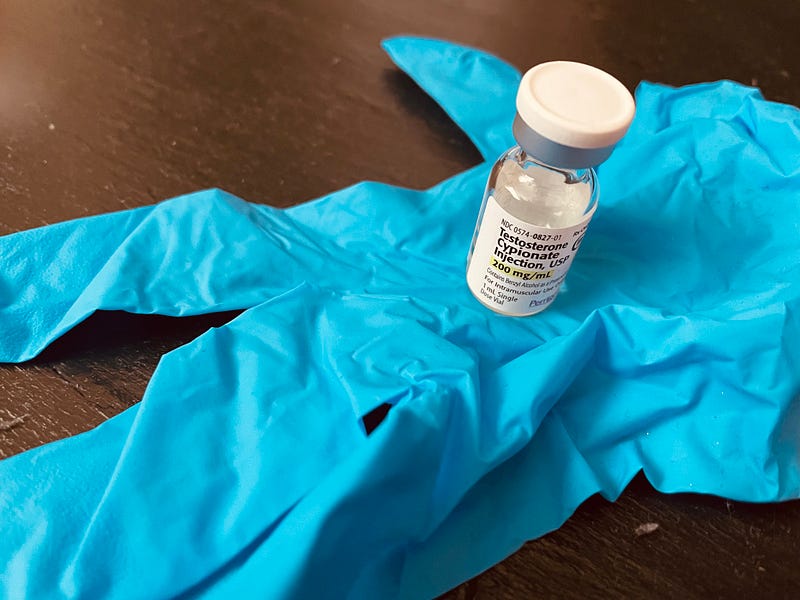
Testosterone contributes to changes in physical strength levels.
Here, I’m defining strength as the simple ability to lift something heavy. There are other forms of strength that I’ve actually lost as a man on T, but that’s a topic for another writing. Suffice to say that I’m not of the opinion that women have the weaker gender. Estrogen offers different forms of strength.
The same amount of exercise will have substantially different results for your muscles, if you are on Hormone Replacement Therapy (HRT), depending on whether you are on T or Estradiol (E). With the resulting sudden changes in strength from T, the hormone medically transitioning men use, the same amount of effort produces a different result for all kinds of little things.
I had been aware of this in some more overt ways.
- There had been a few unfortunate incidents while trying to crack eggs. I’ve spent an embarrassing amount of time picking tiny bits of obliterated eggshell out of sunny-side-up eggs that were spontaneously made into shell-flavored omelets.
- There was also that incident of my wife sneaking up behind me and startling me, causing me to accidentally crush and break the plastic spoon in my hand.
- Then, there was the look of surprise in that coworker’s eyes when she had asked me to “get a man to lift those boxes” and wandered off for a few moments, only to return to see me lifting all of the boxes without incident.
- On another occasion, an elderly coworker assumed she could lift a box just because she saw me lifting it first. The look in her eyes was priceless, too.
Anyway, back to my story. That same mechanism of requiring less effort to have the same result apparently applied to the gas pedal, as well. I thought I was using the same amount of force to press down on the gas but was actually just flooring it every time I accelerated.
I hadn’t noticed how much gas I was wasting until there was very little gas left. My wife wasted much less gas on the trip back from that doctor’s office, proving their point.
After that, I had to relearn how to be gentle with the gas pedal and how not to drive like, well, a T-fueled monster.
Awareness is key.
Now, I understand why car insurance companies charge more for male drivers.
I feel a little guilty, like I’m getting away with something, since they haven’t noticed yet that I’m a man. Shh! If they get over their ignorance and start charging people correctly based on their real gender, instead of the genders people are assigned by doctors at birth, they might legitimately make more money off of me.
Interested in signing up for the Medium to access all of our writers’ fantastic articles for only $5/month? If you would like part of your membership fees to support me at no additional cost to you, sign up here or click on the membership link of your favorite writer to support them!


