
GAN resurrected
Drag Your GAN: Unlocking the Magic of Interactive AI Art. Point-based Draggan tool.
New interactive point-based manipulation method. Code.
Point-based manipulation on the generative AI. Photo image editing
Generative Adversarial Networks, or GANs for short, have taken the creative world by storm over the last decade. A relatively old technology in comparison to diffusion models, it has quickly become a sensational development with an almost cult-like following. The excitement surrounding this groundbreaking field is growing at lightning speed.
Adobe added Firefly straight into Photoshop, uniting the speed of generative AI with the power and accuracy of Photoshop
From Dreams to Reality
Let’s delve into one such innovative method within this fascinating realm that changes how we perceive and interact with AI-generated images — introducing DragGAN and precisely reach target points.
TL;DR
The DragGAN tool, developed by the Max Planck Institute, offers a novel approach to manipulating AI-generated images interactively. Users can manipulate points of the image to precisely reach target objectives on the learned generative image manifold of a GAN, thanks to advanced point tracking methods. This tool allows modifications to be performed on the learned generative image manifold in a user-interactive manner. Even in challenging scenarios such as hallucinating occluded content and deforming shapes, the DragGAN tends to produce realistic outputs. The system also ensures that manipulations are performed in a discriminative fashion, consistently following the user’s input and artistic direction.
ChatGPT is obsolete isn’t a dismissal; it’s a recognition of progress
DragGAN AI — drag and drop : Revealing New Horizons in Image Manipulation
In their paper “Drag Your GAN: Interactive Point-based Manipulation on the Generative Image Manifold,” researchers present a captivating new approach allowing users control like never before! By harnessing powerful point-based manipulation techniques guided through simple clicks and drags — the experience becomes enchantingly engaging as you watch your desired image transformations unfold right before your eyes.
Manipulation on the generative image. New method
But what truly sets DragGAN apart from its counterparts? Let us explore some cutting-edge features driving spellbinding results across diverse datasets spanning categories, including animals (lions, dogs), humans (faces & whole bodies), landscapes — and even cars!
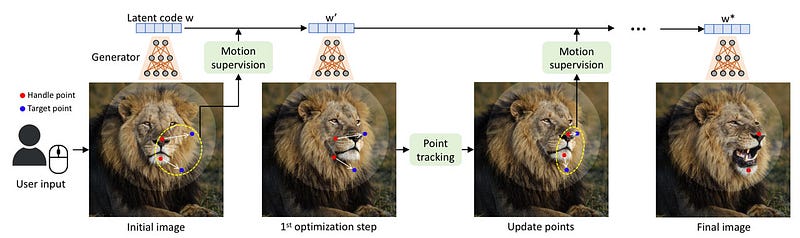
The “Drag Your GAN: Interactive Point-based Manipulation on the Generative Image Manifold” paper proposes several new methods:
1. Interactive Point-based Manipulation: The paper introduces a method that allows users to interactively manipulate images generated by a Generative Adversarial Network (GAN) by clicking on any number of handle points and target points on the image. The goal is to move the handle points to their corresponding target points.
2. Shifted Feature Patch Loss: This method is used for motion supervision. It optimizes the latent code of the GAN, and each optimization step leads to the handle points shifting closer to the target points.
3. Nearest Neighbor Search in Feature Space: After each optimization step, point tracking is performed through a nearest neighbor search in the feature space. This method ensures that the handle points are accurately tracked and moved towards the target points.
4. Region-specific Editing: DragGAN allows users to optionally draw a region of interest on the image to perform region-specific editing. This feature provides users with more control over the editing process.
5. GUI for Interactive Manipulation: The authors developed a Graphical User Interface (GUI) that allows users to perform the manipulation interactively by simply clicking on the image. This makes the process more user-friendly and intuitive.
6. Combination with GAN Inversion Techniques: The authors propose combining DragGAN with GAN inversion techniques. This combination makes DragGAN a powerful tool for real image editing, expanding its potential applications.
Immersive Interactivity Meeting Efficacy:
Dragging handle points strategically around generated images can profoundly affect spatial attributes; each target comes alive thanks to specialized methods employed within shifted feature patch loss optimization refining latent codes while maintaining incredible efficiency vis-à-vis motion supervision.
Moreover — your artistic vision won’t be clouded due to tracking concerns amid these abundant optimizations either! Nearest neighbor search capabilities unlock crucial precision-driven accuracy instantaneously, bringing surreal creations aligned impeccably along targeted regions — all without constraint linked exclusively alongside unique object categorization limitations prevalent elsewhere utilizing similar tech stacks.
Profound Creativity Empowers User Selectivity Too:
Atop achieving unparalleled flexibility standards praised previously — image modification endeavors anchored inside designated neighborhoods paved real-time eradicates prior operational bottlenecks impeding maximal satisfaction.
Couple dynamic GUI implementations bestowing seamless interactive manipulation mastery alongside existing GAN inversion techniques, and you reveal a breathtakingly beautiful realm of possibilities originating deep within AI-based imagination stocks erupting outward, spanning numerous creative endeavors awaiting exploration!
Meitu AI Art The Groundbreaking Anime Filter in the Mobile Photo Editor Realm
A whole new universe for artistic craftsmanship:
You must be wondering: how come the world still seems so captivated by generative adversarial networks after almost 10 years? One key reason is that these amazing inventions continue captivating not only programmers but also artists, entrepreneurs, storytellers — and, indeed, humanity at large.
With endless innovative breakthroughs like DragGAN empowering our aesthetic senses while catalyzing profound emotional connections interlinked uniquely unto every individual’s singular perspective echoing intimate resonance — why would interest in this magical approach subside anytime soon?
AI Detector Mastery: Your essential guide to the AI content detection tools of 2023
So now, with your renewed enthusiasm igniting energetic curiosity sparked anew amid all wondrous developments showcased recently linking science-fiction dreams turn reality… Come join us!
Visit MLearning.ai today, where the latest discoveries are published on an ongoing basis to keep you up to date on the latest methods.
Ready or not — the future’s here…

PAPER:
https://arxiv.org/pdf/1705.07215v1.pdf
CODE will be released in June.
https://github.com/XingangPan/DragGAN
@inproceedings{pan2023draggan,
    title={Drag Your GAN: Interactive Point-based Manipulation on the Generative Image Manifold},
    author={Pan, Xingang and Tewari, Ayush, and Leimk{\"u}hler, Thomas and Liu, Lingjie and Meka, Abhimitra and Theobalt, Christian},
    booktitle = {ACM SIGGRAPH 2023 Conference Proceedings},
    year={2023}
}


