
‘Don’t Worry Darling’ Leaves Every Reason To Worry
Follow these exact instructions or you’ll wake up trapped in 1950s Americana with Jordan Peterson

Don’t Worry Darling, an almost-perfect movie, posits an alternate reality where Shyamalan continued to make incredible movies with terrible endings.
It was perfect until
I haven’t felt that compelled to simply understand wtf is going on since M Night Shyamalan’s early work — see Wide Awake, The Sixth Sense, and Stuart Little.
Then came the twist.
Lots of critics loved Don’t Worry Darling until the twist.
The twist is eerily similar to Serenity. Not the sci-fi western thriller, but the sci-fi thriller starring the guy with the southern drawl.
If you’ve seen that Serenity, then your heart maybe skipped a beat when the twist for Don’t Worry Darling came forward and tried to take the “oh it’s present day disguised as a historical period” crown from Shyamalan’s last great movie The Village.
Is the twist as bad as critics say?
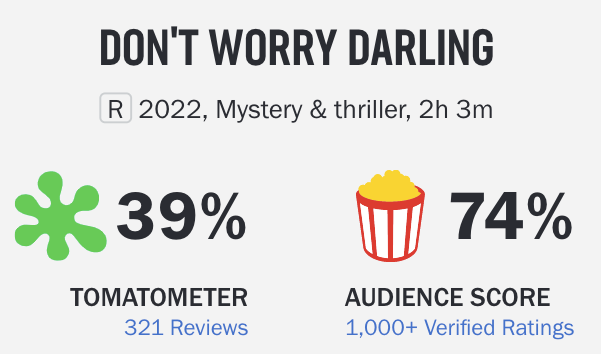
I don’t think it’s really that the twist is bad. I think it’s that the movie ends without showing what happens after Alice wakes up.
In his legendary anthology novel World War Z (adapted into a legendarily bad movie), author Max Brooks said that Americans tend to prefer not just a victory, but an overwhelming victory. Anything less feels like nothing.
Because Don’t Worry Darling ends as Alice wakes up, we’re denied the chance to witness a final confrontation with the organization she almost certainly will face once she opens her eyes. Her battle may have only just begun.
Compare that ending to Vanilla Sky — what some would consider the last great movie by Cameron Crowe (We Bought A Zoo was just fine).
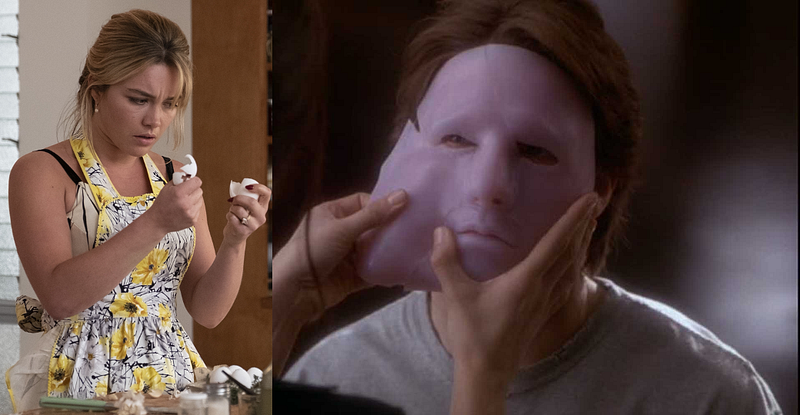
Tom Cruise follows the instructions to “abre los ojos,” thus awakening to what seems a hopeful far future run by the organization keeping him alive. We don’t need to know what happens afterward. A happily ever after is a happily ever after.
‘Don’t Worry Darling’ is a bad dream that never ends
Alice isn’t facing a nightmare that will leave her as soon as she opens her eyes. Even with Frank dead and Shelley taking control, the now-empowered matriarch is unlikely to intervene — at least in time — to stop the security coming to kill Alice.
There’s an easy third act — or an entire sequel — about Alice facing Shelley in the real world. You could fit a secret mid-quel into the trilogy, like Unbreakable, Split, and Glass, that essentially retells Don’t Worry Darling with a new cast, but with the subversive experience possible when the audience begins the story knowing better.
Remember what James Cameron did with Aliens once there was no point waiting to show the xenomorph? And like the Eastrail 177 trilogy, the third movie could join the two storylines with Alice taking on Shelley.
I’m going to step on my own point, though. The movie doesn’t need a third act, sequel, or trilogy.
It’s an allegory for escaping abuse
If you watch the movie as an allegory for escaping an abusive relationship, then the movie not only doesn’t need to show what happens after Alice wakes up, showing it would be redundant.
In Serenity, the twist undoes everything because the main character is a computer program that will disappear from existence if he succeeds.
If they’d found a way to Thirteenth Floor Matthew McConaughey’s character and bring him into the real world, I think we’d still be talking about the movie. In glowing terms, I mean. Not as another example of a great film that feels retroactively terrible once the big twist is unveiled.
Don’t Worry Darling works despite the same terrible twist
Don’t Worry Darling works despite the same terrible twist as Serenity because the main character isn’t a computer program. Alice is a real person. Save for a few easily-cut moments, the audience would have only vague suggestions what kind of “program” she’s trapped inside.
The ending — punctuated by Alice’s first woken breath — illustrates that the most important moment when escaping an abusive relationship is that first step toward escape.
I didn’t understand this until I watched the movie a second time

For me, the obstacles standing in the way of that first step were nearly impossible to overcome. So many of them had to be confronted inside myself.
But once I managed to take that first step, you may as well call me the Juggernaut, bitch.
Don’t Worry Darling is streaming now on HBO.


