
Don’t Look Up? A Sad Reality
We are doomed, aren’t we?
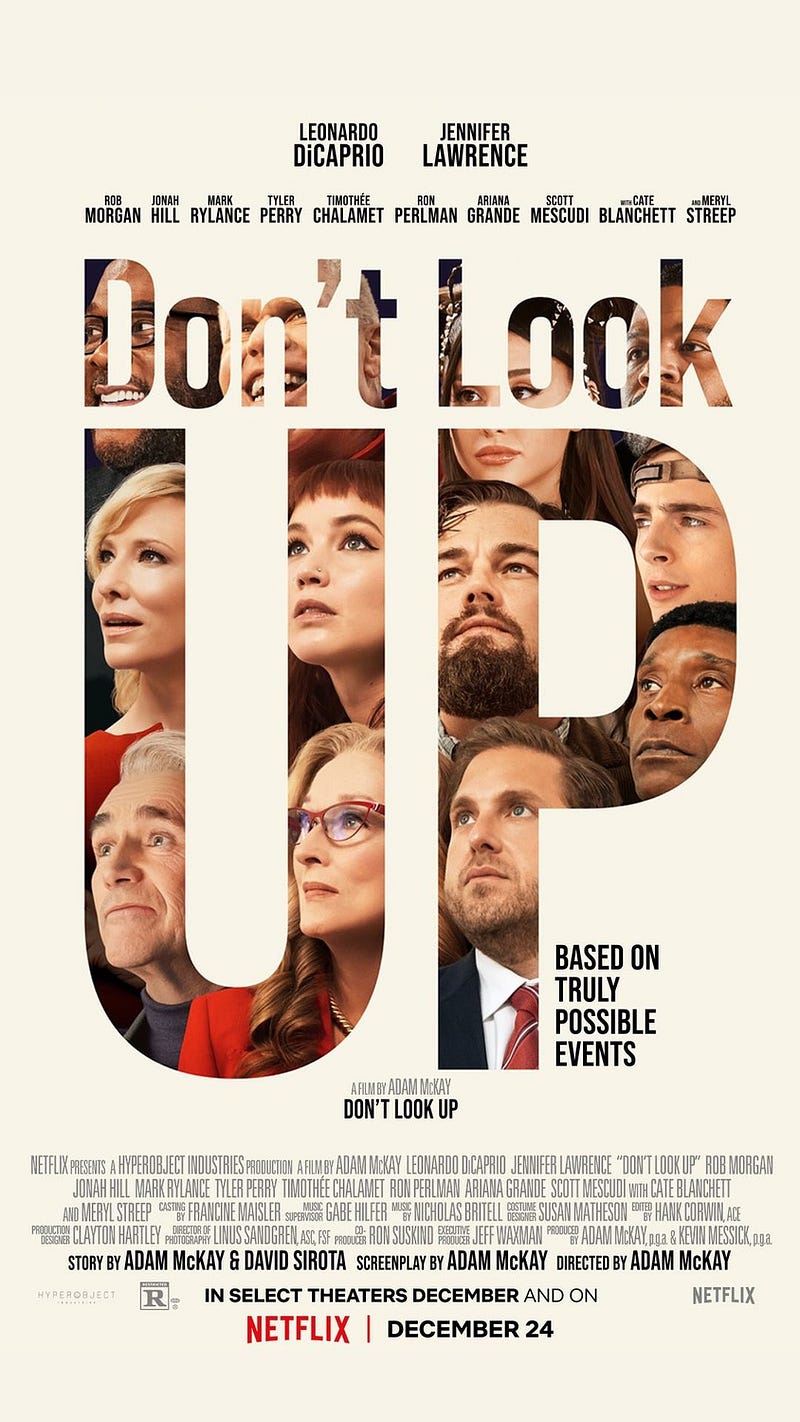
Don’t Look Up was released on Netflix on December 24th, 2021. Since then, I’ve stumbled upon a fair amount of memes on social media. Curious, I decided to watch it.
Oh, my.
The film is presented as a satire — “a way of using humor to show that someone or something is foolish, weak, bad” according to Merriam-Webster dictionary. In this case, it is a satire about climate change and the action (or inaction) of governments.
But there’s more to it.
The pitch is simple.
A Ph.D. candidate discovers a comet. After calculations, it is proven the comet is heading toward us. The scientists go to the President of the United States, who doesn’t take them seriously. They then leak the news on TV and throughout the internet. The rest is history, or it should be.
I remember 2012. The year, and the movie. I was a senior in high school, taking an English test when the world was supposed to end. I didn’t believe it, yet I was anxious. When the time came, I looked up, around. Nothing. I gave it a minute. Still nothing. I went back to English, and on with my life.
Spoilers ahead
So it was not a surprise when no one reacted to the news. I expected some conspiracy theorists to start a movement, and for most people to ignore them. Of course, the world would be busy creating memes and harassing the one person trying to save our lives.
I fairly enjoyed the movie. I laughed often at the absurdity and yet the seriousness of it all. The world is ending, the rest sounds like a Tuesday on Earth.
The cast is as good as they must be expensive. I was pleasantly surprised by Ariana Grande. Jonah Hill had some great lines. Lawrence is playing another eccentric woman (reminds me of The Silver Lining Playbook), but she does it well. DiCaprio sounds surprised half the movie, and back on Wall Street the rest of the time.
It was good — which is high praise coming from me.
All along, we know what will happen, but we don’t want to believe it. Well, like everyone in this movie. We think “come on, they won’t kill everyone, right? Something’s bound to happen!”Yes, a comet was bound to happen. They told us within the few first minutes, it was our bad for not believing it!
I ugly cried
Which is not so rare coming from me.
I wanted to believe they would be saved. I thought the mission would succeed, and no one would know the menace was real all along. The world would go back to its occupations unknowing that those three people saved them.
When I understood that the mission failed and they left to use the bathroom, I even hoped for God. Not sure what would God do in that movie, but I thought “why not, as long as it works!”
Spoiler alert, God did not save them.
So I cried as they reminisced around the table. I cried as they old hands and took time to be grateful and together, one last time.
DiCaprio's character resumes the entire movie with a single line.
We had it all, didn’t we?
Yes you did. Yes we do.
I can’t sleep anymore
First, I thought about my family, back in France. When you witness the end of the world, I suppose you tend to think about the people you miss on a daily basis.
My second thought was funnier, but not better. I distinctly remember — as I was crying in my husband’s arms — stuttering “I don’t want to die in the US!” I stand by it.
I know it’s a movie. A work of fiction. Yet, the paranoid in me can’t help but think that maybe it’s true, it’s their way of telling us, and they’re waiting to see what we’ll do. A Netflix movie would definitely be more efficient than a Presidential announcement.
Should they tell us?
Part of me wonders if sharing the information with the general public is the way to go.
On one hand, I appreciate the heads-up. It gives us some time to say our goodbyes and do the things we never got around doing.
On the other hand, it is a constant crushing reality to know we are dying. Knowing it will happen in a couple of months makes these months that much harder. It’s almost better to die unexpectedly.
As I write, some people in the world do know they only have a couple of months left. I can’t imagine how hard it is, but I want to believe it’s easier to go when we know those we love will remain.
The sad reality
The movie is supposed to be a satire about climate change, and I can see that. But my understanding of it is much larger. To me, it’s a metaphor for life. It’s a reflection of our society. I couldn’t help but see too many similarities with COVID and vaccines. Those who believe, and want to save everyone — and those who refuse to look up.
The movie is a sad and scary reality to face. It is hard to witness inaction, stubbornness, and greed when the world could be saved. Capitalism at its peak effectively destroys all lives.
Maybe there’s something to be learned from it.
What now?
I don’t know. What I do know is that I won’t sleep well tonight. I know I’ll be looking up at the stars for a while. I’ll try to remember there are more important things in life next time my latest article is not being read. And I’m going to hug my husband extra tight tonight.
Thank you for reading. Join Medium to support me and many other writers. This is an affiliate link: a part of your subscription will be distributed to me, at no extra cost for you. You can also buy me a coffee.