
Don’t Fence Me Out
Six Word Photo Story: Freestyle
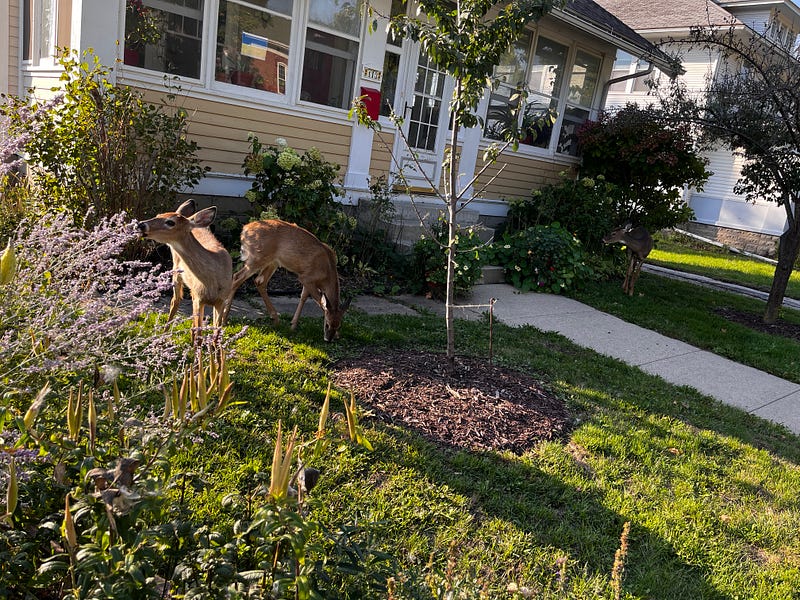
Do good fences make good neighbors?
Deer?
What deer?
My brothers and neighborhood friends spent hours playing wiffle ball in our yard when I was a kid. Our family’s house shared a driveway with the next-door neighbor, the Bartosicks, with twins Tommy and Timmy my age. The two garages were a pitching distance apart. During the winter, we turned that space into a basketball court with hoops attached to the gabled roof of each garage.
Our diamond abutted another neighbor’s backyard property. Kindly and widowed, Mrs. Thompson lived there my entire childhood. Trim bushes, quickly jumped over or through to retrieve foul balls, were unevenly placed between the properties. She never seemed to mind our intrusions.
The pitcher’s mound, a crack in the cement, was just inside our garage with the broken door. The home plate was slightly inclined in front of the other garage door that, thankfully, we could pull down. Hitters looked down on pitchers, a coincidence, but also around 1961, the year Roger Maris broke Babe Ruth’s home run record. The only statistic we kept was the number of dingers. Our backyard served as the outfield, with any ball that landed on the lawn or house of the Welches, the neighbor to the west, designated a four-bagger.
Our field was constructed from the parts of four properties, with no fences to restrict our play. And kind neighbors who didn’t mind kids chasing balls.
Forty years later, my widowed mom and new neighbor with the shared driveway would build an eight-foot-high, solid vinyl fence along our old foul line. She told me Ward wanted more privacy from whoever lived in Mrs. Thompson’s house. Mom lived in her house with that fence for 17 years and never met or glimpsed Mrs. Thompson’s successors.
So, 60 years later, my wiffleball experience leads me to agree with Robert Frost’s narrator in Mending Wall, who says in the first line:
Something there is that doesn’t love a wall
What do you think?
The past becomes the future, according to this story by B.R. Shenoy.


