
REFUGEES
Don’t Assume Refugees Are Happy Just Because Your Country Agreed to Take Them In
If you want to know how they feel, take time to speak with them

A conversation with Syrian children
Child 1: “I was trapped in a circle of fire. I had to run through the flames and smoke.”
Me: “Who was with you?”
Child: “I was alone.”
Child 2: “My house was bombed in the war. My mother and sisters were hurt. My sister lost her leg.”
Child 3: “One night, our town got bombed. My house was the only one left. About 30 people stayed in our house because the bombs destroyed their homes. They had nowhere else to go.”
I spent a day with a group of Syrian refugee children, and it was a heartbreaking and humbling experience.
While we were eating lunch together, one girl told me bombs had crashed through the roof of her house, and she and her mom and sisters were hurt. One sister was so severely injured her leg had to be amputated.
Another said she’d been making a smiley face out of paper napkins on the ground one day,
“ — but then the bombs and fire came, and I had to run.”
A young boy told me that after a bombing raid, his family’s house was the only one standing, and about 30 people who’d lost their homes had to find shelter in his.
Another told me the guns and bombs were so loud it hurt his ears, and there were times he couldn’t see through the smoke.
One child’s father had been chained to a wall and tortured for a month.
Leaving Syria and coming to Canada
Some of the children’s families found refuge in Jordan; however, they were not allowed to work there and had to use their limited savings to survive. Others relocated to Haida Gwaii before finally finding safe homes in Canada.
I asked the children how they felt about moving to Canada. I expected them to say how much they loved Canada and how happy and lucky they felt to live here.
I was wrong — this is not how they feel at all.
Adjusting to life in a new country
The children told me moving to Canada has been difficult for them, and their families are still struggling. Almost everything about their life is different now, the culture, the language, the food and the schools. They’ve had to make constant adjustments since they’ve been here, which is very hard for them.
Some had lost a parent and now had to take on more responsibilities at home, like babysitting younger siblings and household chores. Some said they hated going to school because they were teased and bullied by classmates due to their clothing, language and even the food they brought for school lunches.
As well as these challenges, they have family and friends still living in Syria. Some had no choice but to leave family members behind. The children said they missed their grandparents, uncles, aunts and friends and worried for their safety.
Sharing food and stories
While the children were telling me their stories, they offered me food constantly. I received a cherry from one, a grape from another, chips, rice wrapped in vine leaves, a sweet dessert in filo pastry and more.
They asked me where I was from and many questions about my life, food, and culture. We laughed together about some of the differences between us. I gave them popsicles, and they thought it was funny that English people called frozen things on sticks ice lollies.
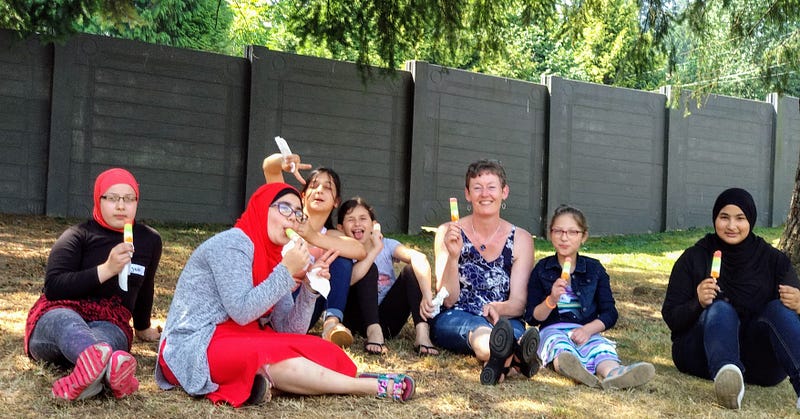
The children said they’re grateful to Canada for helping them, but they don’t want to be here. They want to go home.
UNHCR estimates from mid-2021 show global forced displacement has surpassed 84 million. An estimated 35 million (42%) of these people are children under 18 years.
I feel heartbroken by what humans do to other humans and what some children have seen and experienced. And yet people — at least some of them — are able to gather their courage and find the strength to carry on.
Many refugees have been through hell and are still suffering.
Be kind to them.
Thanks for reading! For an email when I publish a new story, please subscribe here. You can find my story index here.


