
Donjon
Porn in a castle tower?
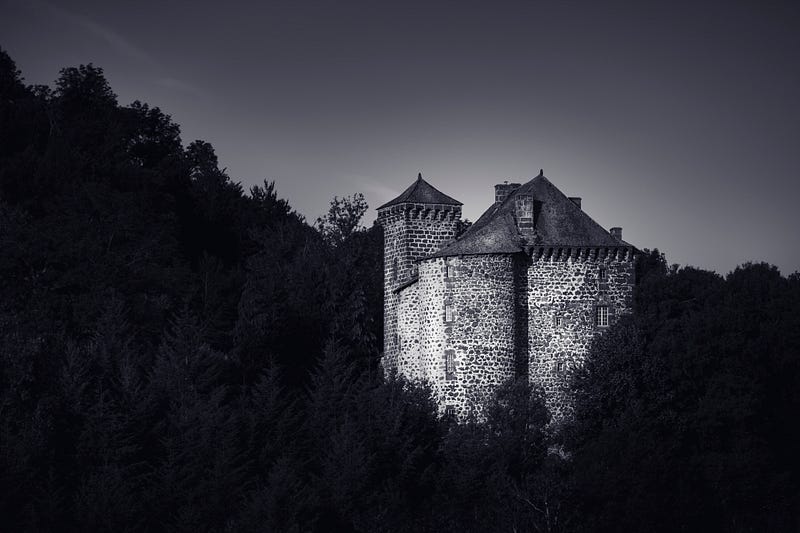
NOTE: Something weird happened today when I published this article, and a big chunk of text got lopped off. It’s been fixed now. Just letting you know in case you happened to be one of the people who read the article during the first hour of its life.
Today’s New York Times Spelling Bee letters:
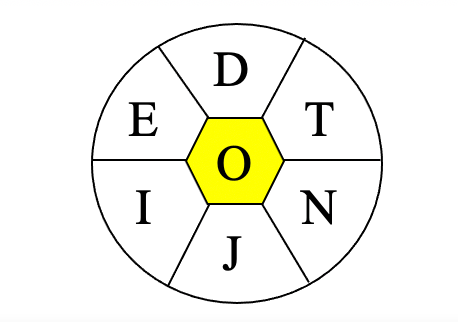
D, E, I, J, N, T, and center O (all words must include O).
Merriam-Webster says…
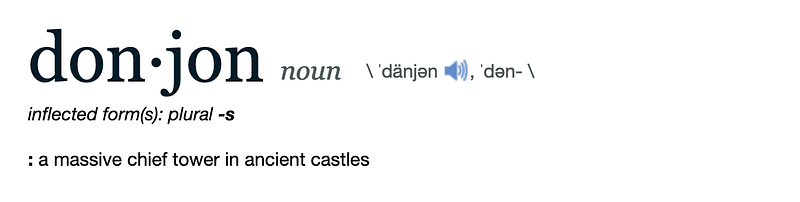
Silly little dictionary! Don’t you know donjon can’t possibly be a word if the New York Times says it ain’t?
For further fascinating facts, check out the Spelling Bee Master.
What’s your favorite dord* from today’s puzzle?
My Two Cents
Sometimes, when I play the Spelling Bee game, I enter random letter combinations just to see if, by chance, they form a word that’s actually a word. And occasionally I get lucky. One example is tony, which I previously thought of as only a name, but is also an adjective meaning “marked by an aristocratic or high-toned manner or style”.
I had no such luck with donjon. Obviously, or it wouldn’t be the title of today’s column, whose point is to discuss words that are not accepted by the editors of the Spelling Bee puzzle.
The reason donjon popped into my mind is because of the movie bearing that title (albeit with a space between don and jon). We’ll get into that a bit later, but first…
Keeping it real… fortified
Donjon comes from the Middle English donjon or dongeoun, from the French word donjon meaning “fortified keep”. Keep, in this case, referring to “the strongest and securest part of a medieval castle often used as a place of residence especially during a siege”, according to our good friends at Merriam-Webster.
In English, donjon eventually evolved into dungeon, which was the lower room in said keep, sometimes used as a prison. And today we refer to dungeons when talking about underground, dark rooms in general. Including those in sex clubs. And of course, “Dungeon” is one half of the best known and most popular tabletop role-playing game: Dungeons & Dragons.
(In French, dungeon is cachot, in case you’re wondering.)
According to a certain Robert Liddiard, an expert on castles, although not on Dungeons & Dragons, the French donjon came from the Latin dominarium (lordship), as an association between the castle keep and the castle authority, which back in the day was usually a feudal lord. This parallels the term for keep used in Spanish: torre del homenaje, or “tower of homage”.
Basically, if the castle came under attack and was conquered, the man of the house and his family would go to the keep, or donjon, to escape been pillaged and raped.
As for the rest of the poor, miserable people who worked for the castle owner? They were pillaged and raped.
See, that’s one of the many reasons living in Medieval times sucked. Big time.
Donjons evolved a bit like the houses in the Three Little Pigs story. They started out weak as can be, made of something not unlike straw, then developed into wood structures, and finally became the badass fortified stone structures we all know and love today.
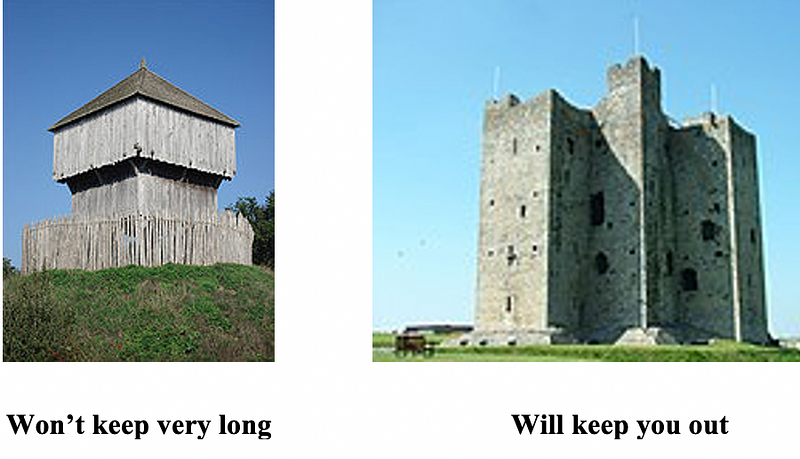
The history of the evolution and designs of donjons is long and long-winded. Which is probably why that Robert Liddiard wrote a bunch of books about castles and their keeps.
I, however, figure you’d much rather talk about porn.
A master debate
Don Jon is the title of a movie released in 2013. It was written and directed by Joseph Gordon-Levitt, his first time at the helm. This rom-dra-com (rom-com with drama added into the mix) deals with porn addiction. Specifically, the porn addiction of the main character (Jon Martello), played by Gordon-Levitt himself.
I’m not going to reveal too much about the movie, but despite its mixed reviews, I do recommend it as an interesting take on the subjct.
Now, the interesting thing is that, although the terms sex addiction and pornography addiction are bandied about on a regular basis, neither one has been classified as a clinical diagnosis by either the Diagnostic and Statistical Manual of Mental Disorders (DSM) or the International Classification of Diseases (ICD).
The only behavioral addiction currently recognized by the DMS is gambling, whose diagnostic elements have a lot in common with those of drug abuse.
Kris Taylor is a graduate teaching assistant from the School of Psychology at the University of Auckland, where he also did his Ph.D. work on pornography addiction. In his May 2019 article, “Nosology and metaphor: How pornography viewers make sense of pornography addiction”, he argued the following:
“It is worth considering whether the apparent epidemic of self-diagnosed pornography addicts seeking help today perhaps represents the ready uptake of a relatively new way to describe one’s problematic behaviour, and not the development of a modern disease entity whose description should dictate its treatment.”
Taylor seems to be saying, in other words, that patients are being diagnosed as porn addicts because they claim to be porn addicts.
The results of a survey he performed during his research indicated to him that criteria for the diagnosis of addiction appear to be implemented in many different and inconsistent ways. He also concludes that pornography addiction as a term has a fluctuating definition and ever-widening limits.
On the other hand, porn is much more readily available than it has ever been in the history of humankind, mostly thanks to Al Gore inventing the internet. And for many years now I’ve been hearing and reading about people kvetching about how porn has both set unrealistic expectations when it comes to sex and caused serious intimacy issues.
And by intimacy I don’t mean sex. I mean everything else that surrounds it when sex is not just a wham-bam-thank-you-ma’am-bye-bye-now-see-ya-later-alligator proposition.
Listen, I don’t have anything at all against porn, as long as it’s done by and with consenting adults, and nobody is being exploited in harmful or dangerous ways. And yes, I know that last part can get very very fuzzy. Just like it does with prostitution.
And I’ve always been very intellectually curious about the sex industry in general, be it magazines, movies, hookers, fetishes, sex clubs, etc., etc., etc. That’s probably why I enjoy reading stories by William (Dollar Bill) Mersey and Demeter deLune, among others here on Medium.
Still, there is the old mantra of “everything in excess can be harmful”. Maybe there is something to that. Some people may feel porn is getting in the way of their relationships. Others may think that their relationships keep interrupting their porn habit.
Whatever floats your boat, I say. Just be honest. It’s the best way to own up to who you are and not hurt other people in the process.
In the words of that great 20th-century philosopher, Clint Eastwood:
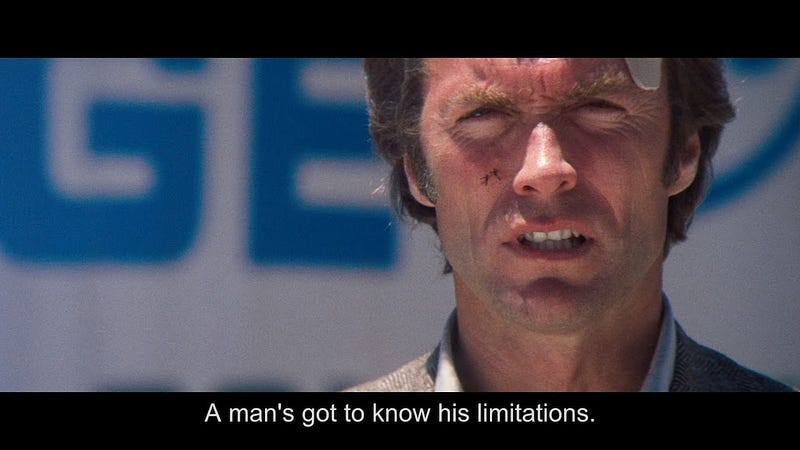
And that includes jacking off, wanking, spanking the monkey, flying solo… or whatever else you want to call it.
In any case, whether you want to talk about old castles or modern sex dungeons, don’t use the word donjon. Because the editors of the Spelling Bee puzzle decided that donjon is a dord.*
You can check out my previous entry on another dord* here:
*What the heck is a dord, you ask? Here’s the answer: