
Thunderdome
Dolores Umbridge Was the Best Teacher Harry Potter Ever Had
Hear me out
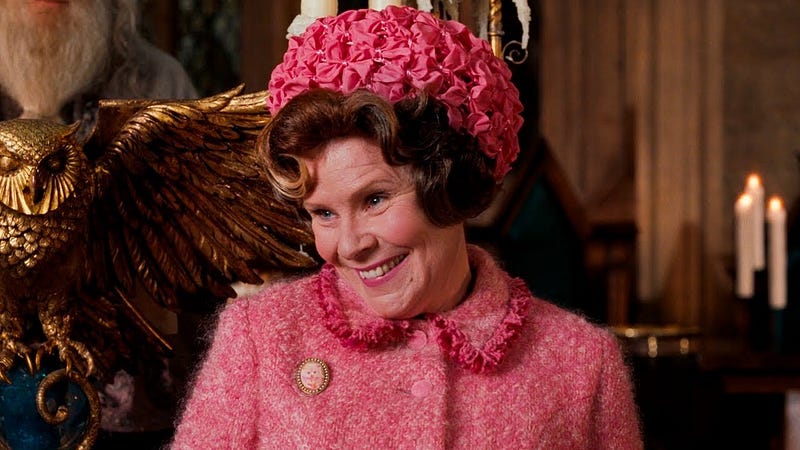
Thunderdome is a FanFare series where our writers good-naturedly debate some matter of pop culture and then leave it to the readers to decide. Read each post and vote at the bottom!When this Thunderdome topic was selected, I chose Dolores Umbridge as Hogwarts’ best professor. Mostly as a joke.
However, I’m a firm believer in no take-backsies.
I was on the debate team in secondary school, and sometimes we’d have to defend some hopeless argument like “gay people shouldn’t get married.” Before you ask, I went to a Catholic school so yes, that was an actual argument my queer ass had to defend.
The choice of Umbridge felt like that, and as I mulled it over, I thought, “How in the world am I going to swing this one?” If politics has taught us anything, it’s that it doesn’t matter whether you’re right as long as you’re able to sell your point.
Here goes.
Dolores Umbridge was the best teacher at Hogwarts. She wasn’t dead last, at the very least. This isn’t a high bar to achieve at Hogwarts as we’ll see.
This is not a competition for the ‘best person.’ God himself couldn’t prove this about Umbridge.
The argument presented here will revolve around Umbridge’s portrayal in the Order of the Phoenix movie. It’s been almost a decade since I last revisited the books.
To be fair, I could’ve reread the fifth book — I had time — but I find it helpful to separate adaptations from their source material. Chances are it’s a craptastic adaptation if it isn’t self-contained. And barring obvious creative liberties, I don’t believe that’s the case for the Harry Potter franchise.
Harry Potter and the Prevailing Perspective Problem
The entire Harry Potter series has a perspective problem that carries over into the film adaptations.
The audience knows and sees only what Harry does. Mostly, this is fine and adds to the suspense and intrigue of the movies. But presenting information from Harry’s perspective has some downsides, too.
Harry Potter’s perception of those around him is often black and white. I mean, he’s a kid. This tendency leads to frequent cases of misdirection in the movies and some reductive opinions. All of Slytherin is evil. Snape is the spawn of the devil. Malfoy is both evil and dimwitted. Dumbledore can do no wrong. Then, Snape is good.
Harry Potter is Mr. Wishy-Washy, and he flippity-flops his way through the films, making wrong assumptions and terrible decisions based on those assumptions.
This flaw is most apparent in the Order of the Phoenix. It’s why it’s my favourite and why, maybe for the first time, so many readers take issue with Harry’s perspective. God, Harry is so annoying. He’s so snippy with everyone. While I disagree with the idea that Harry Potter is annoying in the Order of the Phoenix (trauma, anyone?), the movie exposes something that I realized from the very first instalment: Harry Potter’s perspective cannot be trusted.
It is from this realization that I make my case for Dolores Umbridge.
On the Merit of Theory Versus Practicality
Harry’s first classroom interaction with Umbridge in the movie ends with detention, after a heated argument with the professor.
The scenario was an odd one because, depending on your vantage point, both Harry and Umbridge were right.
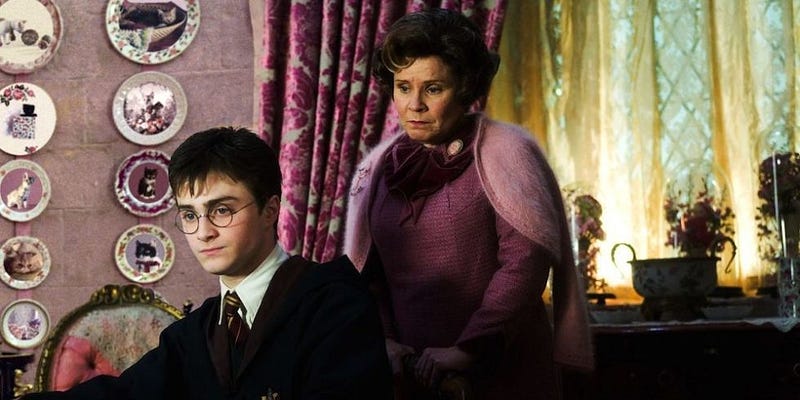
Harry believes the students should learn to defend themselves after his harrowing encounter with Voldemort. Umbridge, operating from the information fed to her by the Ministry of Magic, believes they should focus on theoretical frameworks.
Think about this (I mean, really think about it). What do the students know about Defence Against the Dark Arts up to this point? Eliminate Harry because he had an extraordinary experience and had to learn a lot of advanced spells to prepare for the Triwizard Tournament. But the others?
The teaching position is cursed, so they’ve never had a long-term professor. Their education in this department is sporadic.
Two of their four professors were servants of Voldemort, one was a woefully incompetent fraud, and the other, while a good professor, was a werewolf who was absent for a stretch every month.
They know nothing.
They have no stable foundation in the subject at hand. Harry’s suggestion that they jump to advance spells is comical. Do you want to build a spaceship? Maybe let’s start with Math I.
Umbridge receives a lot of flack for this decision, but her curriculum represented the first introduction of order and structure amidst the chaos of the students’ Defence Against the Dark Arts instruction. It was a directive to try training wheels before signing up for the Tour de France. Not unreasonable.
Dictatorial Decrees or Simple School Rules?
When Umbridge becomes Inquisitor, she posts a bounty of educational decrees at Hogwarts. Most people hate her for it.
While these decrees grow more erratic with each new one posted, the vast majority are just plain old school rules.
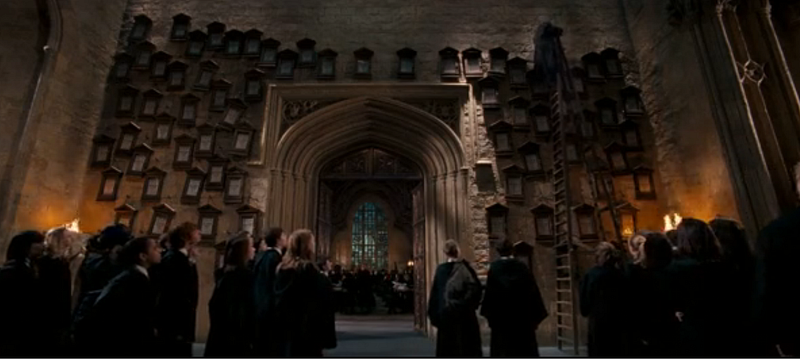
Educational Decree №1: Any student found in possession of a spellcheck charmed quill will be severely punished.
You can’t cheat in school. Go figure.
Educational Decree №24: No music is to be played during study hours.
Correct me if I’m wrong, but we see no evidence of personal music players and headphones at Hogwarts — electronic devices don’t work there. So any music played aloud would serve as a distraction for other students during study time.
Education Decree №25: Broomsticks may not be flown on school grounds unless during authorized Quidditch practice.
I imagine this is a safety issue. Unsupervised children flying hundreds of feet in the air can and will lead to disasters.
Educational Decree №29: Extracurricular activities are subject to review by the High Inquisitor.
They paint this rule as dictatorial in the movie but it is standard practice in most educational institutions. I’m at university and the decision to form a club or student organization is subject to review and approval. Presumably, everything that occurs on school grounds is a potential liability for the administration.
Educational Decree №39: Wands to be confiscated from students casting recreational spells. All magical objects to be held by High Inquisitor until further notice.
Glorious things always happen when students do recreational magic without supervision at Hogwarts. I still have nightmares about cat Hermione.
Educational Decree №45: Proper dress and decorum is to be maintained at all times.
It’s a school.
Educational Decree №74: All pets other than owls are confined to house common rooms and dormitories.
Again, it’s a school.
Educational Decree №99: Students are not permitted to change their hair colour, eye colour, shoe size or any other physical abnormality using magic.
I’m assuming this is linked to an earlier rule about recreational magic — an elucidation to cover Metamorphmagi or the use of the Polyjuice potion.
Educational Decree №109: Students performing prohibited incantations will be subject to severe punishment under Section 28.
More of the same.
Some of the educational decrees are stupid, puritanical and sometimes bloodist — including rules about the permitted distance between girls and boys, banned books and even prohibited sweets.
At their core, though, they represent a decided attempt to establish something that Hogwarts has never known in Harry’s four years of attending there: order. He hates it. And because Harry hates the rules and Umbridge, so do we.
In Defence of Dolores Umbridge
The bar for Hogwarts faculty is subterranean.
Staff at the magical school are way too comfortable placing students in harm’s way. Yet Umbridge receives the bulk of the blame for her Draconian punishment methods.
If I may be the devil’s advocate: how are her methods any worse than other faculty actions at Hogwarts? Given that they didn’t result in near-death experiences, we can make an argument that they’re better. Let’s take a trip down memory lane, shall we?
McGonagall punished Harry, Ron and Draco with detention. They had to enter the Forbidden Forest at night to retrieve a unicorn’s dead body. This detention resulted in Voldemort attacking Harry Potter.
Snape relentlessly bullied Neville Longbottom and terrified him so much that a boggart took his form. He also showed preferential treatment for Slytherin house and routinely docked points from Gryffindor at random because of his distaste for Harry. That’s not to mention the fact that he allowed the Cruciatus curse to be performed on students while serving as headmaster.
Lockhart erased Harry’s bones and attempted to wipe both his and Ron’s memories. Hagrid allowed students to work with many dangerous creatures — lovable guy, terrible professor. Sprout allowed second-year students to work with deadly mandrakes. Quirrell and Crouch tried to kill Harry.
And don’t even get me started on Dumbledore who couldn’t see a death-eater roaming the castle halls — despite having the wherewithal to award house points for events he didn’t witness. Cedric’s death was preventable.
I feel like I’ve made my point. Nothing Umbridge did while serving as a Hogwarts professor overtakes what any of the other faculty have done.
I know there’s going to be one person who’ll say, “Well, Umbridge sent a dementor after Harry.” And yeah, I can’t defend that.
Was she his professor at the time, though?
Umbridge’s actions are level with those of other professors.
The different treatment boils down to the age-old philosophical argument of intent versus impact.
We judge everyone besides Umbridge on a utilitarian basis. The ends justify the means. A benevolent result excuses all the horrible actions they’ve undertaken, regardless of their short-term consequences. Perfect example, Severus Snape. Another archetype, Albus Dumbledore.
In contrast, our approach to analyzing Umbridge is decidedly deontological. The consequences of the actions matter just as much as the intent; actions are universally good or bad. Even if those acts caused less harm, you are the devil if they’re committed with malicious intent.
I won’t go into deep detail about my opinion on either ethical framework but to summarize my thoughts on the analysis of Umbridge compared to other characters who have done equally bad or worse things: bullshit.
Unorthodox Learning and the Solidification of a Hero
The discussion of education is not as simple as good and bad. Outstanding student, terrible student. Good teacher, poor teacher. Learning is more complex than that.
Every experience in school is an opportunity for learning and development and shapes us in ways that we don’t grasp until much later.
Umbridge’s tenure as a professor supported Harry Potter’s development as a protagonist whether he appreciated or acknowledged her impact.
The best lessons are taught outside of the classroom.
The Order of the Phoenix is the film where Harry becomes himself — that’s a weird turn of phrase, I know. He goes from being the unwilling hero to fully embracing that role. He solidifies elements of his character that we the audience witnessed fleetingly in the past films: leadership, courage and rebellion.
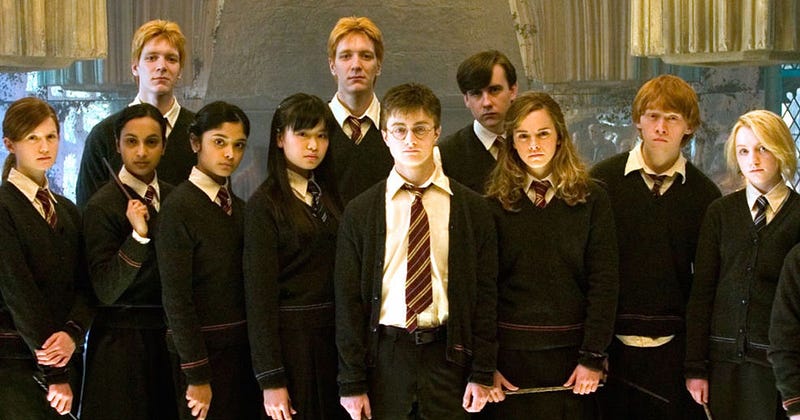
He forms Dumbledore’s Army and begins teaching his fellow students advanced spells in secret. Some may object and say this happened despite Umbridge rather than because of her.
I disagree. There’s little evidence that Harry would have formed this group without Umbridge’s commanding presence. It’s also ironic that in running from the rigid order imposed by Umbridge, Harry and his friends form a tight-knit student group replete with promises of secrecy, rules (with painful consequences for breaking them) and internal organization — which, just to reiterate, he “hates.”
Every educational interaction shapes our personalities and characters and I’m sorry, like it or not, Umbridge’s stint at Hogwarts shaped Harry Potter for the better.
Finite Incantatem
I chose Dolores Umbridge as Harry Potter’s best teacher because, unlike most of the Harry Potter fandom, I don’t hate her.
Several fans imply she’s more sinister than Voldemort. A stronger antagonist, undoubtedly. More evil? No!
I don’t think she’s a good person, but she’s not as bad as the image of her that’s burned into our memory. Umbridge is filtered through Harry’s flawed perspective, and this has implications for our mental rendering of the character.
Her insistence on establishing a theoretical framework for Defence Against the Dark Arts and many of her educational decrees are agreeable.
Compared to the actions of other Hogwarts faculty, she’s also managed not to kill any of the students under her care. Furthermore, her distinct impact on Harry’s character development and the subsequent events of the fifth movie — including the formation of Dumbledore’s Army — left a lasting impact on the rest of the series.
So yes, she was the best teacher Harry Potter ever had. Although, given the quality of Hogwarts’ faculty, this isn’t exactly high praise.
What say you?
Based only on the arguments presented (you have read all of them, haven’t you?) and not on personal preference: who wins this bout? Voting closes on July 29 at 7:59 AM.The other entries:


