
Does Protein Damage Our Kidneys? Science Explains.
Kidney disease patients must restrict protein intake but does protein cause kidney disease?
There are many worries of consuming a high-protein diet despite being frequently advocated for muscle and metabolic health. Kidney disease is undoubtedly one of the concerns. This story will discuss the role of protein in kidney disease by:
- Briefly introducing the versatility of kidney.
- Explaining the Chronic Kidney Disease (CKD).
- Finding the evidence (if any) that points the high-protein diet towards CKD.
Lastly, I will be giving you a few take-home messages.
Kidney as a versatile organ
- Kidney’s primary role is to ‘filter’ the blood. Blood flows through the kidney at high pressure, and the ‘filters’ inside the kidney selectively remove waste and retain other important molecules to maintain the right blood chemistry for life.
- The kidney also regulates water balance, indirectly regulate blood pressure.
- Interestingly, human has two kidneys, but we can live with just one functional kidney without measurable differences in overall wellbeing between healthy kidney donors living with a single kidney and healthy individuals living with two kidneys [1]. This shows how much versatile one kidney can be.
Chronic Kidney Disease
The kidney disease I would like to discuss in particular is the Chronic Kidney Disease (CKD), characterised by the inability to filter our blood efficiently. One of the symptoms is the presence of microalbumin (a type of protein commonly found in the blood) in the urine. In a healthy person, microalbumin cannot pass through the kidney’s filtration membrane, hence microalbumin stays in the bloodstream. In other words, CKD patients have a ‘leaky kidney’. The late stage of CKD requires dialysis or a kidney transplant.
CKD is an irreversible disease as kidney cells are among one of the few cell types in our body that has minimal capacity to regenerate. However, current scientific advancement is looking for a way to regenerate kidney cells [2]. Presently, more than 50% of CKD patients in the US have high blood pressure, whereas more than 30% of diabetic patients develop CKD [3]. Irrespective of the cause, the disease progression eventually scars blood capillaries and filtration membranes in the kidney [3].
Scarred tissue cannot be fully regenerated, just like the scar on your skin, it is no longer a real skin cell. A scar has no function other than to cover the wound physically [4].

Like other non-communicable diseases, there is an association between diet and CKD, either direct or indirect (through the development of high blood pressure and diabetes). Doctors typically advise CKD patients to have a low-protein diet due to their inability to filter the waste compounds from amino acid (protein) metabolism. Consequently, some people assume that a high-protein diet must be bad for kidney, and the common saying is,
“A high-protein diet increases the kidney filtration rate and put a heavy tax onto the kidney”.
A plausible thought, but what is science’s verdict?
What is the role of dietary protein in CKD?
Low-protein diet slows the disease progression among CKD patients
For those who are suffering from CKD, a low-protein diet (less than 0.8g protein per kg body weight) can reduce the risk of kidney failure by 41% and end-stage renal disease by 36% [5]. Moreover, the greater the protein-restriction, the greater the benefit. This evidence is compelling and clear cut simply because this study reviews a total of 2492 patients, in addition to the high percentage reduction in risk.
As with many nutritional sciences, how best to translate to clinic practice is of question.
Reducing protein has to be accompanied by an increase in either carbohydrate or fat. Since many CKD patients are also diabetic and hypertensive, how best to substitute protein for carbohydrate or fat is still a matter of question. A good salad is probably an option, but CKD patients are going to fall short of calories in the long-term.

The relationship between protein and the risk of acquiring CKD
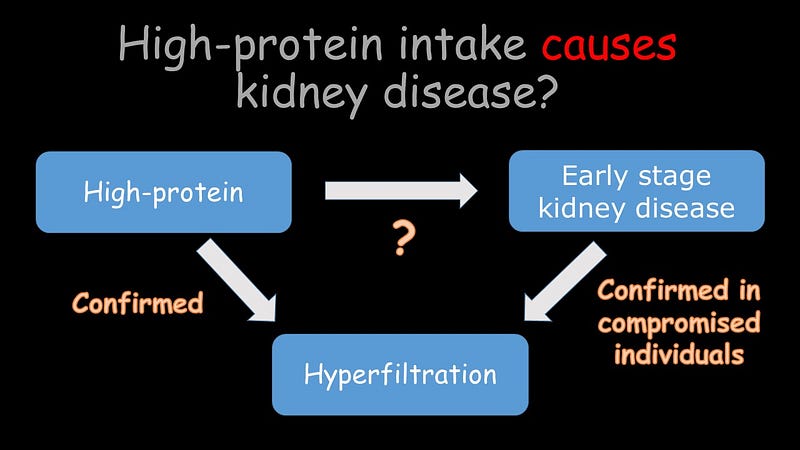
Fact 1: High-protein diet causes hyperfiltration, but this is an adaptive response
Hyperfiltration means an increase in the kidney filtration rate. There was a tightly-controlled nutrition study which required participants to consume all foods prepared by the laboratory for 6 weeks and concluded that a high-protein diet leads to hyperfiltration [6]. Hyperfiltration is an adaptive response to a high-protein diet, as well as an adaptive response during pregnancy and those living with one kidney [7, 1], to filter excess waste compounds.
The same hyperfiltration is also a sign of the early stage of kidney disease in diabetic and obese individuals [8]. The damaged of some filtration units in the kidney increases the workload of other functional filtration units in order to maintain healthy blood chemistry [7].
Since hyperfiltration is both an adaptive response and a consequence of early-stage kidney disease in compromised individuals, it is very hard to pinpoint hyperfiltration as a result of consuming a high-protein diet in otherwise healthy individuals can cause kidney disease.
Fact 2: Animal protein, animal fat and sodium intake associates with ‘leaky kidney’.
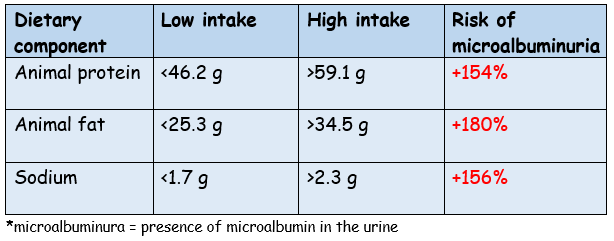
It is more likely the Standard American Diet rather than high-protein per se that is associated with CKD. A group of researchers from Massachusetts followed 3348 women for a period of 14 years and found women who consumed more animal protein, animal fat and sodium in a day were more likely to have ‘leaky kidney’, confirming the early stage of kidney disease [9]. This study did not find an increased risk with total protein intake (when including plant protein).
According to Google Scholar, this study has been referenced by at least 135 other scientific papers. It is arguably one of the most commonly cited articles to support the role of animal protein in the development of kidney disease in a healthy person.

Fact 3: Athletes usually do not manifest kidney disease with a high-protein intake
If a high-protein is truly harmful to kidney health, the population who is most susceptible to this adverse effect is athletes, who commonly consume at least 2 g protein per kg of their body weight [10]. This amount is 150% higher than the recommendation for an average healthy person (0.8 g protein per kg of body weight).
Prof Kevin Tipton spoke in the 2010 British Nutrition Society Conference,
“The current evidence suggests no relationship between high-protein intake with kidney disease in athletes.” [10]
Certainly, athletes are highly active individuals and there is a lack of studies in measuring how exercise might have boost (if any) kidney function. Today, 10 years later, there is little advancement in this understanding.

Take-home messages
- The saying that a high-protein diet increases the workload of the kidney is true but is not sufficient to cause kidney disease among healthy individuals. Evidently, those who live with one kidney can be as healthy as those who live with two kidneys, despite their one kidney is working very hard to maintain healthy blood chemistry.
- The amount of protein consumed by an average American (approximately 100 g a day) is unlikely to cause CKD. Since high animal protein, high animal fat and high sodium are related to ‘leaky kidney’, we should probably worry where we source our protein from.
- Switching from animal to plant protein appeared to be protective of kidney disease among healthy individuals. The beneficial effect is unlikely to be directly associated with the protein per se. This beneficial effect of this switch is likely to be associated with the contribution of other protective factors of a plant-based diet. Dietary fiber and phytochemicals from a plant-based diet help to maintain healthy blood pressure and blood glucose, both of which are important predictors of kidney disease.
- Don’t worry too much about protein per se, you can never go wrong by having a mixture of lean unprocessed animal protein and plant protein. Be mindful where you get your protein from:
Thanks for reading.



