
Do You Write Top-Down or Bottom-Up?
Two strategies how you can write your stories
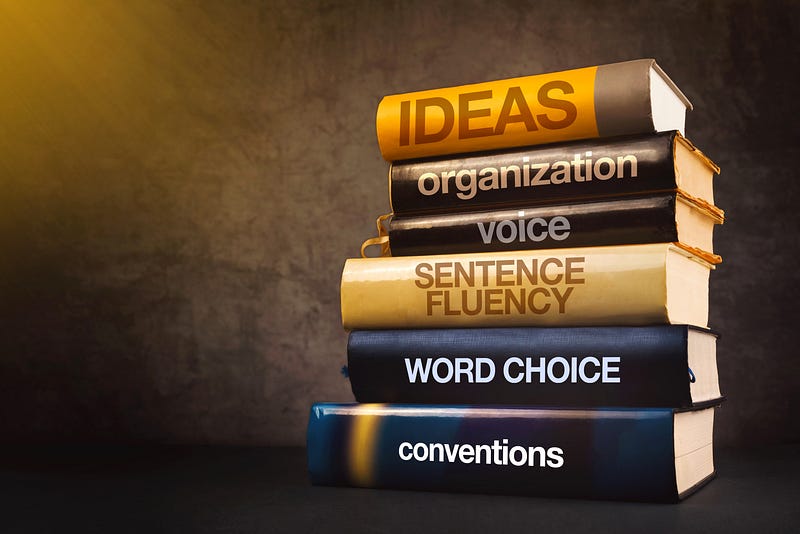
Did you know that when you write stories you unconsciously use certain text production directions and thus heuristic methodologies? This is because of whether you are starting to write from an idea or reading text.
Because many people think that writing just happens that way: intuitively, just get started, without much organization. But that is only the half truth. Writing does not always come out of intuition, but is also used purposefully and consciously.
The two terms top-down and bottom-up are usually terms that mainly describe two opposite directions of action in economic, political, software-technical or psychological contexts.
The Germanist Sylvie Molitor-Lübbert, however, uses these terms and places them in the context of the writing process in her work, which allows the respective writing process to be described very precisely. Here, too, she calls these directions of action “top-down” or “bottom-up”. But what exactly is behind it and how can you use these writing strategies for your texts?
Writing Processes Change the Way We Deal with Knowledge
The Germanist Sylvie Molitor-Lübbert (SML) examines in her work “Scientific text production under electronic conditions. A Heuristic Model of Cognitive Requirements ”from 1997 describes the relationship between the writer and the medium and distinguishes between two writing-process directions that can be used separately or in a cycle. Above all, she refers to the special influence of the media, which brings about heuristic approaches in the combination of reading and writing, which obviously changes the way knowledge is dealt with.
Here, personal experience of prior knowledge and logical analysis skills and a “mental representation” play a special role. Because every writer will go through both strategies, whether top-down or bottom-up, over and over again during the text production, sometimes even in several passes one after the other. But every time a new and, above all, individual creative result is created.
The question is how exactly the two directions of text production run and to what extent the results of the two directions of action differ. SML explains:
“From a cognitive point of view, the production of scientific texts can be viewed as overlapping or alternating cycles of knowledge acquisition, knowledge production and knowledge communication […].”
Here, SML recognizes four cognitive process groups that arise during the two directions of action:
1. Planning processes: Idea or project as a selection and structuring process, for example a mind map or a keyword list
2. Production processes: the actual materialization as notes, graphics, text
3. Reception processes: either “accompanying controlling reading” or “independent text production in phases of knowledge acquisition”
4. Evaluation processes: the final control of actions as an editing, proofreading and evaluation process
These four cognitive processes are visible in both the top-down and the bottom-up strategy. Due to the constant flow of information, the mental representation (whether cognitive, emotional or motivational) is constantly being renewed.

Top-Down Strategy: the Materialization of Thought
The top-down strategy is the most noticeable variant when writing. In this strategy, we go through the structure from top to bottom.
As an author, we first have the need to produce a text. Our intention or idea behind it forms the starting point of the top-down writing process. The ideas come from everywhere: whether in the shower, while shopping or just before going to bed.
Once the idea becomes clear, we start structuring and planning the text. We take notes, lists, keywords or a mind map and plan for whom or what and in what time we want to write the text.
After this preparation we start with the actual text production. At the same time, we are supported by the reception process by researching helpful references and suitable reading texts and making sure that our idea can be well supported by the reading texts. In turn, new ideas can arise, which in turn are initiated by further reading texts. In this phase we are often very text-laden and are only familiar with the content in sections when we write.
As soon as we have roughly completed our text for the first time, the last writing process, the so-called evaluation process, begins. This is the editing and proofreading phase. Here we check our text for grammatical, orthographic and formal errors and evaluate whether our initial intention is reflected as a red thread in the text. Errors in content are also noticed and corrected.
Mental representation of the top-down strategy
The real exciting question here is the mental representation, that’s what SML calls the process while writing. So what is the point of writing here? — In order to actually store newly learned knowledge and to consolidate the development of new knowledge structures. The influence of the medium has a controlling effect here, by making references and to confirm or reject the thesis during the writing cycle.
The aim of the top-down strategy
The aim is to concretize a thought or an idea as a text that is relevant, reader-friendly and, above all, true to the facts and to fix it in the media. A text structure is created even before writing. So the writing direction is from the thought to the word and thus to the text.

Bottom-up: the Dematerialization of the Word
The bottom-up strategy is actually the reverse of the top-down process. Because with the bottom-up strategy, the starting point is a text, a study or a literary source. In contrast to the top-down strategy, with the bottom-up strategy we start from the bottom up.
That means we start with the evaluation process. Here it is first decided what kind of media source can be relevant for the result. An evaluation is already taking place, as we decide at the beginning which sources, whether through news, documentaries or literature, have added value for us and for the reader.
These text sections or sources are then repeatedly analyzed and compared with reference during the actual text production. In the planning process, they result as a non-textual conclusion, which creates a new perspective on the topic.
Mental representation of the bottom-up strategy
The exciting question of mental representation is deliberately based on the influence of the media. The intensity, effectiveness and originality of information are of great interest to us as authors. Based on this, says SML, the media sources can be forgotten, distorted or subconsciously developed further during the writing process, so that a new flow of thoughts always emerges. The reading intention is decisive here because with the bottom-down strategy we combine the information we have collected with our existing prior knowledge and create new directions of thought.
This can be followed by a further run in the top-down process. Especially to start an evaluation process for editing and proofreading.
The bottom-down strategy therefore does not serve to consolidate knowledge, but rather to develop new, creative approaches to solutions or ideas from the knowledge. The ability to analyze text breaks up the faithfulness to the text and raises new, often non-textual and creative questions that lead to further interesting trains of thought and ideas.
Aim of the bottom-up strategy
This strategy is used to analyze information from media sources and to combine and reflect with existing knowledge in order to produce new thoughts and directions. The text structure only emerges while you are writing. The reading reception consequently leads to the idea. So the writing direction is from the text, the word, to the thought.
Conclusion
Both strategies serve to produce a text and open up different processing of knowledge and mental processes, which have different functions and goals depending on the initial situation. They can be used together in a production process or strategically separated. Both together form a cycle that analyzes and highlights the process of writing particularly well. Passing through them separately, they result in different text products.
So the next time you plan to “produce” a new text or thought, you will become aware of the strategy behind it. As a result, you can also better respond to the requirements of the text and your trains of thought. So next time you are more aware of the process of writing and what’s going on during that time.
Cover Photo: Six Traits of Effective Writing/ Bits and Splits — stock.adobe.com
Other Images:
- Businessman working on worktable with computer laptop and notepad/ hakinmhan — stock.adobe.com
- Crop close up of male student make notes handwrite in notebook study online on computer from home/ fizkes — stock.adobe.com


