avatarPervin Shaikh

Free AI web copilot to create summaries, insights and extended knowledge, download it at here

3442

Abstract

consulting firms, Richard climbed the corporate ladder with a focused drive and an unwavering commitment to excellence. He joined as a Junior Analyst and worked his way up to Principal.</p><p id="b350">However, Richard felt emotionally and physically drained beneath the surface of his seemingly perfect career. He’d recovered well after getting Covid just before Christmas. Still, the relentless pace of meetings, emails, and deadlines had become a cycle of busyness, leaving him feeling even more drained than usual, especially after a long day in the office.</p><p id="f835">Richard realised he had fallen into the trap of being busy for the sake of being busy. This realisation came sharply into focus one evening as he sat alone in his office long after his colleagues had left.</p><p id="84c4">Richard remembered reading an article by Pervin Shaikh about productivity that challenged the norm of working harder. Instead, it proposed doing less, which could lead to achieving more. This concept resonated with Richard, who had reached a point where the endless busyness treadmill was no longer appealing.</p><p id="9f31">Richard wanted to change his status quo and reclaim his time and energy by swiftly changing his work schedule. He started with a time audit and tracked how he spent each hour of his day. This eye-opening exercise revealed how much time was wasted on unproductive tasks and distractions.</p><div id="9005" class="link-block"> <a href="https://readmedium.com/three-ways-that-10-minutes-of-daily-meditation-can-make-you-creative-bc22d2ad6a14"> <div> <div> <h2>Three Ways That 10 Minutes Of Daily Meditation Can Make You Creative</h2> <div><h3>Are you one of those who hit the road running when you wake up? If you are, hold your horses.</h3></div> <div><p>medium.com</p></div> </div> <div> <div style="background-image: url(https://miro.readmedium.com/v2/resize:fit:320/1*3cc8xNF3JOL4vDUlemIy_A.png)"></div> </div> </div> </a> </div><p id="acdc">Richard decided to prioritise his tasks and focus on those that moved the needle towards his and the firm’s goals. He embraced the ‘work smarter, not harder’ mantra, delegating tasks that didn’t require his direct involvement and setting specific times for checking emails and attending meetings. This approach allowed him to focus on strategic planning and decision-making, where he could make the most significant impact.</p><p id="8e5c">Richard also applied the 85% rule, pacing himself like a marathon runner. He realised that operating at total capacity all the time was unsustainable and counterproductive. By allowing himself to work optimally, he found that he could maintain a consistent performance without risking burnout.</p><p id="a938">The changes Richard made had a profound effect not only on his work life but also on his well-being. He no longer felt guilty for taking regular breaks, understanding that these moments of rest were crucial for maintaining his productivity and creativity.</p><p id="791b">Richard noticed a shift in the office culture as he implemented these changes. His team, inspired by his example, began to adopt similar practices, leading to improved efficiency and a more positive work environment. The firm’s performance improved, and Alex’s approach to manag

Options

ement was recognised as a model for sustainable success.</p><p id="54f9">Ultimately, Richard’s willingness and courage to challenge the status quo led to doing less of what drained him and more of what truly mattered. He also found a better work/life balance and enjoyed a renewed sense of energy and passion for his career.</p><p id="9fe1"><b>Parting Comments</b></p><p id="2588">Make time work for you instead of running after it. It pays to add more buffer time to your work schedule so you’re not spinning multiple ‘plates simultaneously. I know many people who do, and they feel guilty for not taking regular breaks.</p><p id="73a6">The 85% rule encourages you to reevaluate your approach to tasks and goals and promotes a sustainable and balanced way of working and living. It also allows you to have reserve energy as a backup if you need to dip into the reserve.</p><p id="0e67">Remember, the onus is on you because no one will figure this out. Only you know yourself better than anyone else. However, striking a better work/life balance pays handsome rewards in the short and long term.</p><p id="9f72">It also means you have enough energy and brain space to think about the next steps and strategically position the intelligent way. Indeed, that’s a win/win.</p><p id="c753">Thank you for your attention.</p><p id="c9d1">Follow me for more valuable tips.</p><p id="ab10">Pervin</p><p id="3244">linktr.ee/AimHighLtd</p><div id="ac4e" class="link-block"> <a href="https://readmedium.com/three-ways-resilience-helps-deal-with-workplace-stress-bbda453da79e"> <div> <div> <h2>Three Ways Resilience Helps Deal With Workplace Stress</h2> <div><h3>The workplace has a lot of stress, especially with all the changes. No wonder people are feeling the heat under the…</h3></div> <div><p>medium.com</p></div> </div> <div> <div style="background-image: url(https://miro.readmedium.com/v2/resize:fit:320/1*pmQcq97UpfR4BcNrig7LFg.png)"></div> </div> </div> </a> </div><div id="f09f" class="link-block"> <a href="https://readmedium.com/master-the-power-of-resilience-0fd560f932fc"> <div> <div> <h2>Master The Power Of Resilience</h2> <div><h3>Resilience isn’t about enduring difficulties and suffering. It’s about being imaginative when it comes to learning…</h3></div> <div><p>medium.com</p></div> </div> <div> <div style="background-image: url(https://miro.readmedium.com/v2/resize:fit:320/1*74EzzmxJ2YpIi08JpXQXxg.png)"></div> </div> </div> </a> </div><div id="8689" class="link-block"> <a href="https://readmedium.com/stuck-try-these-four-things-to-shift-gears-d57f69e8367e"> <div> <div> <h2>Stuck? Try These Four Things To Shift Gears</h2> <div><h3>Suppose a career curveball hits you unexpectedly one day. Do you…</h3></div> <div><p>medium.com</p></div> </div> <div> <div style="background-image: url(https://miro.readmedium.com/v2/resize:fit:320/1*xq35jwtlb-voNsILq0BnXw.png)"></div> </div> </div> </a> </div></article></body>

Do You Want To Be More Productive? Then Do Less
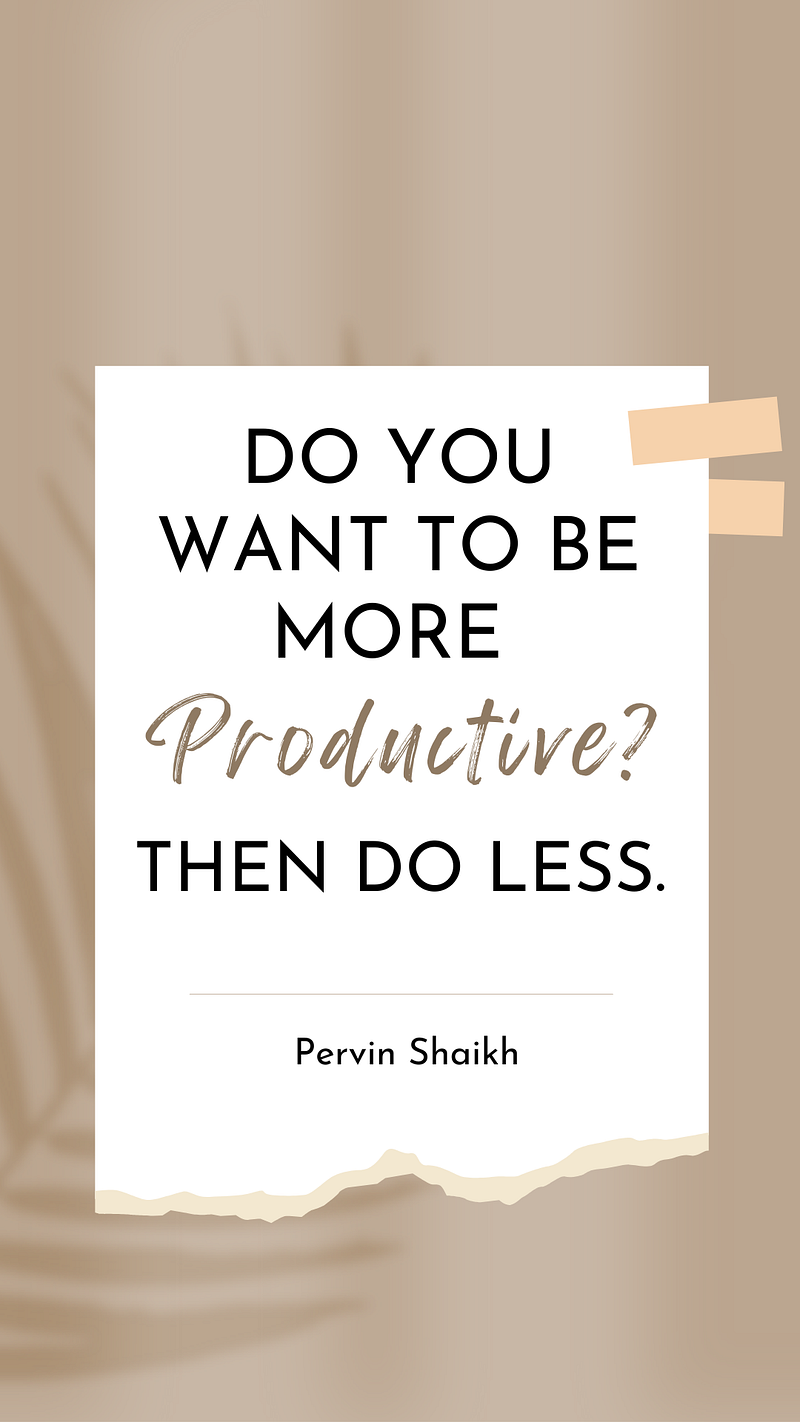
Yes, you’ve read right, do less. Why? You can get more of the right things done instead of working on things that keep you busy.

Busy for the Sake of Being Busy

Busyness Sucks. Do you know where your time goes each day? Doing a Time audit is a great way to understand what you spend your time on and how. When you know what consumes your time, self-awareness equips you to make the necessary changes. For example, if you’re not careful, it’s easy to pick up your phone or tablet while away for a few hours.
That’s not to say don’t enjoy yourself or deprive yourself, but if you’re trying to achieve great goals and accomplish tasks, be mindful of where your attention goes. It’s easy to waste time on activities that could zap your energy and time. If you set specific times for activities during your day, you will have better control over your time.
Work Smarter

We’ve all heard the ‘Work smarter, not harder’ mantra. Now, you’d think most people would get that being busy for the sake of being busy isn’t conducive to better returns. You’d be surprised how many don’t. I call these guys’ firefighters’ because they run from one ‘fire’ to another.

As an Executive Coach, you must watch out for what makes you busy. Are you working on goals that move you forward or projects that keep you busy most days of the week?
Apply The 85% Rule

Athletes know the secret formula, which is the 85% rule. What does this mean? It means paving yourself like a marathon runner. They’ve identified 85% effort as the ‘sweet spot’ — the optimal level. This level of effort provides room for growth, consistency, and longevity in their athletic journey.

Operating at 85% effort allows athletes to balance pushing their limits and preserving their physical and mental reserves. It respects the need to recover and adapt whilst sustaining a quest for success. Subsequently, athletes avoid the pitfalls of overtraining, injury, and burnout.

The Employee

You might say that applies to an athlete, but how does this play out in the workplace? It’s not about juggling multiple tasks but choosing your effort levels based on importance. It’s about reaching the finish line and consistently moving forward with resilience and wisdom. This way, we can sustain ourselves without the risk of burnout, which is real if no checks are in place.

Imagine the Following

Richard Thompson stood looking out of the glass windows of his office, which overlooked St Paul’s Cathedral in the City of London. As a successful manager at one of the most prestigious consulting firms, Richard climbed the corporate ladder with a focused drive and an unwavering commitment to excellence. He joined as a Junior Analyst and worked his way up to Principal.

However, Richard felt emotionally and physically drained beneath the surface of his seemingly perfect career. He’d recovered well after getting Covid just before Christmas. Still, the relentless pace of meetings, emails, and deadlines had become a cycle of busyness, leaving him feeling even more drained than usual, especially after a long day in the office.

Richard realised he had fallen into the trap of being busy for the sake of being busy. This realisation came sharply into focus one evening as he sat alone in his office long after his colleagues had left.

Richard remembered reading an article by Pervin Shaikh about productivity that challenged the norm of working harder. Instead, it proposed doing less, which could lead to achieving more. This concept resonated with Richard, who had reached a point where the endless busyness treadmill was no longer appealing.

Richard wanted to change his status quo and reclaim his time and energy by swiftly changing his work schedule. He started with a time audit and tracked how he spent each hour of his day. This eye-opening exercise revealed how much time was wasted on unproductive tasks and distractions.

Richard decided to prioritise his tasks and focus on those that moved the needle towards his and the firm’s goals. He embraced the ‘work smarter, not harder’ mantra, delegating tasks that didn’t require his direct involvement and setting specific times for checking emails and attending meetings. This approach allowed him to focus on strategic planning and decision-making, where he could make the most significant impact.

Richard also applied the 85% rule, pacing himself like a marathon runner. He realised that operating at total capacity all the time was unsustainable and counterproductive. By allowing himself to work optimally, he found that he could maintain a consistent performance without risking burnout.

The changes Richard made had a profound effect not only on his work life but also on his well-being. He no longer felt guilty for taking regular breaks, understanding that these moments of rest were crucial for maintaining his productivity and creativity.

Richard noticed a shift in the office culture as he implemented these changes. His team, inspired by his example, began to adopt similar practices, leading to improved efficiency and a more positive work environment. The firm’s performance improved, and Alex’s approach to management was recognised as a model for sustainable success.

Ultimately, Richard’s willingness and courage to challenge the status quo led to doing less of what drained him and more of what truly mattered. He also found a better work/life balance and enjoyed a renewed sense of energy and passion for his career.

Parting Comments

Make time work for you instead of running after it. It pays to add more buffer time to your work schedule so you’re not spinning multiple ‘plates simultaneously. I know many people who do, and they feel guilty for not taking regular breaks.

The 85% rule encourages you to reevaluate your approach to tasks and goals and promotes a sustainable and balanced way of working and living. It also allows you to have reserve energy as a backup if you need to dip into the reserve.

Remember, the onus is on you because no one will figure this out. Only you know yourself better than anyone else. However, striking a better work/life balance pays handsome rewards in the short and long term.

It also means you have enough energy and brain space to think about the next steps and strategically position the intelligent way. Indeed, that’s a win/win.

Thank you for your attention.

Follow me for more valuable tips.

Pervin

linktr.ee/AimHighLtd

Self Improvement
Business
Entrepreneurship
Self
Mindfulness
Recommended from ReadMedium