
Do you really agree to those terms and conditions? — A look into the new WhatsApp Privacy Policy
You know that long list of terms and conditions that no one ever reads before clicking yes? Like, yes, yes, I agree, let’s move on already! Most of the time we’re operating on an irrational but lucky assumption that there really isn’t anything particularly important in those long boring paragraphs.

What if there is, though?
What if we assumed this about yet another privacy policy and ended up agreeing to something that we never really agreed to?
If you were confused by your friends and family flooding their statuses with sudden migrations to other messaging apps, you might be familiar with this topic. WhatsApp, perhaps the most popular messaging platform in India, recently updated their privacy policy with some concerning changes.
We’ve all joked about the FBI agent secretly judging our YouTube video choices at some point or the other, but the reality of this hypothetical person looming over the shoulder and looking into our chats might be a bit too close to the truth.
The new Privacy Policy
According to WhatsApp’s new policy changes, when users rely on “third-party services or other Facebook Company Products that are integrated with their Services, those third-party services may receive information about what the user or others share with them.”
This includes third-party integration activities like using the in-app video player, which will effectively be providing your IP address and the fact that you are a WhatsApp user to the third-party in question or to another Facebook company product.
This is similar to backing your data or chats up into Google Drive or iCloud, which would then be getting access to your messages. Technically speaking, nothing has changed, other than the fact that WhatsApp is now a bit more clear on what it means for data sharing when users rely on these third-party integrations.
It also states that when someone is using “third-party services or other Facebook Company Products, their own terms and privacy policies will govern your use of those services and products.” This has also already been in effect since WhatsApp can integrate with features like Rooms on Facebook.
WhatsApp has also explained the extent to which they work with Facebook and its companies and the kind of data that is exchanged. This includes information around “improving infrastructure and delivery systems,” safety and security around Facebook products, service experiences such as making suggestions for users, personalized content around purchases and transactions.
And since no news about all our data being leaked onto a dark database somewhere in the middle of nowhere is complete without advertisements, Facebook and all its companies will be able to give us amazing recommendations! You know, since they basically know us better than ourselves now.
WhatsApp is also collecting new information from your device such as “battery level, signal strength, app version, browser information, mobile network, connection information (including phone number, mobile operator or ISP), language and time zone, IP address, device operations information, and identifiers (including identifiers unique to Facebook Company Products associated with the same device or account).” I know. That just went from slightly concerning to slightly terrifying.
What can we do?
And of course, if you are, for some unfathomable reason, someone who actually read through these and felt justifiably outraged, you can’t really do anything about it other than stop using the messaging service. This is because if you don’t accept these policies by February 8th, 2021, you won’t be able to use WhatsApp anymore.
Of course, if you simply delete the app off your phone, WhatsApp can still access your previous data! You have to delete your account using the in-app delete my account feature, or else your information will remain stored within the platform. It adds that “when you delete your account, it does not affect your information related to the groups you created or the information other users have relating to you, such as their copy of the messages you sent them.”
Even if you’ve become jaded to the internet stealing your data, it would be insightful to try to go through exactly what you are agreeing to when you accept the new privacy policy. Software services like WhatsApp rolling out new policy changes is not a new thing. But since most people skim over the same without actually understanding what they are agreeing to, it’s not surprising that it’s taken us this long to start an enraged Twitter thread about it.
The new policy saw people taking to social media platforms to vent their outrage, and other messaging platforms like Signal and Telegram have gained a sudden rise in popularity.
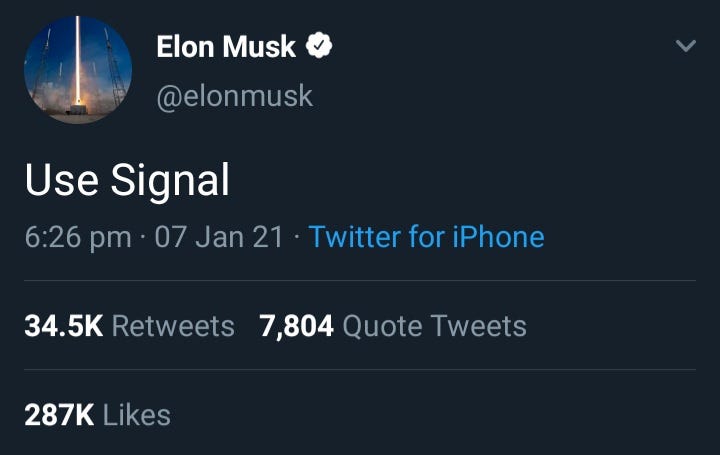
In fact, Elon Musk urged his followers on Twitter to convert to Signal, which seems to be a safer alternative to WhatsApp now that we know what happens behind the scenes, but some people took it in a slightly different way.
I’m sure the folks at Signal Advance are probably pleasantly surprised though.
Is Signal a better alternative?
The short answer would probably be yes. Not just Signal, apps like Telegram have also existed all this time without concerning privacy issues, but since people prefer WhatsApp to its alternatives due to a large number of people using it and the more comfortable design, they have not received the kind of popularity that WhatsApp has.
Signal is end-to-end encrypted just like WhatsApp, but unlike the same, Signal is not owned by Facebook. So that’s a plus point for it already!
Signal’s focus on the security aspect of things certainly gives it a more positive image. It has all the features of a messaging service, similar to WhatsApp, and it can be used on your laptop or tablets as well.
The perks — and the drawbacks
The signal does not reveal your IP address to your contact during calls, but according to them, this does reduce the quality of the calls. This might not be a feature everyone wants on their device as well. Signal also has a screen lock feature and an option to keep a security PIN.
But one amazing thing about Signal is that there is no “status” that lets others know whether or not you are online so that one person you’ve been ignoring for the last 10 years can never really know if you’re online and ignoring them, or if you’ve been kidnapped by aliens.
Does Privacy reallyyyy matter?
“Um. YA!”
While it may be easier for us to blindly accept whatever terms and conditions we come across, it is our responsibility to at least be aware of what we are agreeing to. So check up on the conditions to which you are saying yes to, and if the results scare you a little, give open-source alternatives like Signal a try!
Read more
We are now on LinkedIn! Do follow us there!
Follow us on Medium for more for International events, news, MUN tips and tricks, and detailed analysis. Get in touch with us on Social media to stay in the loop -
Facebook| Instagram|Telegram Channel |YouTube|Twitter|LinkedIn.
We also invite guest writers to publish their material via this blog!
Interested in writing for MUNner’s Daily? Go right ahead and fill out this form. We will get back to you soon!


