
Astrophysics
Do dark energy and dark matter affect Earth and Sun? (# 29)
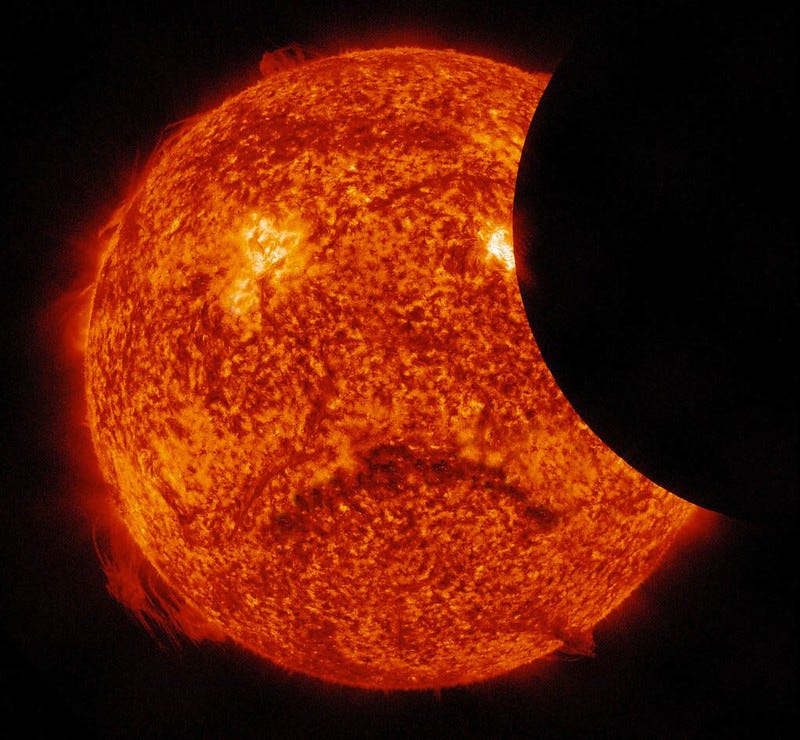
Previous articles presented theoretical arguments about the nature of dark energy and why cosmologists believe there is a substance called dark matter. Article 28 - Predicting rotation velocities of stars - presented data from 161 galaxies comparing predictions about the velocity of 2,683 stars using Newton’s law for gravity and with predictions using a modification of Newton’s equations. This article presents predictions about the impact of dark matter and dark energy on our Sun and our Earth.
Dark energy
To explain the fact that most galaxies are moving apart, cosmologists have proposed that there is some kind of negative energy in space. In brief, space is growing. Furthermore, not only is space growing, but it is growing at an accelerating rate.
While cosmologists do not have an explanation for this growth in space, they have estimated the rate of expansion. Article 21 - Is there a rational explanation for Dark Energy? - argued that the reason for the growth in space is increasing computational complexity. Inserting actual data into an algebraic equation shows that predictions from the equation are consistent with cosmologists’ estimates of the rate of expansion of the universe.
One estimate of the rate of expansion of the universe is about 72 km per sec per megaparsec where 1 parsec is about 3,250 light-years.
There are 31.538 million seconds in a year.
Hence expansion of universe = 2,300 million km/year/megaparsec or 2,300 km/year/parsec.
Our Sun in the Milky Way
Astronomers estimate the age of the Milky Way galaxy to be around 11 billion years and our sun is about 4.5 billion years old. Since the birth of our sun, the universe has expanded by:
2,300 km/year/parsec * 4.5 billion years = 10.35 trillion km/parsec.
As 1 light-year = 9.5 trillion km, since the birth of our sun, the universe has expanded by:
10.35/9.5 light-years/parsec = 1.0895 light-years/parsec.
Our sun is now 8,600 parsecs (28,000 light-years) from the center of the Milky Way galaxy.
Assuming the only reason our sun has moved away from the center of the galaxy is the expansion in space, the distance of our sun at birth from the center of the galaxy was approximately:
8,600 / (1 + 1.0895) parsecs = 4,116 parsecs or 13,377 light-years
Hence our sun was born 13,377 light-years from the center of the galaxy and has moved to 28,000 light-years.
In Article 26 - Does Dark Matter exist? - the rotation velocity, v, for a star was derived from the Kolmogorov equation. Information on the amounts of mass between our sun and the center of the Milky Way (m₁), however, is not readily available. Ignoring any change in temperature in our sun since its birth, the Kolmogorov equation for estimating the velocity of our sun is:
v² = (1/G²) * d₂ * m₁ * (A₁ / A₂) / ((d₁ + d₂)/2)²
This equation shows that the mass of a star does not affect the velocity of the star. A comparison of this equation to Newton’s equation for v² shows the mass of the galaxy inside the orbit of our sun needs to be adjusted by two factors:
1) (A₁ / A₂) = 11/4.5 = 2.44; and
2) 1 / ([1 + {d₁ / d₂}]/2)² = 1/([1+{13,377/28,000}]/2)² = 1.83
where 2.44 * 1.83 = 4.5
The number 4.5 could be considered as a ‘dark matter’ adjustment factor for our sun. Every star will have its own ‘dark matter’ adjustment factor depending on its age, age of its galaxy, as well as any change in a star’s temperature which was not taken into account in the above calculation.
Cosmologists suggest that dark matter accounts for 85% of the total matter in the universe with the remaining 15% being ordinary matter i.e. in the universe, there is on average 5.7 times more dark matter than ordinary matter. Some galaxies, however, appear to have little or no dark matter. In other words, the ratio of dark matter to ordinary matter varies between galaxies. The 4.5 adjustment factor for our sun is not inconsistent with the average estimate for the universe’s ratio of dark matter to ordinary matter, especially as changes in our sun’s temperature have not been taken when calculating the adjustment factor.
Astronomers estimate the density of dark matter varies within a galaxy with a lower density close to the center of a galaxy. For example, the Lambda Cold Dark Matter (ΛCDM) model which is the most popular scientific explanation of how the universe has evolved predicts the core of a galaxy should have a higher density dark matter than is observed. Based on observations, the ratio of dark matter to baryonic matter within the radius of our sun is probably less than the universe’s average ratio.
If our galaxy had been younger, the ‘dark matter’ adjustment factor would have been less. This suggests, younger galaxies may have smaller ‘dark matter’ adjustment factors than older galaxies. Collisions between galaxies would also complicate calculation of ‘dark matter’ adjustment factors. According to recent research:
Dark matter may be even more elusive than previously thought, as researchers believe the mysterious material hidden at the heart of galaxies can be moved around with the power of heat. … The process described as “dark matter heating” occurs in dwarf galaxies that are often found hovering around larger galaxies like the Milky Way. A group of international astrophysicists from the University of Surrey, Carnegie Mellon University, and ETH Zurich studied a total of 16 dwarf galaxies split into two shapes: irregular, amorphous blob-like ones and spheroid ones. All were at various stages of evolution, and the researchers estimated the amount of dark matter contained in each one.
They found that older galaxies with slower rates of star formation had denser cores of dark matter than younger galaxies. Galaxies older than six billion years had more than a whopping hundred million solar masses worth of dark matter at their core, whereas as ones younger than three billion years had “shallower” dark matter cores.
Dark energy and our Earth
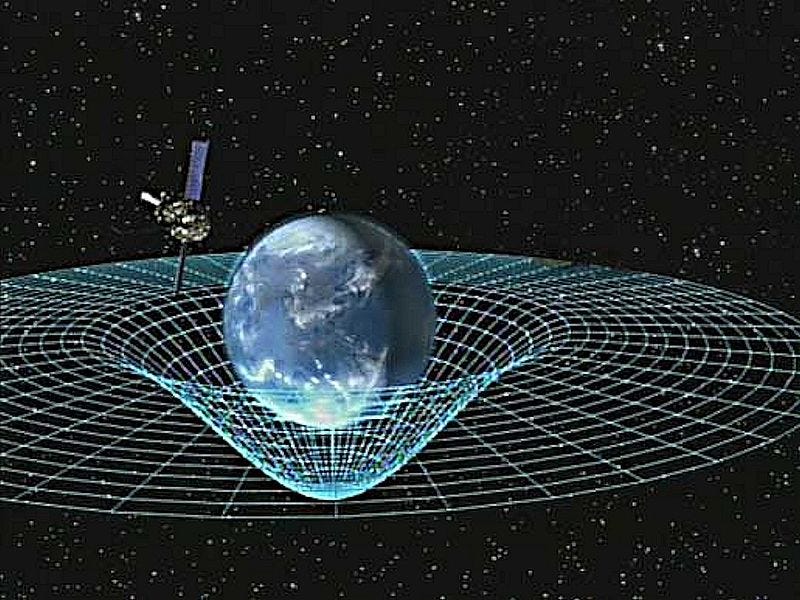
As Earth and sun are roughly the same age, the expansion of space means Earth should be moving away from the sun. However, the effect of temperature changes in Earth on the force of gravity just offsets the effects of increases in space leaving the current force of gravity equal to that calculated by Newton’s law.
When the Kolmogorov equation incorporates temperature changes, the velocity equation becomes:
v² = (1/G²) * d₂ * m₁ * (A₁ / A₂) * (T₁ / T₂) / ([{d₁ * (T₁ / T₂)}+ d₂]/2)²
where:
T₁ is the temperature at the birth of Earth; and
T₂ is the current temperature
The Earth and the Sun are approximately the same age so A₁ = A₂. As the universe has expanded by 1.0895 light-years/parsec since the birth of our sun:
d₂ = d₁ +d₁ * (1.0895) or d₁ =d₂ / (2.0895)
T₁ refers to the temperature when asteroids combined to form the Earth.
According to Encyclopaedia Britannica, accretion and heating caused by planetesimal impacts can lead to a planet forming a core. For Earth, the sinking of metal to form the core released enough gravitational energy resulting in heating the entire planet by 1,000 ᵒK. Once core formation began, Earth’s interior became sufficiently hot to begin the process of convection. Assuming that the start of convection is equivalent to defining a new form of matter, T₀ could be set at 1,000 ᵒK.
The volume of the Earth is 4πr³/3. The radius of the Earth is about 6,357 km. The base of the mantle is about 3,100 km from the center of Earth. The volume to the base of the mantle is 40bnπ at an average temperature of 4,000 ᵒK. The base of the mantle to the crust of the Earth is about 3,100 km. The volume from the base of the mantle to the crust is 278bnπ at an average temperature of 3,000 ᵒK. The crust of the Earth is about 100km. The volume of the crust is 16bnπ at an average temperature of 1,000 ᵒK. Based on these estimates, the present average temperature of Earth is about 3,000 ᵒK.
The temperature effect on the force of gravity today can be calculated from:
d₂ *(T₁ / T₂) / ([{d₁ * (T₁ / T₂)}+ d₂]/2)²
as d₁ = d₂ / (2.0895), the temperature adjustment factor is:
(1000 / 3000) / ([{(1000 / 3000) / 2.0895} + 1] / 2)² which is approximately equal to 1
In brief, the effect of the increase in the temperature of Earth is currently canceling out the effect of the expansion of space (dark energy) in terms of affecting Earth’s distance from the sun. In other words, Newton’s equation for gravity currently closely approximates the Kolmogorov equation.
The Kolmogorov equation describes what happens when there is a small expansion in space. The full effect should take into account past expansion. The curvature of space includes a ‘memory’ of what was previously in that space. That memory is recorded in the density of charged ions in hydrogen gas. Earth, however, is near the sun which is hot. Also, the amounts of gas and matter in the space between Earth and the sun are constantly changing. Hence, the space between Earth and the sun may not be sufficiently cool and/or stable to be able to record what was in the space previously i.e. there is no dark matter. The gravitational attraction between Earth and the sun appears to be described by Newton’s inverse square law.
What does this mean?
The estimates for the dark matter adjustment factors for our sun and Earth using the Kolmogorov equation for gravity are close to Newton’s equation when Newton’s equation includes dark matter. Newton’s equation, however, does not explain why the force of gravity appears to be inversely related to the square of the distance between two masses. Until information becomes available on the age and temperature of stars, it may be difficult to check whether the Kolmogorov equation is a better explanation for the rotation velocities of stars.
Applying Occam’s Razor, the Kolmogorov equation may be preferred over Newton’s equation as it explains why the force of gravity is inversely related to the square of the distance between masses.
The question for this article is:
Is our universe inside a wormhole created by two entangled black holes?
To view the headings of all the articles to be published in this series please click on https://michaeledalton.medium.com/orbiting-stars-and-origin-of-our-universe-338906930f51
To obtain a copy of the book ‘Orbiting Stars’ which contains the first drafts of all these articles, please visit https://www.amazon.com


