

Do Any of these Inventions fascinate you?
Liquid Magnet, Plasma-powered satellite, Wearable Air conditioner, Robotic contact lens & more…
The emerging tech has kick-started the innovative spirit around the globe. We discover new inventions on a daily basis as the digital age kicks into high gear. Yesterday’s science fiction is quickly becoming today’s reality. There were just a few too many in the past week so I thought of sharing a few with you guys.
Liquid Magnet
This was a purely accidental discovery, but then again how many inventions have we seen over the years that came into being by accident. University of Massachusetts Amherst engineers told Live Science that they were working on 3D-printing liquids when they stumbled upon iron, oil, and water droplets depicting magnetic properties.
The researchers are now trying to figure out how & why the droplets were able to maintain a magnetic field around them. And more importantly how these liquid magnets can be utilized. Researchers discussed in their study how these magnetic droplets can be programmed into different shapes to create different tools.
Plasma-powered Satellite
Current satellites are powered by conventional gas or rocket fuel. However, tiny satellites or CubeSats as they are called can’t maneuver & navigate different altitudes in space efficiently. Engineers at the Princeton Plasma Physics Laboratory have now designed a new plasma-fueled thruster, which provides a much better impulse than the current systems.
According to a Princeton press release, this can open up a new area of scientific research. One use case discussed in the details is how the CubeSats can descend to a lower orbit to monitor varying weather conditions. Once done, it can return to its higher orbit.
Wearable Air Conditioner
This invention can be especially useful for people living & working in hot climates, where working in the sweltering summer months is a huge challenge. Tech giant Sony has come up with an innovative solution — a tiny personal AC which can fit in a shirt pocket. REON Pocket as it is called is worn below the neck in an undershirt and can be controlled by a smartphone App.
Sony claims Reon can reduce a person’s body temperature by 13 degrees Celsius (or 23 Fahrenheit). The device can also be used in winter months to keep warm by raising the temperature by 8C (or 14F). Each unit is priced between $117 — $175 for which the company is taking orders on its crowdfunding platform First Flight. The good news is that the project has met its goal, but the disappointing news is that Reon is only available in its native country Japan.
Robotic Contact Lens
University of California San Diego has created a robotic contact lens which can zoom in and out with the blink of an eye. Not only can this be used as a visual prosthesis, but also act as smart eyewear by acting as mini binoculars. The team of scientists figured that there is a small electric potential between the front & back of the human eyeball when it is closed.
This electric potential can be used to control the contact lens as reported by New Scientist. The biometric soft lens designed to respond to the normal eye movement is made out of a thin sack of saltwater. The polymer-based casing acts as a convex or concave lens depending on the voltage change. The lens was eventually programmed to zoom in on blinking twice and zoom back out on another two blinks.
Quantum Microphone
Stanford University Physicists have developed a “quantum microphone” — a device so sensitive that it can measure individual particles of sound called “phonons.” These phonons originally proposed by Einstein in 1907 are packets of vibrational energy which is manifested by heat or sound depending on their frequency.
“One phonon corresponds to an energy ten trillion trillion times smaller than the energy required to keep a lightbulb on for one second,” Patricio Arrangoiz-Arriola, a co-first author of the study.
The study states that the quantum microphone will use supercooled resonators, only visible via an electron microscope to measure sound. The device can eventually lead to more efficient & compact mechanical quantum computers by relying on phonons rather than photons for encoding information.
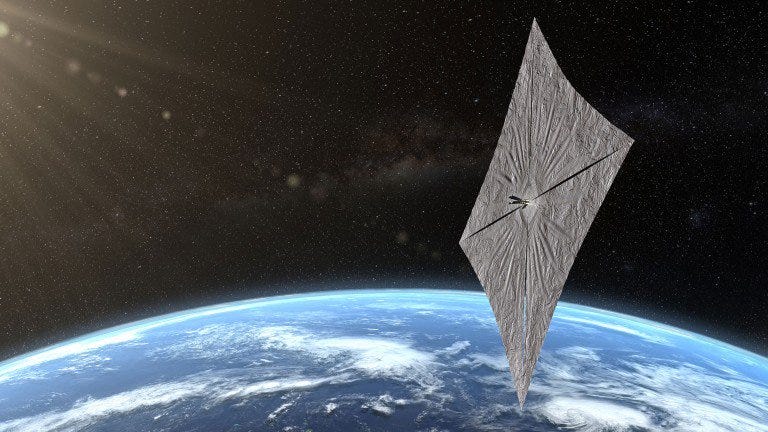
Solar-powered Spacecraft
A decade in the making — The Planetary Society project LightSail2, paid for by crowdfunding finally launched on June 25th of this year, onboard SpaceX’s Falcon Heavy rocket. It’s predecessor LightSail1 which took to the skies in 2015, unfortunately, failed & fell back to Earth in a few days. This spacecraft will harness the sunlight to power its operations in low Earth orbit.
LightSail2’s sails were unfurled a few days ago — having a surface area of 340 square feet (or 32 square meters) and are thinner than a human hair. The sails can be adjusted by the Engineers on the ground to harness maximum power from the sunlight via photons. It has already sent back the first batch of photos recently. Solar sailing seems to be possible after all.