

A Comparative Analysis of global growth between 2018–2020
IMF calls for supportive policies to counter partly self-inflicted downside risks
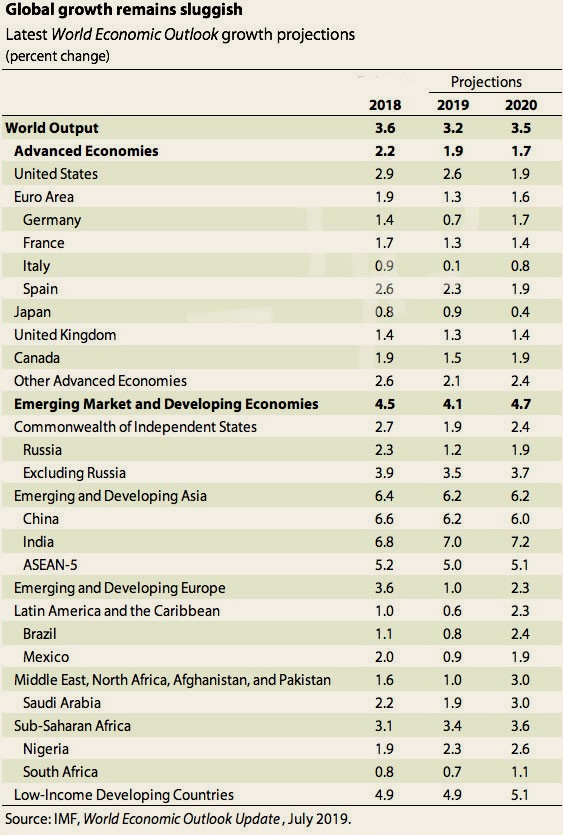
International Monetary Fund revised the global growth lower to 3.2% in 2019 and 3.5% in 2020 from the 2018’s 3.6%. Although these numbers reflect minor downward revisions from April, nonetheless, it reflects some of the negative surprises offsetting the positive signs in the advanced economies.
There is a silver lining to all this though— growth is projected to pick up again in 2020. However, It all depends on the growth drivers of the global economy — emerging markets & developing economies, which at the moment are subject to high uncertainty owing to the on-going Trade war between the U.S & China.
This self-inflicted wound caused by the unresolved trade issues between the two biggest economies of the World is weighing down on global economic growth. As if this was not enough, the trade war has branched out into technology tensions which may threaten global technology supply chains as well. A no-deal Brexit in Europe may throw the whole region in a tailspin.
Mixed Picture
The IMF projection talks about the divergence between the manufacturing and services sector. Purchasing Manufacturing Indices (PMIs) continue to slide across the board with the souring of the business sentiment as they hold off on making any new investments. On the positive side, however, the services sector is holding off well as consumer sentiment stays strong with record low unemployment rates & increasing wages in many countries.
The biggest uncertainty comes from a notable weakness in the global trade, which has slowed down to 0.5% year-over-year in Q1 2019' — the slowest pace of growth since 2012. The following growth projections can change drastically amid high uncertainty caused by the unresolved trade & technology disputes.
Overview of Growth Projections
In Advanced Economies, the U.S, Euro area, Japan & the United Kingdom grew faster than expected in Q1, 2019 — mostly due to the inventory build-up. The growth momentum for the rest of the year is expected to be slower due to reduced global demand. The cumulative growth of Advanced economies will continue to weaken posting 1.9% & 1.7% in 2019 & 2020 respectively.
- United States economy seems to be losing momentum going into 2020 — however, it would stay above the average growth of the advanced economies posting 2.6% in 2019 & 1.9% in 2020.
- Euro Area would track the global average falling in 2019 with a slight rebound in 2020 — recording 1.3% and 1.6% in the current & the following year
- The biggest economy in the EU — Germany would see a sharp decline of 50% in 2019 falling to just 0.7% growth before making a strong come back with a 1.7% growth in 2020.
- Italy is somewhat of an anomaly in advanced economies bracket, expected to show negligible growth of 0.1% in 2019 before returning to 2018 level posting 0.8% in 2020. Largely attributed to political instability & inconsistent policies.
- Japan continues to post sluggish growth of 0.8%, 0.9% and 0.4% in the three year period. The export-driven economy will get battered with the on-going trade war, just like Germany.
- U.K, France, Canada & other advanced economies will see a slow 2019 before returning to 2018 growth levels in 2020.
- The emerging-market & developing economies will slow down from the 2018 average growth of 4.5% to 4.1% in 2019, before rebounding to 4.7% in 2020.
- China will be stagnating around the 6.0% growth, both in 2019 & 2020, the lowest level in three decades. The trade war with the U.S is certainly not helping their case.
- India, on the other hand, would continue to outperform its neighbor with a growth rate of 6.8%. 7.0% and 7.2% expected in the three years with continued economic reforms & consistent economic policies.
- Russia would see a sharp decline in 2019 recording 1.2% from 2.3% a year earlier before returning to 1.9% in 2020. Low prices of Oil are causing problems for the commodity-driven economy.
- ASEAN economies would hold off around the 5.0% growth mark for the three years in question.
- Latin American economies would also see a sharp decline in growth for 2019 before making a comeback in 2020. Brazil would jump from 0.8% in 2019 to 2.4% in 2020, while Mexico would gain from 0.9% to 1.9% in the same time period.
- The Middle East & North African countries would see an impressive recovery in 2020, from the 2019 slump. Sub Saharan Africa will be the only exception showing upward growth for all three years.
- And Lastly, Low-income developing countries would post similar growth of 4.9% in 2018–19 before recording a nominal increase to a 5.1% average growth.
- Stressed economies like Argentina, Turkey, Iran, and Venezuela remain subject to high uncertainty.
Proposed Actions
IMF proposes keeping accommodative monetary policies to counter increased downside risks. More importantly, it suggests placing sound trade policies with an emphasis on the resolution of current disputes. The bank suggests employing macroprudential tools to make sure that financial risks do not build up from this ultra easing economic cycle (low-interest rates).
Fiscal policy should be used to balance growth, equity, and sustainability concerns. Lastly, IMF suggests global economic cooperation is imperative in resolving technology tensions & addressing external threats like Climate change, corruption, Cybersecurity and challenges of the emerging digital payment technologies. It looks like a tall order ahead.


