avatarPrecambrian Tales

Free AI web copilot to create summaries, insights and extended knowledge, download it at here

5113

Abstract

"><figcaption><b>Bioluminescent fungi (<a href="https://en.wikipedia.org/wiki/Mycena_chlorophos">Mycena chlorophos)</a>. </b>Photo by <a href="https://mushroomobserver.org/observer/show_user/1293">Steve Axford (steveaxford)</a>. Taken from <a href="https://mushroomobserver.org/image/show_image/77081">mushroomobserver.org</a> via <a href="https://commons.wikimedia.org/wiki/File:Mycena_chlorophos_(Berk._%26_M.A._Curtis)_Sacc_77081.jpg">Creative Commons</a></figcaption></figure><p id="f675">Bioluminescence evolved as an active form of communication for various purposes, such as hunting prey, warding off predators, and attracting mates [<a href="https://www.sciencedirect.com/science/article/pii/B9780126569704500543">5</a>].</p><p id="8201">It is more frequent in <b>marine organisms</b> such as <b>fishes</b>, <a href="https://en.wikipedia.org/wiki/Cnidaria"><b>cnidarians</b></a>,<a href="https://en.wikipedia.org/wiki/Ctenophora"> <b>ctenophores</b></a>, <a href="https://en.wikipedia.org/wiki/Crustacean"><b>crustaceans</b></a>,<b> <a href="https://en.wikipedia.org/wiki/Mollusca">mollusks</a></b>,<b> <a href="https://en.wikipedia.org/wiki/Echinoderm">echinoderms</a></b>, <a href="https://en.wikipedia.org/wiki/Chaetognatha"><b>chaetognaths</b></a>, <a href="https://en.wikipedia.org/wiki/Annelid"><b>annelids</b></a>, and <a href="https://en.wikipedia.org/wiki/Protist"><b>protists</b></a>, but it also can also be found in some groups of <b>bacteria</b>,<b> <a href="https://en.wikipedia.org/wiki/Fungus">fungi</a></b><a href="https://en.wikipedia.org/wiki/Fungus">,</a> <a href="https://en.wikipedia.org/wiki/Myriapoda"><b>myriapods</b></a>, and <b>insects</b>.</p><figure id="32ce"><img src="https://cdn-images-1.readmedium.com/v2/resize:fit:800/0*hewqZxALPqHkPQ2O"><figcaption><b>An abyssal fish (<a href="https://en.wikipedia.org/wiki/Triplewart_seadevil">Cryptopsaras couesii</a>). </b>Photo by<a href="https://commons.wikimedia.org/wiki/User:Etrusko25"> Etrusko25</a>. Taken from<a href="https://commons.wikimedia.org/wiki/File:Cryptopsaras_couesii.png"> commons.wikimedia.org</a> via Creative Commons</figcaption></figure><p id="8dc6">There are many chemically different luciferins and luciferases isolated from luminous organisms in different <a href="https://www.nature.com/scitable/topicpage/reading-a-phylogenetic-tree-the-meaning-of-41956/#:~:text=Reading%20a%20Phylogenetic%20Tree%3A%20The%20Meaning%20of%20Monophyletic%20Groups&amp;text=A%20phylogenetic%20tree%2C%20also%20known,genes%20from%20a%20common%20ancestor.">phylogenetic groups</a>.</p><p id="0e04">While light-emitting systems of not-related biological groups share some similarities, they can be functionally and biochemically very different [<a href="https://pubmed.ncbi.nlm.nih.gov/6358519/">2</a>,<a href="https://www.researchgate.net/publication/236114716_Darwin_shines_light_on_the_evolution_of_bioluminescence">6</a>].</p><figure id="e92c"><img src="https://cdn-images-1.readmedium.com/v2/resize:fit:800/0*zASLZUc6czKEGsJG"><figcaption><b><i>Side view of a bioluminescent beetle (<a href="https://en.wikipedia.org/wiki/Elateroidea">Elateroidea</a>). </i></b><i>Photo by<a href="https://commons.wikimedia.org/wiki/User:Basile_Morin"> Basile Morin</a>. Taken from<a href="https://commons.wikimedia.org/wiki/File:Close-up_view_of_a_bioluminescent_beetle_Elateroidea.jpg"> commons.wikimedia.org</a> via Creative Commons.</i></figcaption></figure><p id="74d2">Indeed, genes and proteins involved in bioluminescence in different biological groups of organisms are mostly unrelated.</p><p id="26d7">This molecular biodiversity means that then each of them must have evolved independently from a different origin. In evolutionary biology, this event is better known as <a href="https://en.wikipedia.org/wiki/Convergent_evolution">convergent evolution</a>.</p><p id="6265" type="7">Indeed, it is estimated that the ability to emit light has arisen independently at least 30 times in the course of evolution, and there is no discernible evolutionary pattern across different taxa [2,7].</p><figure id="9201"><img src="https://cdn-images-1.readmedium.com/v2/resize:fit:800/0*65pN12giBbenUjEO"><figcaption><b>A bioluminescent fungus (<a href="https://en.wikipedia.org/wiki/Panellus_stipticus">Panellus stipticus</a>). </b>Photo by<a href="https://commons.wikimedia.org/wiki/User:Ylem"> Ylem</a>. Taken from<a href="https://commons.wikimedia.org/wiki/File:PanellusStipticusAug12_2009.jpg"> commons.wikimedia.org</a> via Creative Commons</figcaption></figure><figure id="682a"><img src="https://cdn-images-1.readmedium.com/v2/resize:fit:800/0*zZibfS1vwRwp2fXO"><figcaption><b>Insect larvae species of the genus<a href="https://en.wikipedia.org/wiki/Arachnocampa"> <i>Arachnocampa</i></a> that use their lights to attract prey. </b>Photo by<b> <a href="https://pixabay.com/es/users/eyriephotography-10419291/"></a></b><a href="https://pixabay.com/es/users/eyriephotography-10419291/">EyriePhotography</a>. Taken from<a href="https://pixabay.com/es/photos/resplandor-gusano-gusanos-5942350/"> pixabay.com</a></figcaption></figure><p i

Options

d="81a7">A curious fact is that <a href="https://en.wikipedia.org/wiki/Charles_Darwin">Charles Darwin</a> was puzzled by the evolution of bioluminescence.</p><p id="6be7">He couldn’t imagine how small changes (<a href="https://en.wikipedia.org/wiki/Phyletic_gradualism">phyletic gradualism</a>), could lead, apparently out of the blue, to a completely new phenomenon (such as specialized light-producing organs), through his idea of <a href="https://en.wikipedia.org/wiki/Natural_selection">natural selection</a> [<a href="https://www.researchgate.net/publication/236114716_Darwin_shines_light_on_the_evolution_of_bioluminescence">6</a>].</p><figure id="4458"><img src="https://cdn-images-1.readmedium.com/v2/resize:fit:800/0*tNXEJFfeg63_y5WZ"><figcaption>Photo by <a href="https://unsplash.com/@hulkiokantabak?utm_source=medium&amp;utm_medium=referral">Hulki Okan Tabak</a> on <a href="https://unsplash.com?utm_source=medium&amp;utm_medium=referral">Unsplash</a></figcaption></figure><p id="9eca">Currently, bioluminescent organisms are a target for different scientific research.</p><p id="f9c1" type="7">There are over 30 known bioluminescent systems, but only 11 systems have been characterized [8].</p><p id="42ae">Genes responsible for the bioluminescence reaction are frequently used for molecular markers or reporter genes that have different biotechnological applications.</p><p id="9871">Bioluminescence is currently used for <a href="https://pubmed.ncbi.nlm.nih.gov/17682345/">gene assays</a>, the <a href="https://www.hindawi.com/journals/ijpro/2014/147648/">detection of protein–protein interactions</a>, <a href="https://www.sciencedirect.com/science/article/abs/pii/S1367593100001101">high-throughput screening</a> (HTS) in<a href="https://pubmed.ncbi.nlm.nih.gov/12879192/"> drug discovery</a>, <a href="https://bmcinfectdis.biomedcentral.com/articles/10.1186/s12879-018-3505-y">hygiene control</a>, <a href="https://www.ncbi.nlm.nih.gov/pmc/articles/PMC4456501/">analysis of pollution in ecosystems</a>, and <i>in vivo </i>imaging in <a href="https://www.sciencedirect.com/science/article/abs/pii/S1055937X0180013X">small mammals</a> [<a href="https://pubs.rsc.org/en/content/articlelanding/2021/cs/d0cs01492c">8</a>].</p><figure id="f0e8"><img src="https://cdn-images-1.readmedium.com/v2/resize:fit:800/0*srI3vc01aHXfkF0W"><figcaption><b>Bioluminescent jellyfish</b>. Photo by <a href="https://unsplash.com/@m3design?utm_source=medium&amp;utm_medium=referral">Marat Gilyadzinov</a> on <a href="https://unsplash.com?utm_source=medium&amp;utm_medium=referral">Unsplash</a></figcaption></figure><p id="6ceb">You can find more information about bioluminescent organisms in the following links: [<a href="https://pubmed.ncbi.nlm.nih.gov/21141672/">1</a>,<a href="https://pubmed.ncbi.nlm.nih.gov/6358519/">2</a>,<a href="https://pubmed.ncbi.nlm.nih.gov/3503524/">3</a>,<a href="https://link.springer.com/chapter/10.1007/978-94-017-0619-3_19">4</a>,<a href="https://www.sciencedirect.com/science/article/pii/B9780126569704500543">5</a>,<a href="https://www.researchgate.net/publication/236114716_Darwin_shines_light_on_the_evolution_of_bioluminescence">6</a>,<a href="https://www.britannica.com/science/bioluminescence/The-range-and-variety-of-bioluminescent-organisms">7</a>,<a href="https://pubs.rsc.org/en/content/articlelanding/2021/cs/d0cs01492c">8</a>,<a href="https://www.sciencedirect.com/topics/agricultural-and-biological-sciences/bioluminescence">9</a>,<a href="https://www.researchgate.net/publication/278304125_Bioluminescence">10</a>,<a href="https://www.sciencedirect.com/science/article/pii/B0123693977000455">11</a>].</p><p id="4716">Let me know your opinion in the comments.</p><p id="a0b7"><b><i>If you enjoy reading stories like these and want to support me as a writer, consider <a href="https://medium.com/@juan.ag.san.92/membership">signing up to become a Medium member</a>.</i></b></p><p id="8b80"><b><i>See also:</i></b></p><div id="2da5" class="link-block"> <a href="https://readmedium.com/how-many-species-are-there-d81a3f86d074"> <div> <div> <h2>How Many Species Are There?</h2> <div><h3>The challenge of describing Earth’s life</h3></div> <div><p>medium.com</p></div> </div> <div> <div style="background-image: url(https://miro.readmedium.com/v2/resize:fit:320/0*QBp6WuSMw1xHXSxj)"></div> </div> </div> </a> </div><div id="3d21" class="link-block"> <a href="https://readmedium.com/mind-control-parasites-dcb060d92a50"> <div> <div> <h2>Mind-Control Parasites</h2> <div><h3>Pathogens that can control the behavior of their hosts</h3></div> <div><p>medium.com</p></div> </div> <div> <div style="background-image: url(https://miro.readmedium.com/v2/resize:fit:320/0*oENko3zE776IchYC)"></div> </div> </div> </a> </div></article></body>

Diversity of Bioluminescent Organisms

Living beings that glow in the dark
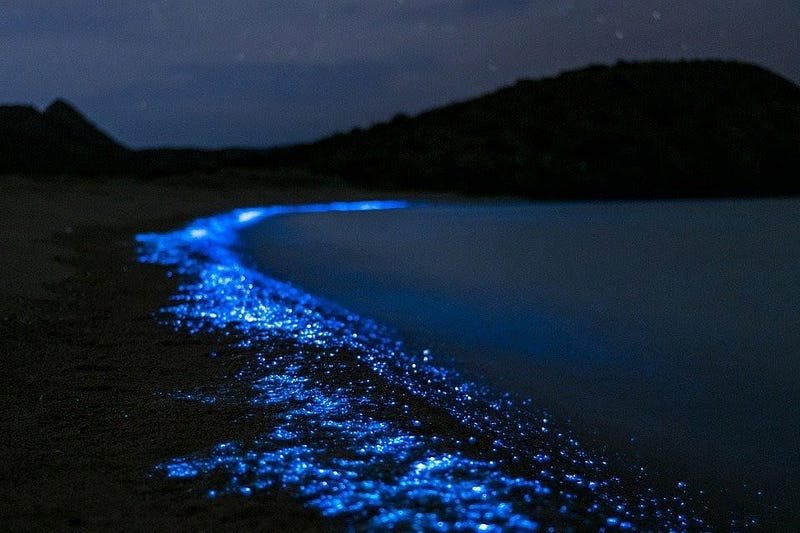
Photo by Alvaro_Bejarano. Taken from pixabay.com

I imagine that some people may not be familiar with the image above, but I assure you that these lights were not added through image editing.

These lights are naturally produced by dinoflagellate species such as Noctiluca scintillans (protist), microscopic organisms that constitute a part of marine plankton.

The first time I saw them was in Chacahua Lagoon, Oaxaca, Mexico, but actually, they can be seen on various beaches around the world.

Walking on the beach at night or sailing in a dark sea, you will be able to see these bright lights on the water at specific seasons of the year [check out this video].
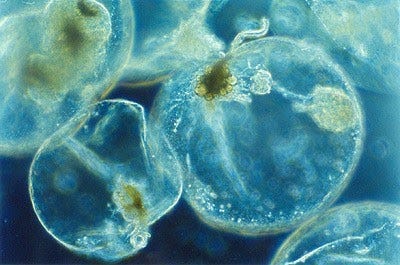
Microscopic view of bioluminescent dinoflagellates. Picture by Maria Antónia Sampayo. Taken from planktonnet via Creative Commons.

Production of light by living organisms

Bioluminescence is the capability of some organisms to emit visible light as a result of a chemical reaction [1].

Some species can not produce their own light per se, but can be bioluminescent if they have symbiotic relationships with bacteria that allow them to glow in the dark.

The luminescent reaction in most organisms occurs through an enzymatic oxidation reaction involving two substances: luciferin (a protein that produces light when oxidized) and luciferase (an enzyme that catalyzes the biochemical reaction in the presence of oxygen) [2].

Organisms such as fireflies (insects of the family Lampyridae) can carry out this chemical reaction inside of specialized light-emitting organs located in the lower part of their abdomen.
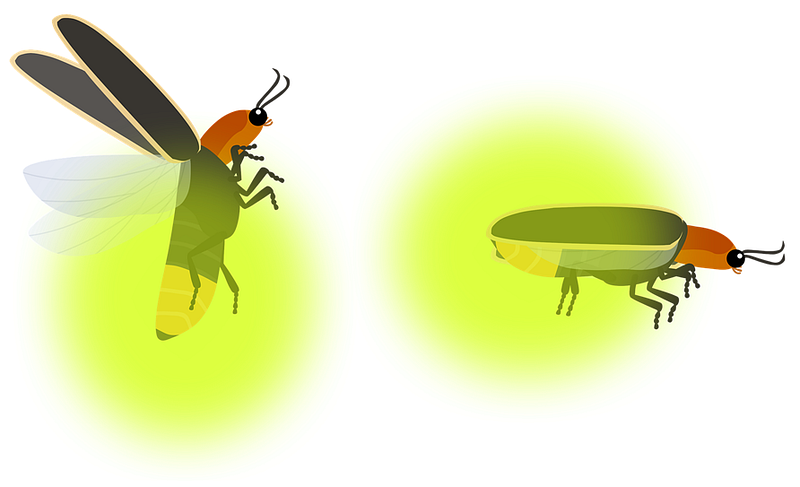
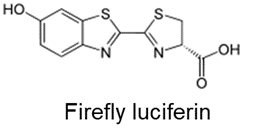
Image by MostafaElTurkey36. Taken and modified from pixabay.com
Image by Yikrazuul. Taken from commons.wikimedia.org via public domain

Evolution of bioluminescent organisms

Despite there being relatively few known luminous species, bioluminescence is a widely distributed feature in nature (it can be found in ~666 genera from 13 phyla) [3,4].
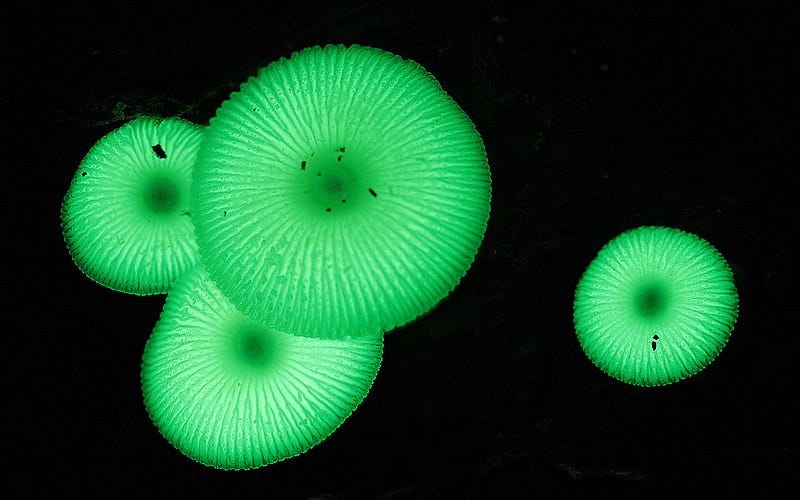
Bioluminescent fungi (Mycena chlorophos). Photo by Steve Axford (steveaxford). Taken from mushroomobserver.org via Creative Commons

Bioluminescence evolved as an active form of communication for various purposes, such as hunting prey, warding off predators, and attracting mates [5].

It is more frequent in marine organisms such as fishes, cnidarians, ctenophores, crustaceans, mollusks, echinoderms, chaetognaths, annelids, and protists, but it also can also be found in some groups of bacteria, fungi, myriapods, and insects.
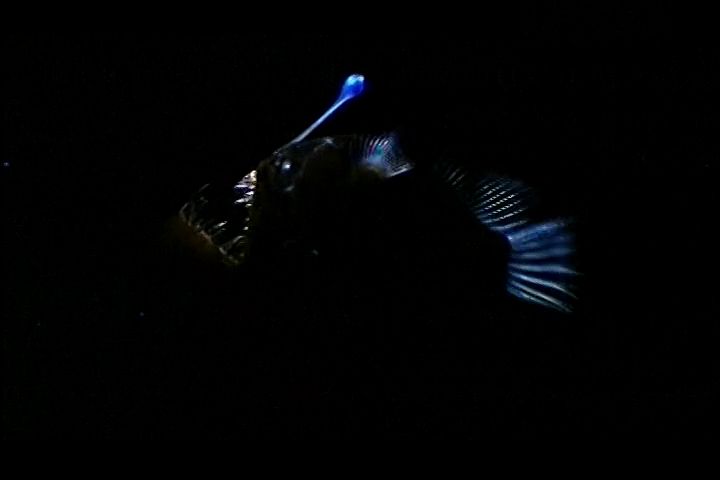
An abyssal fish (Cryptopsaras couesii). Photo by Etrusko25. Taken from commons.wikimedia.org via Creative Commons

There are many chemically different luciferins and luciferases isolated from luminous organisms in different phylogenetic groups.

While light-emitting systems of not-related biological groups share some similarities, they can be functionally and biochemically very different [2,6].
Side view of a bioluminescent beetle (Elateroidea). Photo by Basile Morin. Taken from commons.wikimedia.org via Creative Commons.

Indeed, genes and proteins involved in bioluminescence in different biological groups of organisms are mostly unrelated.

This molecular biodiversity means that then each of them must have evolved independently from a different origin. In evolutionary biology, this event is better known as convergent evolution.

Indeed, it is estimated that the ability to emit light has arisen independently at least 30 times in the course of evolution, and there is no discernible evolutionary pattern across different taxa [2,7].
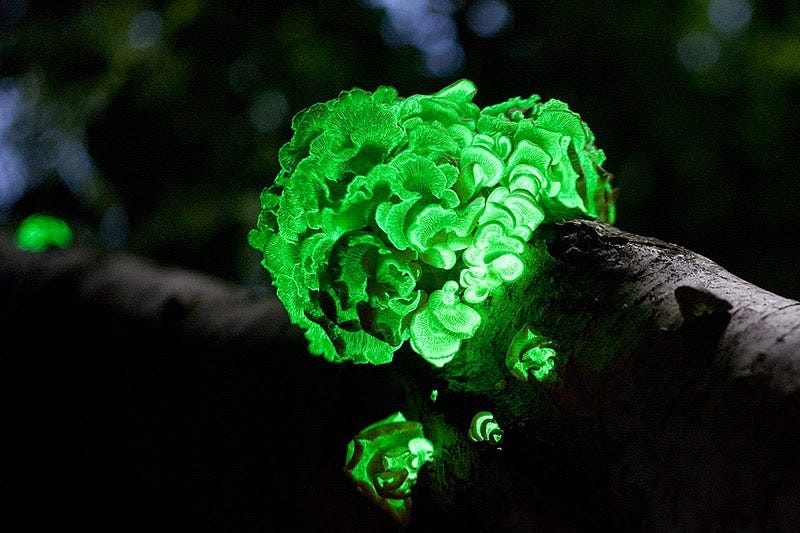
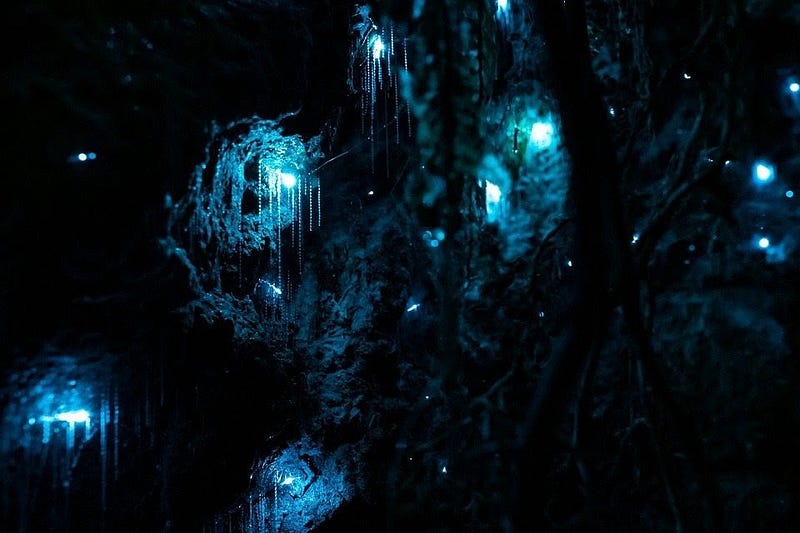
A bioluminescent fungus (Panellus stipticus). Photo by Ylem. Taken from commons.wikimedia.org via Creative Commons
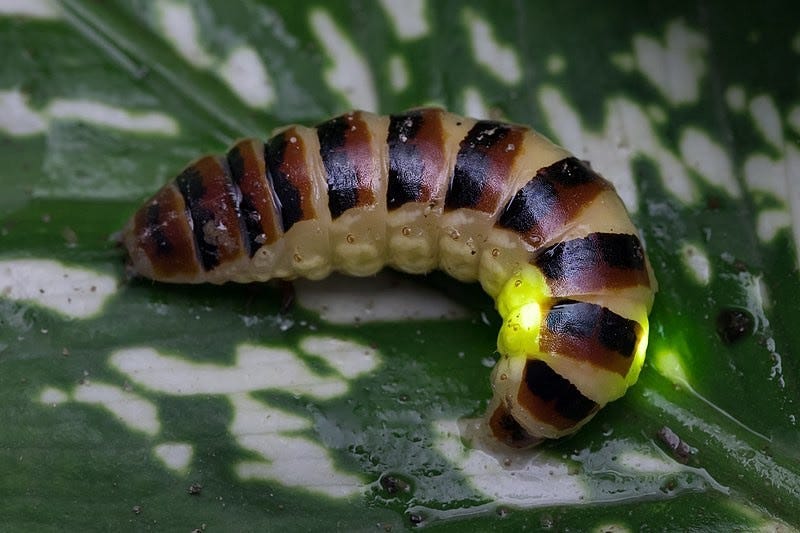
Insect larvae species of the genus Arachnocampa that use their lights to attract prey. Photo by EyriePhotography. Taken from pixabay.com

A curious fact is that Charles Darwin was puzzled by the evolution of bioluminescence.

He couldn’t imagine how small changes (phyletic gradualism), could lead, apparently out of the blue, to a completely new phenomenon (such as specialized light-producing organs), through his idea of natural selection [6].

Photo by Hulki Okan Tabak on Unsplash

Currently, bioluminescent organisms are a target for different scientific research.

There are over 30 known bioluminescent systems, but only 11 systems have been characterized [8].

Genes responsible for the bioluminescence reaction are frequently used for molecular markers or reporter genes that have different biotechnological applications.

Bioluminescence is currently used for gene assays, the detection of protein–protein interactions, high-throughput screening (HTS) in drug discovery, hygiene control, analysis of pollution in ecosystems, and in vivo imaging in small mammals [8].
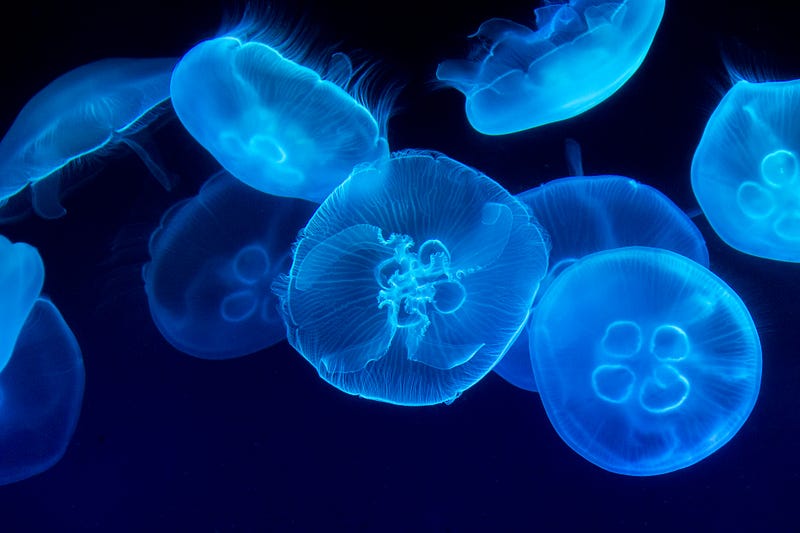
Bioluminescent jellyfish. Photo by Marat Gilyadzinov on Unsplash

You can find more information about bioluminescent organisms in the following links: [1,2,3,4,5,6,7,8,9,10,11].

Let me know your opinion in the comments.

If you enjoy reading stories like these and want to support me as a writer, consider signing up to become a Medium member.

See also:

Science
Biology
Bioluminescence
Evolution
Biodiversity
Recommended from ReadMedium