
Dive into service design with the help of a generative AI coach
Generative AI will not replace humans in teaching service design but it can help you apply service design concepts in practice
Introduction — How intuitive is service design?
I’ve heard many opinions about service design in recent years, and it’s quite evident that there’s a big disagreement on what service design means among members of the global design community. I believe it’s due to the nature of its abstract concepts.
Some designers with a more old-school visual design background might not consider service design as “design” at all. Meanwhile, others who were either schooled in certain parts of Europe where service design was developed since the 1990s, or by schools around the world that taught them to use design thinking to design processes and services, could easily see a lot of value in it (Look into the four orders of design by Buchanan where the design of services is mentioned).
Many of us, design professionals, are familiar with certain service design tools such as customer journey mapping, and service blueprints. However, the truth is that service design is a way of thinking that goes beyond just using these tools, and it takes time to internalize it. That can become particularly challenging if you don’t work in service design but only learn service design to apply it in your work in another design discipline, or even beyond design.
In this article, I’m discussing a customized ChatGPT I developed to help anyone who’d like to learn how to start thinking like a service designer.
Don’t get me wrong, I’d still suggest that you take a course or read a few books to learn the basics and I’ll add some suggestions at the end of this article. However, if you’re already familiar enough with service design and want a thinking partner to understand how it can be applied in practice within the context of your actual work, you’ll likely find value in continuing reading this article before you do actual work with your partners and stakeholders.
Lastly, this article is the third in a series of articles where I’ve already explored using generative AI in strategic foresight, and in storyboarding, two tools that can be useful for service designers and strategists.
Let’s explore how generative AI can help us internalize the service design mindset.
What can the Service Design Companion do for you?
Service design, just like any other discipline that’s based on Design Thinking, is not a linear process. Therefore, I built the Service Design Companion (a customized ChatGPT) to accommodate non-linear processes and help you at different points throughout the design process.
It can help you with several parts of the design process:
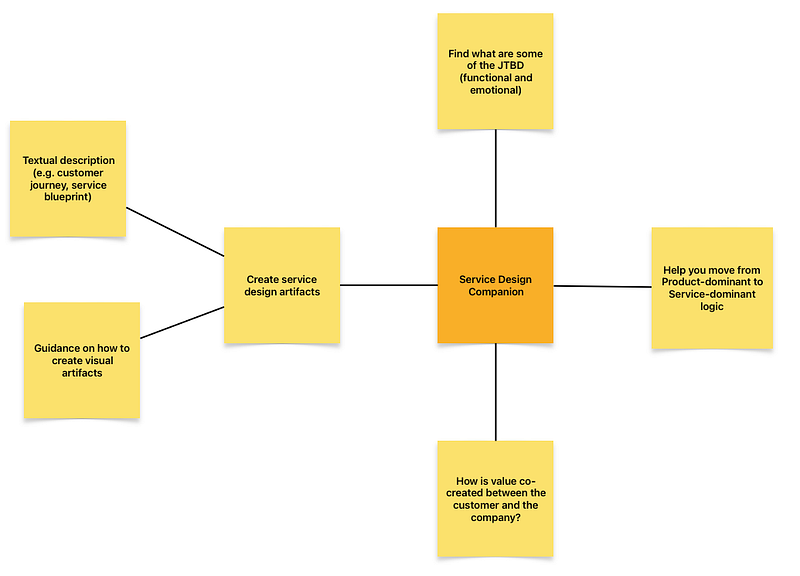
- Demonstrate how complex service design concepts translate into practical terms— Have you ever wondered how your service idea could lead to the co-creation of value between a company and a customer in your business case? Or what are the emotional and functional jobs to be done (JTBD) of a potential client? Some of the academic and professional articles that explain it can be hard to read. The good news? You can type these questions into the Service Design Companion and get answers that will help you understand how such concepts work in reality. Just a reminder, if you want to know the JTBD of your actual clients, you’ll still have to talk to them and learn about it from them
- Help you move from product-based to service-based ideas — In a world where certain business models are likely to become circular in the future, you can use the Service Design Companion to brainstorm ideas to move from product-based business models to service-based models and help make our world a more sustainable place to live in
- Show you how to apply common service design tools — Curious to learn what a potential customer journey for your service idea could look like? The Service Design Companion could help you illustrate that. The same thing applies to service blueprints
- Guide you through the creation of visual artifacts — If you’d like some help on how to visually create service design artifacts, the Service Design Companion could guide you through the creation of such articles
To support the creation of this customized ChatGPT, beyond writing custom instructions for it in the ChatGPT editor, I inserted a small number of service design academic articles into the model behind it. You can find them in the “Resources” section at the end of this article.
The mind map below describes what you can ask the Service Design Companion to do for you.
Let’s look at some examples
In this part of the article, I’ll give you a few examples of questions you can ask the Service Design Companion and show you how it can help you apply some of the concepts in practice.
My recommendation is to only use it to get inspiration, and then run through actual workshops, research, and prioritization exercises with your team.
Understanding Service Design Concepts
JTBD
I asked the Service Design Companion the following question: “ What are some of the JTBD in the case of a customer who uses an app to find a dog walker?”
I instructed it to break it down to functional JTBD, emotional JTBD, and motivations. The output I received included things such as:
- Functional jobs — Find a reliable care professional, convenience in scheduling, and ensuring the dog’s well-being
- Emotional jobs — Peace of mind, building a trusted relationship, and community belonging
- Motivations — Time-saving, Dog’s well-being and happiness
As you can see, that is a good breakdown. I think it gives you a sense of how you could map these JTBD in categories, and then go and talk to real customers (or potential users) who use the app and understand which JBTD are important for them and why, and if they have other ones in mind.
This is how service designers can complement their field work with AI, but not replace it with AI.
Value Co-Creation
This time I asked the following question about the dog-walking app: “ How is value co-created in the case of this app through interactions between the service and its customers? “. My intention here is to deeply understand the notion of value co-creation in the case of this service.
Some of the ideas generated by the Service Design Companion were:
Customer Feedback and Ratings:
- Interaction: Customers provide feedback and rate dog walkers after each walk.
- Value for Customers: Helps ensure a high standard of service and allows them to influence the quality of dog walkers available.
- Value for Service: Enables continuous improvement based on real user experiences, enhancing the app’s reliability and trustworthiness.
Customized Service Offerings:
- Interaction: Customers can specify their preferences and requirements, such as walk duration, preferred routes, or special care instructions.
- Value for Customers: Ensures a personalized service that caters directly to their and their dog’s needs.
- Value for Service: Gathers valuable data on customer preferences, allowing for better matching algorithms and service personalization.
Community Features:
- Interaction: The app may include community features such as forums, social events, or shared content related to dog care.
- Value for Customers: Provides a platform for exchanging tips, advice, and experiences, fostering a sense of belonging among dog owners.
- Value for Service: Enhances user engagement and loyalty, and attracts new users through a vibrant community.
As you can see, this helps see how value is co-created in the case of this app. You can create a list for yourself, and then go deeper through user interviews. In this case, AI has a very good potential of helping to move service design concepts from theory to practice.
Transitioning from product-based to service-based business models
This one can be particularly hard to understand for businesses that want to develop a service arm while being in the business of selling products.
I asked the following question: “A company that manufactures furniture wants to move from selling products to a service-based business model. List some suggestions for them.”
Some of the suggestions I received were:
- Furniture-as-a-Service (FaaS) — Offer subscription-based models where customers can lease furniture for a certain period, with options to swap, return, or buy at the end of the term. This caters to the growing preference for flexibility and sustainability among consumers.
- Customization Service — Provide a platform where customers can design or customize their furniture based on their specific needs and preferences. This service could include virtual consultations with designers, 3D visualization tools, and personalized recommendations.
- Maintenance and Upkeeping Services — Offer services for the maintenance, repair, and refurbishment of furniture to extend its lifecycle, promoting sustainability and reducing waste. This could include regular maintenance checks, repair services, and refurbishing old furniture pieces.
In a world where the industry has just started talking about circular and sustainable business models, I think that understanding the concept of “servitization” will become more and more important in the coming years. The Service Design Companion could help you break down this concept into practical terms.
Designing Service Design Visual Artifacts
Ecosystem Maps I asked the Service Design Companion to suggest a structure for an ecosystem map for the dog walking app.
I received a few ideas to think about such as the immediate stakeholders of the app: the dog owners, and the dog walkers as well as other stakeholders such as veterinarians, dog food companies, and pet insurance companies.
I then asked the GPT for some guidance on how to draw the ecosystem map and took action on it. Here’s the result of me following the instructions and adding some thoughts of my own.
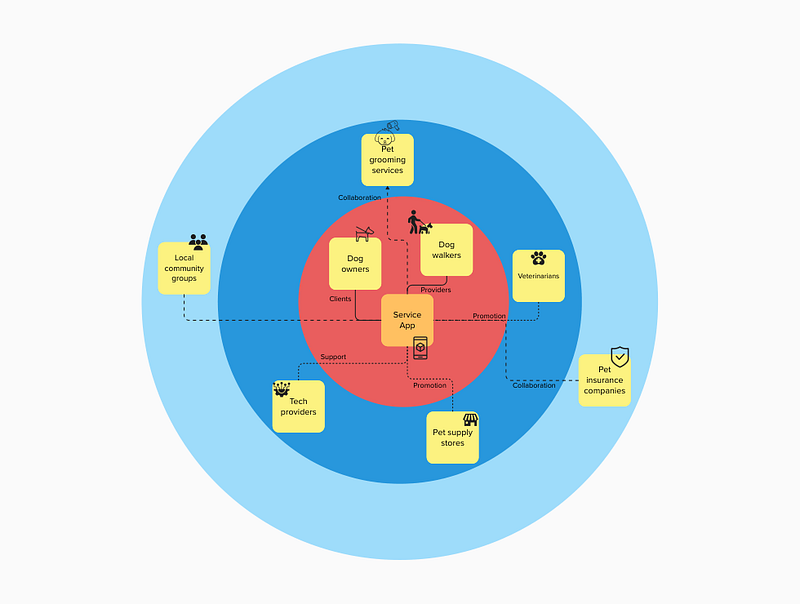
An ecosystem map is just one of the service design visual artifacts the Service Design Companion could help you create while guiding you through the process.
You could ask for help with other visual artifacts such as customer journey maps, service blueprints, and the business model canvas.
Conclusion — You can now move more easily from service design theory to practice
I had a lot of fun creating this customized ChatGPT. It gave me some clarity about what the potential usage of generative AI tools could look like in the context of strategic design in the future.
It made me understand that there will be no shortcuts if you’d like to use service design tools.
One will still have to get a good education on the foundations and the theory behind service design concepts and tools to know when and why we need to use them. However, the big change that generative AI could bring to the mix is the fact that you’ll now have a personal AI coach to help you see how service design tools and concepts could be applied in practice.
From there, it will be slightly easier to plan workshops, user research, and any activity to explore, research, ideate, and validate with customers and stakeholders.
I’d like to invite you to experiment with the Service Design Companion application that I created and let me know your thoughts.
This article is the third in a series of articles where I write about my experiences in developing customized applications with AI in the context of strategic design. The first article I wrote is about using Gen AI in strategic foresight, and the second one is about using Gen AI for storyboarding.
You can also listen to this webinar hosted by Dscout’s People Nerds and hear me talking more in detail about the first two articles in the series.
The intention is to show how the AI-savvy people of today (e.g. people who use AI tools and know how to take advantage of them) can become Citizen AI Developers in the future, and learn how to customize AI to their needs.
Resources
How to learn more about service design
- TISDD book
- IxDF service design course
- IDEO course
- Service Design College (advanced service design course)
Articles used for the creation of the Service Design Companion
- Ying Gao, Qing Zhang, Xiaofeng Xu, Fu Jia & Zhibin Lin (2022) Service design for the destination tourism service ecosystem: a review and extension, Asia Pacific Journal of Tourism Research, 27:3, 225–245, DOI: 10.1080/10941665.2022.2046119
- Kanda, W., Geissdoerfer, M., & Hjelm, O. (2021). From circular business models to circular business ecosystems. Business Strategy and the Environment, 30(6), 2814–2829. https://doi.org/10.1002/bse.2895
- Ng, I., & Briscoe, G. (2011). Value, Variety and Viability: Designing For Co-creation in a Complex System of Direct and Indirect (goods) Service Value Proposition. ArXiv. /abs/1111.2651
- Surya , B., Ali Nur A., Agustini T., Ergo Nurpatria K. (2021). Perspective of Competitive Advantage in Services Dominant Logic DOI: 10.4108/eai.17–7–2020.2303084


