
How to use generative AI in strategic foresight
Lessons learned through experimentation with the creation of a customized ChatGPT for scenario planning

Introduction — Generative AI is your new thinking partner
During 2023 we’ve all got a taste of what large language models (LLMs) and generative AI can do for us in areas such as content generation, data analysis, and just as a brainstorming partner. In addition, by now we can all assume AI won’t replace humans in most jobs, including design and strategy roles, but people who know how to leverage AI and deliver better results, definitely will.
This article is the first in a series of a few articles I’m working on to experiment with generative AI as a thinking partner in the fields of service design, strategic design, and user research, and how it can help us deliver better results than what we can do without it.
Understanding the limitations of generative AI, I chose to focus on narrowing the applications I experimented with since AI delivers the best results in well-scoped areas. Moreover, I chose areas where precision isn’t necessary. AI is known to sometimes “hallucinate” and deliver made-up facts (a lawyer even lost a case because of it). If all you need is some inspiration while you go wild and ideate, then less precision isn’t going to harm you.
This first article will look into how to create and use a customized ChatGPT in the area of scenario planning, and it’s inspired by the article “Use GenAI to Improve Scenario Planning” in Harvard Business Review. I developed a customized version of ChatGPT that can help strategic foresight professionals explore different scenarios together with Gen AI and maybe get exposure to less thought-of possibilities. These scenarios can help design teams envision future situations to design solutions.
As we embark on this journey together, I challenge you to think differently about the role of AI in your work. How can generative AI not just aid, but transform your strategic design processes? Let’s find out.
A blueprint of the service
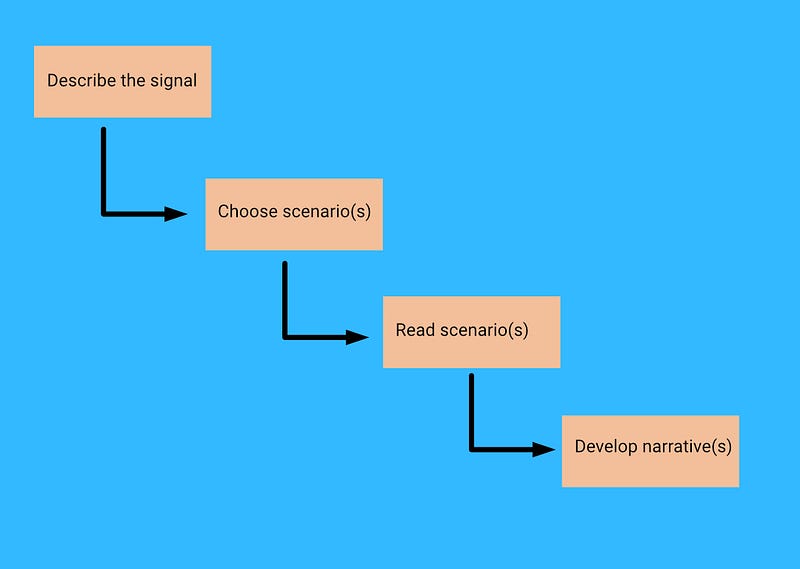
Before I started to build our customized version of ChatGPT for scenario planning I visualized the steps a user would go through while interacting with it.
The steps I identified follow the way strategic foresight is used:
- Write a few words about your signal — Many of us look for signals all the time. Did you find one you’re excited about? Great! You’ll have to write a few words about it inside the customized ChatGPT, and you can also provide the link to an article where there’s a further description of it
- Choose the desired scenario— Ask the customized ChatGPT to come up with one or a few scenarios based on the signal you found. I’ll expand more about the types of scenarios my customized ChatGPT can generate in the next part of this article
- Read scenarios — This is your chance to start reading what each scenario could look like based on the signal you provided.
- Develop narratives for the scenarios — This step follows the recommendation from the HBR article I mentioned earlier. By developing a richer narrative, you can use the scenarios in a group discussion and decide what you want to do about them
Here’s a visualization of the steps a user of the customized ChatGPT will go through.
Building The Scenario Planner GPT
Prominent industry voices such as Atlas AI talk about narrowing the scope of LLMs because the more scoped the data they are trained on, the better results you could get from it, theoretically.
I think we’ll still need to learn what’s the optimal size for a dataset to get the best results from LLMs, but that’s a topic for another article.
I built a customized ChatGPT called “Foresight Facilitator” (ChatGPT helped me choose the name) that will focus on generating scenarios for changes in Canada’s society and economy based on the signals provided.
The four scenarios correspond to the scenario planning methodology taught by the Institute for the Future and are:
- Growth — An extrapolation of trends continues into the future with minimal disruption (See the visual representation by looking at S1 in the image at the beginning of this article)
- Collapse — A rapid, catastrophic system and infrastructure breakdown (See the visual representation by looking at S4 in the image at the beginning of this article)
- Constraint — A core guiding value or purpose organizes society and governs behavior (See the visual representation by looking at S3 in the image at the beginning of this article)
- Transformation — Society or systems fundamentally change or reorganize around a new paradigm (See the visual representation by looking at S4 in the image at the beginning of this article)
Practically speaking, I created the customized ChatGPT through a function within ChatGPT that allows you to do so and guides you through the process. You can find it within ChatGPT under “Explore” and then “Create a GPT”.
Take a look below to see what the interface where you’ll work on developing customized ChatGPTs looks like.
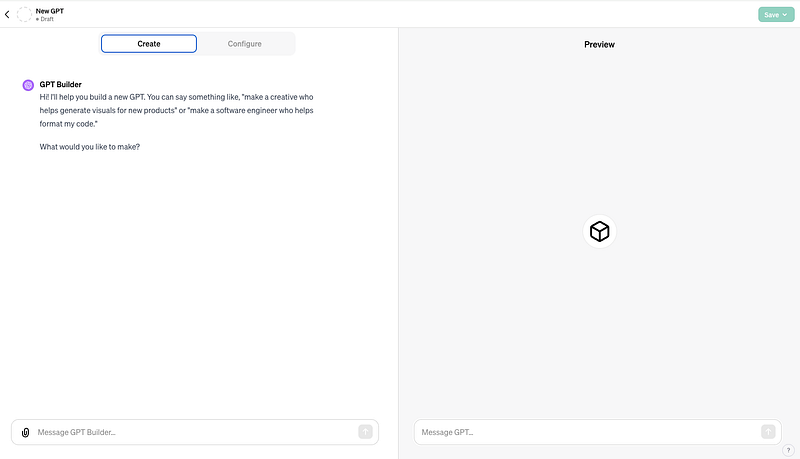
The function guides you through the process of building the chatbot (the screen on the left), and you’ll be able to play with it right away and run through a couple of iterations to see how you like the output (the screen on the right).
I recommend describing the steps you visualized in the first part and providing as much context as possible about the scope of the application. In this case, it’s about generating scenarios and narratives about Canada’s society and economy in the future based on signals.
Include more context about the voice and tone of your application, and most importantly, remember that you can change it later if you don’t get the desired results.
Using the Foresight Facilitator
The best way to illustrate the benefits of using generative AI for scenario planning as well as the limitations of this technology, is to run a few signals through it and see what we’re getting as output.
I’ll give one example here in the interest of time, and I’ll share the link to the Foresight Facilitator at the end of the article in case you want to try it.
I decided to run with this signal — We’re disrupting Earth’s salt cycle through activities such as mining and construction and this poses a significant risk to freshwater. Not a lot is talked about when it comes to Earth’s salt cycle compared to other environmental impacts, so let’s see how this situation could evolve.
This signal resonated with me since as a resident of Montreal, Canada, I witness the large amount of salt used on roads and sidewalks in the winter to help melt the large amount of snow that falls on the city. Therefore, here in the city, we can all literally feel how we disrupt the salt cycle.
I asked the Foresight Facilitator to generate the four scenarios I mentioned earlier. Here’s an example of the growth scenario as it applies to Canada:
In this scenario, Canada experiences significant advancements in environmental technology and policy-making. The government and private sector collaborate to develop innovative solutions for maintaining balanced salt levels in water bodies. These solutions not only prevent damage to freshwater ecosystems but also foster economic growth through the creation of new industries and job opportunities in green technology. Investments in research and education lead to a more environmentally conscious society.
That is a pretty short and general description of the growth scenario. I took it one step further and this is what I received when I asked the Foresight Facilitator to generate an actual narrative around the growth scenario in the next 10 years:
Over the Next 10 Years:
Excitements: Canada becomes a global leader in environmental technology, especially in water management. The green tech sector booms, attracting international investments and talent. Canadian cities are hailed as models of sustainable living, with innovative water purification and conservation systems. Education systems integrate environmental studies extensively, fostering a generation deeply aware of ecological issues.
Worries: There’s concern over the rapid pace of industrial growth in the green sector, potentially leading to new forms of environmental impacts. Economic disparities might arise, favoring regions that excel in green tech. Additionally, reliance on technology might reduce societal resilience in handling environmental crises without technological aids.
I think this is good as a starting point and as inspiration. Let’s explore another scenario. Here’s the opposite scenario, the collapse scenario:
In this scenario, the disruption of salt levels leads to a significant decline in freshwater quality. This impacts agriculture, drinking water sources, and natural habitats. The economy faces challenges as key industries struggle with water scarcity. Public health concerns rise, and there is increased social unrest due to water-related conflicts. The government faces difficulties in managing the crisis, leading to a decline in public trust.
This is the more developed narrative for the collapse scenario for the next 10 years:
Over the Next 10 Years:
Excitements: In response to the crisis, there’s a surge in community-led initiatives and grassroots movements aimed at water conservation and local ecosystem restoration. These movements foster a strong sense of community and shared responsibility.
Worries: Widespread water scarcity leads to significant challenges in agriculture, affecting food security. Public health issues escalate due to poor water quality, and there’s increased migration from affected areas, leading to social and economic strains. Political tensions rise as the government struggles to manage the crisis effectively.
Once again, I think this is pretty good for inspiration, but I find it to be a bit too broad. I feel like a group of experts could get some ideas for further analysis and research from looking at these descriptions, but it doesn’t go further than that at this point.
Conclusion — Inspiration is the name of the game
My short experimentation running a few signals through the Foresight Facilitator showed me that it tends to provide no more than one example of something that could happen in each scenario, and the rest of the description contains only a general description of the situation.
I think that this type of output is good for inspiration, and for ideas about where to dig more to build richer scenarios, but quite frankly, a group of experts working together with a human facilitator could come up with much better results. The good thing about using Gen AI for this use case is that it sometimes leaves you with more questions than answers so you know where humans could help you fill in gaps and dig more.
In addition, many of us do strategic foresight as a side-of-the-desk type of task and not as our main profession, and for those of us working alone, such a tool can help with inspiration if we want to do scenario planning. You can always try to poke around the Foresight Facilitator a bit more and ask follow-up questions, sometimes you get some good ideas, but I find that they tend to be pretty limited to the scope of the initial output you get in each scenario.
Finally, since Gen AI is only as good as the data it’s trained on, I believe that Gen AI developers that collect and train models based on past scenarios and even potential future scenarios suggested by human experts could provide much richer descriptions, but we’re not yet there. Much more effort and skill is necessary to build something like this.
To sum it all up, It was an insightful experiment, and I hope that it sparked some ideas in your head to either use the Foresight Facilitator or build your own customized ChatGPT.
If you’d like to experiment with the Foresight Facilitator, then I invite you to check it out and let me know your thoughts.
This article is the first in a series of articles where I write about my experiences in developing customized applications with AI in the context of strategic design. The second article I wrote is about creating storyboards with Gen AI.
You can also listen to this webinar hosted by Dscout’s People Nerds and hear me talking about it more in detail.
The intention is to show how the AI-savvy people of today (e.g. people who use AI tools and know how to take advantage of them) can become Citizen AI Developers and learn how to customize AI to their needs.