
Discovering Microservices Design Patterns: Real-World Examples and Benefits
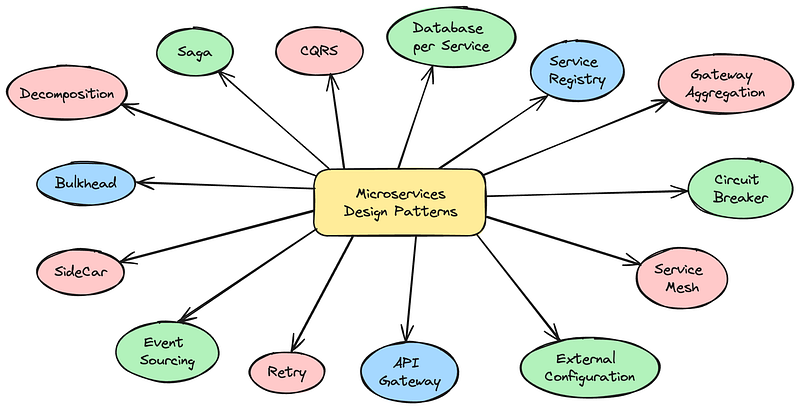
Okay, But why?
Microservices architecture is making waves due to its scalability, flexibility, and modular components. It’s not just a trending approach; it’s a hot demand for constructing robust software systems and excelling in interviews too!
Let’s explore some common microservices design patterns and their ACTUAL examples:
1. Service Registry Pattern: — Enables microservices to track, find, and communicate seamlessly with each other. — Netflix’s Eureka: Maintains a dynamic registry of services for effortless service discovery and interaction.
2. Service Mesh Pattern: — Manages microservices communication with control and security. — Istio with sidecar proxies: Centralized control, resilience, and enhanced security.
3. API Gateway Pattern: — Single entry point handling authentication, routing, and translation. — PayPal’s API Gateway: Simplifies client interactions and enforces security policies.
4. Circuit Breaker Pattern: — Prevents failures from cascading, automatically stops requests to a failing service and uses alternatives. — Amazon Web Services (AWS) SDK: Enhanced resilience and availability.
5. Event Sourcing Pattern: — Captures transactions for auditing and data integrity. — Financial systems: Audit trail and accurate historical data.
6. Saga Pattern: — Orchestrates complex transactions for consistency. — eBay’s Transaction Management: Coordinating microservices.
7. Bulkhead Pattern: — Isolates components to improve resilience and performance. — Netflix’s Fault Isolation: Smooth user experience.
8. Database per Service Pattern: — Independent scaling and data ownership for microservices. — Uber’s Approach: Autonomy and scalability.
9. Retry Pattern: — Automatically retries failed requests for fault tolerance. — Twitter’s Microservices Infrastructure: Improved success rate.
10. CQRS Pattern: — Separates read and write operations for scalability and efficiency. — Eventbrite’s Implementation: Optimized data operations.
11. Sidecar Pattern: — Extends the primary service functionality with an attached sidecar. — Kubernetes with Sidecar Containers: Adds additional functionalities like logging, monitoring, and security to the main application container.
12. Gateway Aggregation Pattern: — Aggregates multiple microservices into a single API gateway. — Netflix’s Zuul: Unified access for multiple services.
13. Decomposition Pattern: — Breaks down monolithic applications into manageable microservices. — Amazon’s Transformation to Microservices: Independent development and scalability.
14. External Configuration Pattern: — Dynamically updates microservices with external configuration. — Spring Cloud Config: Centralized configuration management.
So, let’s discover how these microservices patterns can reshape your system architecture! Do share your thoughts in the comments.
You can also check out,
Thanks for reading and stopping by,


