
Demystifying A/B Testing, Canary Testing, and Blue-Green Deployments
Do you ever find yourself lost in the tangled web of A/B testing, canary testing, and blue-green deployments? You’re not alone.
In this blog, we’ll unravel the mysteries behind these techniques, exploring their differences, use cases, and real-life examples. Get ready for a journey through controlled experiments, incremental releases, and smooth deployments.
A/B Testing: Versions Face-Off
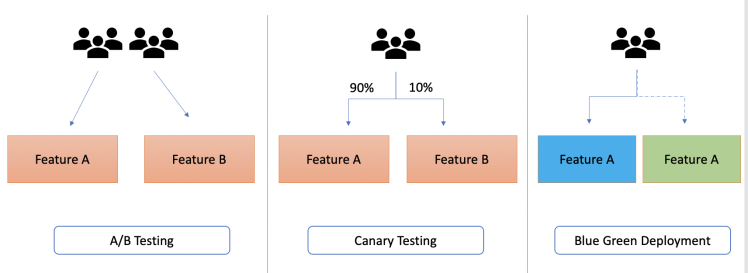
In the left corner, we have “version A,” and in the right corner, it’s “version B.” Welcome to the arena of A/B testing, where versions battle it out to prove their superiority. A controlled experiment that splits user groups into two — the control group (A) and the treatment group (B) — A/B testing is the litmus test for performance. Remember that A/B testing is not just about deploying a tested idea but comparing different ones.
In the world of A/B testing, every version gets its day in the sun, but only the best survives the statistical scrutiny.
Canary Testing: Whistling Away Risk
Canary testing is like releasing new software features to a small group of daring users — the canaries in the coal mine. This incremental release allows quick reversals if the code proves buggy. Think of it as a cautious whisper to a select few before shouting to the masses. While A/B testing is about controlled experiments, canary testing focuses on risk reduction.
Canary testing: Because sometimes, you want to release software features like a secret agent, one small audience at a time.
Blue-Green Deployments: Seamless Switching
Enter the world of blue-green deployments (also known as a red/black deployment), a strategy honed at places like Amazon for over a decade. With two identical environments — the “blue” and “green” — changes are seamlessly deployed to the inactive environment. If issues arise, the router switches back, ensuring zero downtime. This strategy is not just about deployment; it’s a disaster recovery dance.
In the realm of blue-green deployments, we don’t roll the dice; we roll the environments, ensuring a graceful dance of versions.
Where to Apply Each Strategy:
When to use which strategy is the key question. A/B testing for market reactions, canary releases for incremental rollouts, and blue-green deployments for seamless IT testing. It’s like choosing the right tool for the job but in the world of software deployment.
Real-Life Examples:
1. Amazon’s Decade-Long Blue-Green Ballet: Amazon has been perfecting the art of blue-green deployments for over ten years, showcasing the power of this strategy in managing seamless transitions and minimizing downtime.
2. Netflix’s Canary Symphony: Netflix, the streaming giant, relies on canary releases to test new features on a small scale before a widespread rollout, ensuring a glitch-free binge-watching experience for millions.
3. Google’s A/B Search Button Boost: In the vast realm of Google’s search engine, A/B testing played a pivotal role. One experiment focused on the colour of the search button. By testing various shades, Google honed in on the button colour that significantly increased user engagement, making each click count.
Choosing Your Strategy:
The million-dollar question — which deployment strategy is right for you? It depends on your application type and target environment. Mission-critical web applications often opt for blue-green or canary deployments, minimizing business impact during transitions.
Pros and Cons:
- Canary Deployments: — Pros: Real user testing, cost-effective, quick and safe rollback. — Cons: Complex scripting, manual verification, additional research for testing in production.
- A/B Testing: — Pros: Experimentation, exploration, user traffic routing based on demographics. — Cons: Focus on testing multiple ideas, not immediate deployment.
- Blue-Green Deployments: — Pros: Disaster recovery, identical environments, seamless cutover. — Cons: Requires two production environments, and meticulous testing within the inactive environment.
In Conclusion:
As we wrap up this journey through A/B testing, canary releases, and blue-green deployments, remember that these strategies are not one-size-fits-all. Choose wisely based on your specific needs, and may your deployments be as smooth as a canary’s song! :)
If you found this exploration into deployment strategies enlightening, there’s more where that came from! Check out my other blogs for in-depth insights into the ever-evolving landscape of technology and software development. Happy reading!
References: 1. BelowTheMalt — A/B Testing vs. Canary Release vs. Blue-Green Deployment 2. Harness — Blue-Green & Canary Deployment Strategies


