
Discover Your Mission — Gameful Writing (A Parable), Chapter 4 (of 7), Section 2 (of 3)

To celebrate the launch of my new book Gameful Writing, I am sharing it with you here, one section of each chapter at a time. Each of the seven chapters is a separate story, but they are interconnected. I hope you enjoy reading this little parable.
Chapter 4: Sofie
Section **
Welcome back to the Gameful Writing blog.
Only two more types of writing to go. Here is Level Four of your writing game. Writing to explore yourself.
Any type of writing will reveal something new to you about yourself if you just let it.
You might be wondering why you are doing something. But as we’ve seen in previous posts, anything you do and don’t give up at some point, you also want to do or at least try out before giving up.
Any piece of writing you do, however impersonal and dry you think it is, should have your personal touch. If you write it, it is a piece of you. Own it.
Remember that in games it is the same. Each move you make in those is yours, no one else’s. And you own it. The same is true of your writing game.
In a minute, I’ll ask you to go back to your writing and discover what there is of you in the task you need to accomplish. If you feel like there is nothing, then the solution is even simpler. Bring a part of you in there. If you know what part that is, then go to your work-in-progress and incorporate that part into it.
Are you still here? You are?
That may be because despite agreeing that there is or should be a part of you in whatever you do and there is a very personal reason for why you do what you do, you can’t see it clearly. An activity or a project draws you like a magnet, and you seem unable to get rid of it, even given the chance, but you don’t understand what is binding you to it.
So, what are you supposed to do? Is anything wrong? Anything missing?
When you feel something is missing or not quite right, then something might be both missing and not. Let me explain.
You and whatever you do, or did until now, is whole and perfect, whatever state or shape you are or it is. But your searching feeling and the need to move forward or dig deeper is perfect too. “Perfect,” don’t forget, also means “done” and “completed.”
So if something doesn’t leave you in peace and you feel like you should go on a quest (often just figuratively and in exploring your thought processes and feelings), then there is a reason for it.
First of all, there’s the reason of curiosity. We’ve all been born curious. That is how we grow, in all senses of the word.
How far you go with your curiosity is up to you. Only you can define when something is done, closed, and perfect for you.
For example, if you are a painter standing at an easel and letting spectators observe how you work, you and them would have different opinions on when your painting is finished, at times them being sure that you’re done with the art you do for them, long before you think so.
Only you can define whether something is “missing” for you. Take a non-judgmental look at what is telling you that what you do is (or you as a person are) incomplete.
Is it fear of putting your writing (since we talk here about writing, but of course, you can see that it applies to anything) out there, and being judged for it?
If yes, then flip this coin and realize that you are ready and even excited to take your work to the next level, whether it is sending it to your editor, agent, or self-publishing it. Your fear is just an indicator that it’s time to press that “Start” button.
Let’s reformulate it. Your worry is the excitement you feel before playing that new game, the game of sending your manuscript to the editor, submitting your thesis, or publishing your work.
But if after becoming equipped with the awareness above, you still feel that something is missing, then trust yourself and search for this bit.
I learned that when I feel that something is missing, then that missing part is me.
That’s why, all of a sudden, in the last post, I told you about my cancer and how I try to deal with it. My challenges are a part of my journey, a part of me. So why not share them with you? Otherwise, my blog would be just a disembodied rambling about games and writing.
The same is true of your writing. Whatever you do and whoever assigned it to you, and however challenging it might appear to you, there is a bit of you in it, especially if it has gone on a long time already.
If discovering yourself and looking at your feelings seems hard to you, even if I keep telling you “Look at them non-judgmentally,” you might still have thoughts like “Easy for you to say!” and “What the hell is non-judgmental anyway?!”, then I have a game for you to play.
I will send you on a quest to find the mission of your writing game. So your work-in-progress is already a game. We’ve established that. You might know the win-state of your game, that is what you get when you finish the project (a degree, a published book to your name, etc.). But what is the mission of it? Are you saving someone in this game, like a princess? Are you solving a puzzle, like in an Escape Room? Some games don’t explain any rules but throw you immediately into action and let you discover the rules by finding clues.
Here, you have this kind of quest.
So, study yourself for five, more, or fewer minutes. You could use those variants with dice or cards to determine for how long.
You could also go for a walk. Or you could wash the dishes like Agatha Christie was famous for doing, where she claimed to get her best ideas.
Thus, do whatever appears helpful for you to find the mission of your writing game. Again, it is there.
Don’t dismiss any of the thoughts or ideas that come. Your gut is your compass. Others would call this “instrument” heart or intuition. Whatever it is for you, listen to it. Anything it points to is a resource.
See where you are, what you feel, what moved you to be where you are, what are the goals and dreams towards which you want to proceed, what are you doing now, and where does this step lead you in relation to your goals and dreams.
Sorry for repeating things, but I feel like I have to. Find your mission and trust that there is one. Just observe what you are doing and where your gut (heart or intuition) sends you, and move along. Don’t be afraid to get lost somewhere. Your trusty timer is there to bring you back.
How I see the mission of this game for you, you might ask? I am convinced that you will discover something that you don’t know yet, but something you very much want to know. That’s the magic of being here, moving in small steps, and treating everything like the best and most exciting game in the world.
Now, all that’s left is to send you on your quest.
Ready, set, go!
The End of Chapter 4, Section **
Credits:
This is a work of fiction, but like any other, it was inspired by a myriad of creations and ideas I’ve had the honor of reading, seeing, and experiencing.
To share them all would be impossible, but I would like to credit those I can “tackle.”
Agatha Christie and Washing Dishes
Chapter 4: Sofie, section **, the fourth blog post:
You could also go for a walk. Or you could wash the dishes like Agatha Christie was famous for doing, where she claimed to get her best ideas.
I found several accounts of Agatha Christie claiming to get her best ideas while doing the dishes.
Question: “How do you concoct whodunits that have rolled up world sales of 300-million copies?”
Answer: “Walking or just washing up, a tedious process. Years ago I got my plots in the tub, the old-fashioned, rim kind — just sitting there thinking, undisturbed, and lining the rim with apple cores.” — Agatha Christie
From Gameful Writing: Seven People, Seven Stories, Seven Lessons Learned.
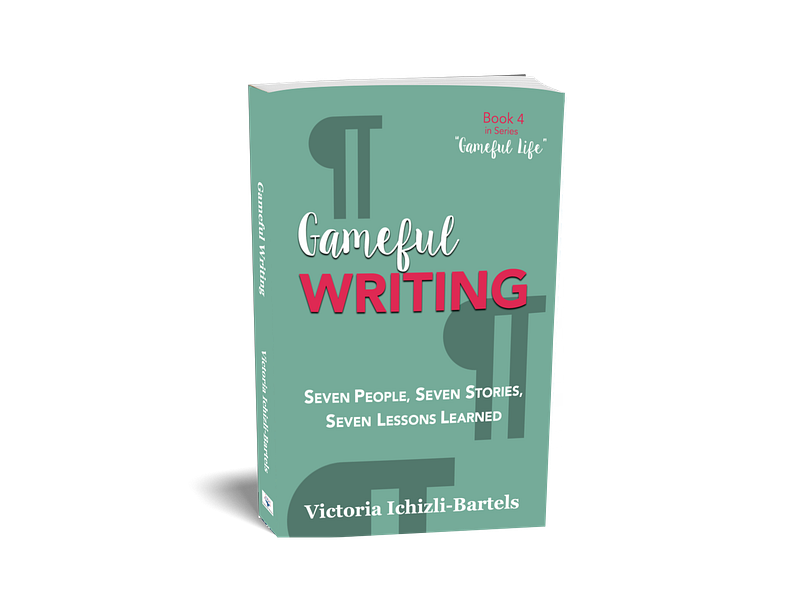
We are all required to write something at some point in our lives. For some, writing is a great passion, while others do it only under duress. Even the same person will enjoy writing some assignments while subconsciously resenting others. The writing “game” will unfold differently, in each case, for all of us.
In this little parable, several people receive a mysterious email from an anonymous blogger, challenging them to play the “Gameful Writing” game. Each of them has been struggling with writer’s block, or to deal with something in their lives, and this game just might hold the key to unlocking their potential.
Join Miriam, Will, Toni, Sofie, Torben, Lily, and Karina as they experience the healing and empowering nature of gameful writing.
And discover these forces for yourself.
P.S. To stay in touch, join my e-mail list, Optimist Writer.
About the author:
Victoria is a writer, instructor, and consultant with a background in semiconductor physics, electronic engineering (with a Ph.D.), information technology, and business development. While being a non-gamer, Victoria came up with the term Self-Gamification, a gameful and playful self-help approach bringing anthropology, kaizen, and gamification-based methods together to increase the quality of life. She approaches all areas of her life this way. Due to the fun she has, while turning everything in her life into games, she intends never to stop designing and playing them.


