
Dimidiate
Is half an impalement better than none?
Today’s New York Times Spelling Bee letters:
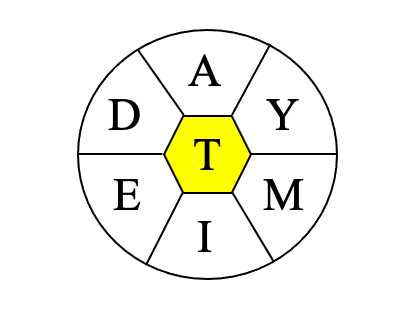
A, D, E, I, M, Y, and center T (all words must include T)
Merriam-Webster says…
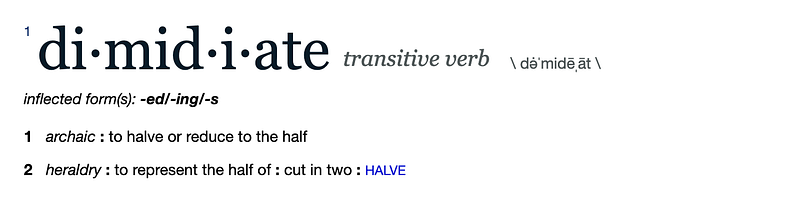
Silly little dictionary! Don’t you know that dimidiate can’t possibly be a word if the New York Times says it ain’t?
For further fascinating facts, check out the Spelling Bee Master.
What’s your favorite dord* from today’s puzzle?
My Two Cents
Our friends at Merriam-Webster explain that heraldry is “the art or practice of an officer of arms including the devising, blazoning, and granting of armorial insignia, the investigation of persons’ rights to use arms or particular armorial ensigns, the tracing and recording of pedigrees, the settling of questions of precedence, the marshaling of processions, and the supervision of public ceremonies”.
Today I’m not going to investigate any person’s rights to use arms or bear arms or even bare their arms — it is almost summer in the Northern Hemisphere, anyway. Go topless for all I care!
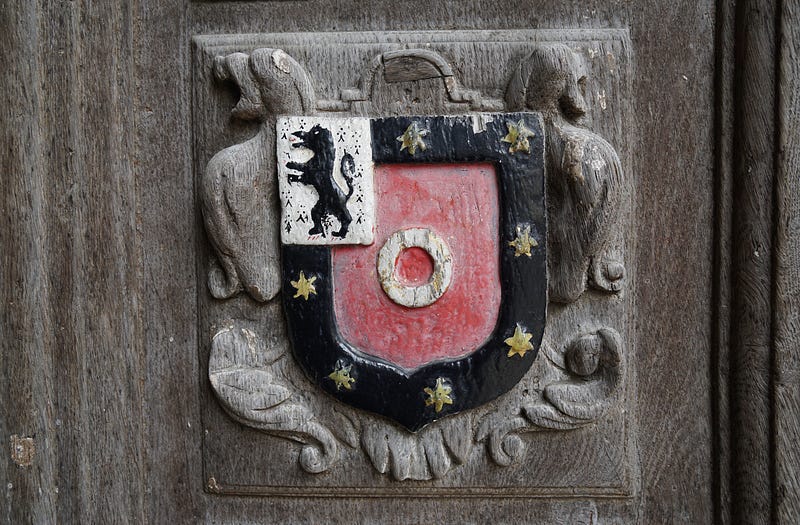
I will discuss armorial ensigns, or emblems and symbols. More specifically, coats of arms and their impalement and dimidiation. The latter term brings us the verb dimidiate, today’s daily dord*.
Divide and conquer
I confess “heraldry” isn’t the first thing that comes to mind when I hear the word impalement. Instead, this is what I picture:
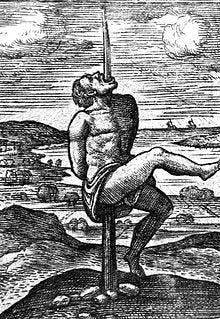
There’s a cruel joke here about how that may have been the very first pole dancing, but I’m not going to mention it. Oh, wait… ooops!
Impalement in heraldry is something completely different. It’s one of the ways to marshal, or combine two or more coats of arms in one heraldic shield, or escutcheon. Impalement was usually used to represent a union, most often involving a husband and wife, but also of other natures (for example, ecclesiastic).
Impalement was a natural evolution of dimidiation, in which the combination of the coats of arms was done in halves. The husband would place the right half (called the dexter) of his coat of arms next to the left half (sinister) of his wife’s. Dexter and sinister refer to the bearer’s right and left sides, not the viewers.
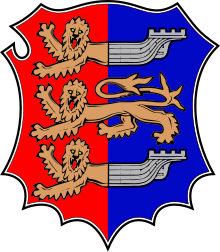
These combinations sometimes created an unusual or unfortunate result. Behold the lion-cement-mermaids!
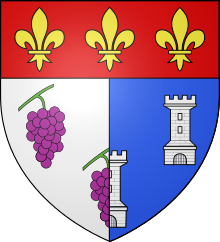
And the castle with hemorrhoids:
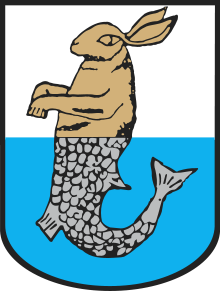
Sometimes coats of arms were dimidiated vertically, and the results were not much better:
Even though the above examples look cute or funny or horrific (depending on your point of view), the coats of arms of each side of the union were identifiable. This was not the case when the marshalling created a new design that could not be distinguished as two separate elements combined. For example:

Someone who saw the bottom coat of arms would think it was a chevron (inverted V) instead of two bends (the diagonals in the above two).
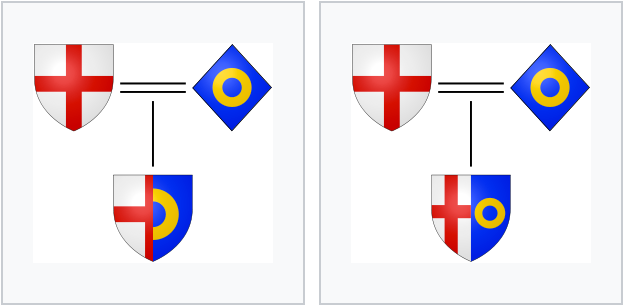
Impalement solved this problem by including the full coats of arms on each half. Below is an example of how two coats of arms look when dimidiated (on the left) and when impaled ( on the right).
A special and rare kind of impalement called tierce split the heraldic shield in three, and was sometimes used when a man had married twice. Some colleges have also used it:
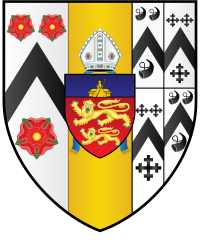
Above is the coat of arms of Brasenose College, in Oxford. The tierce to the reader’s left shows the personal arms of founder William Smyth, while the middle tierce shows his position as Bishop of Lincoln. The third tierce shows the coat of arms of the other founder, Sir Richard Sutton.
All pain, no gain
As I mentioned earlier, when I hear or read the word impalement, I think of that horrible way to die on a sharp stick. Specifically, two scenes come to mind.
One is the opening of The Loo Sanction, the sequel to The Eiger Sanction, both written by the late great Trevanian. The Eiger Sanction is the more famous of the two novels featuring Dr. Jonathan Hemlock, an art professor, mountaineer, collector of paintings… and paid assassin. Eiger was made into a movie featuring Clint Eastwood as the titular Hemlock.
The first scene in The Loo Sanction describes a spy dying after being impaled in the belfry of a church in London. Trevanian does a great job showing the agony the man is suffering.
The other scene is from the 1980 movie Cannibal Holocaust, directed by Italian Ruggero Deodato. This is one of the theatrical posters:
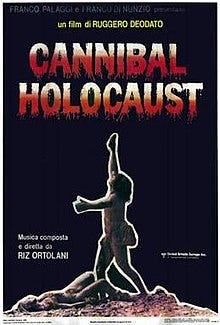
The rather tame one, considering the one I saw as a kid in Venezuela (where I grew up) featured a woman impaled on a stick. Just that poster gave me nightmares, and it took me a couple of decades to screw up enough courage to sit down and watch this movie.
Cannibal Holocaust was the original Blair Witch Project, at least when it comes to the “found footage” category of films. In the movie, New York University anthropologist Harold Monroe leads a rescue team into the Amazon rain forest to find a crew of filmmakers that went missing while filming a documentary on cannibal tribes. Monroe recovers only the crew’s lost cans of film and, upon viewing it, is horrified by what the filmmakers did in the Amazon.
The movie itself is supposed to be a commentary of America’s cult of violence.
It was extremely controversial when it was released, and was banned in many countries. The scenes of violence — including the impalement — were so realistic, that the director had to explain in court how the special effects were done and also had to prove that the actors he hired for the movie were still alive.
The movie holds up today, I think, and is indeed tough to watch. But in my opinion it’s worth it if you can stomach that level of violence and gore.
So, why did today’s Spelling Bee not include the word dimidiate? I have no clue, but it’s clear that the editors of the New York Times decided it is a dord.*
You can check out my previous entry on another dord* here:
*What the heck is a dord, you ask? Here’s the answer: