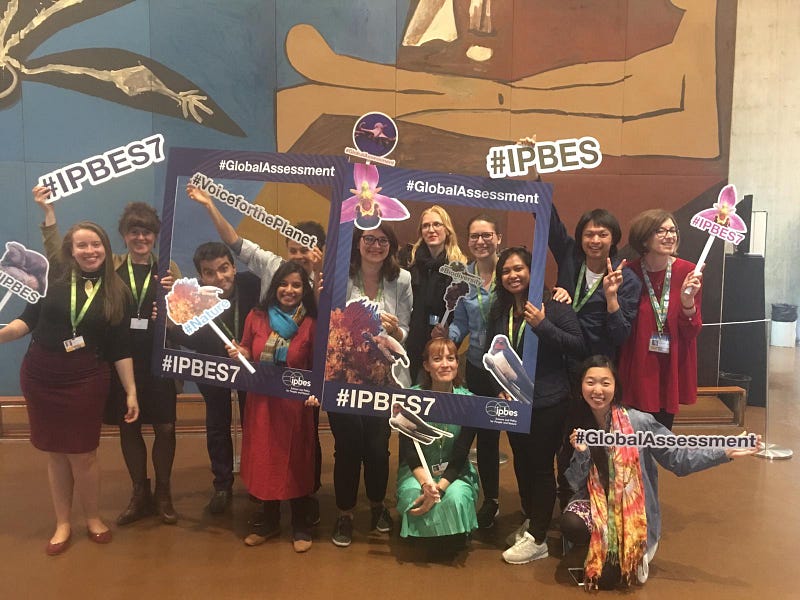
Did we agree on saving biodiversity?
Magnificent forests, cute animals, edible plants, all were at the centre of a debate between more than one hundred country delegates including countries hosting a large amount of humanity natural heritage and countries hosting industries threatening wildlife. During the first week of May, the Intergovernmental Platform for the Biodiversity and Ecosystem Services, IPBES also known as the IPCC for biodiversity, facilitated an international agreement shaped as a global assessment of biodiversity and ecosystem services that was officially released last week in Paris.
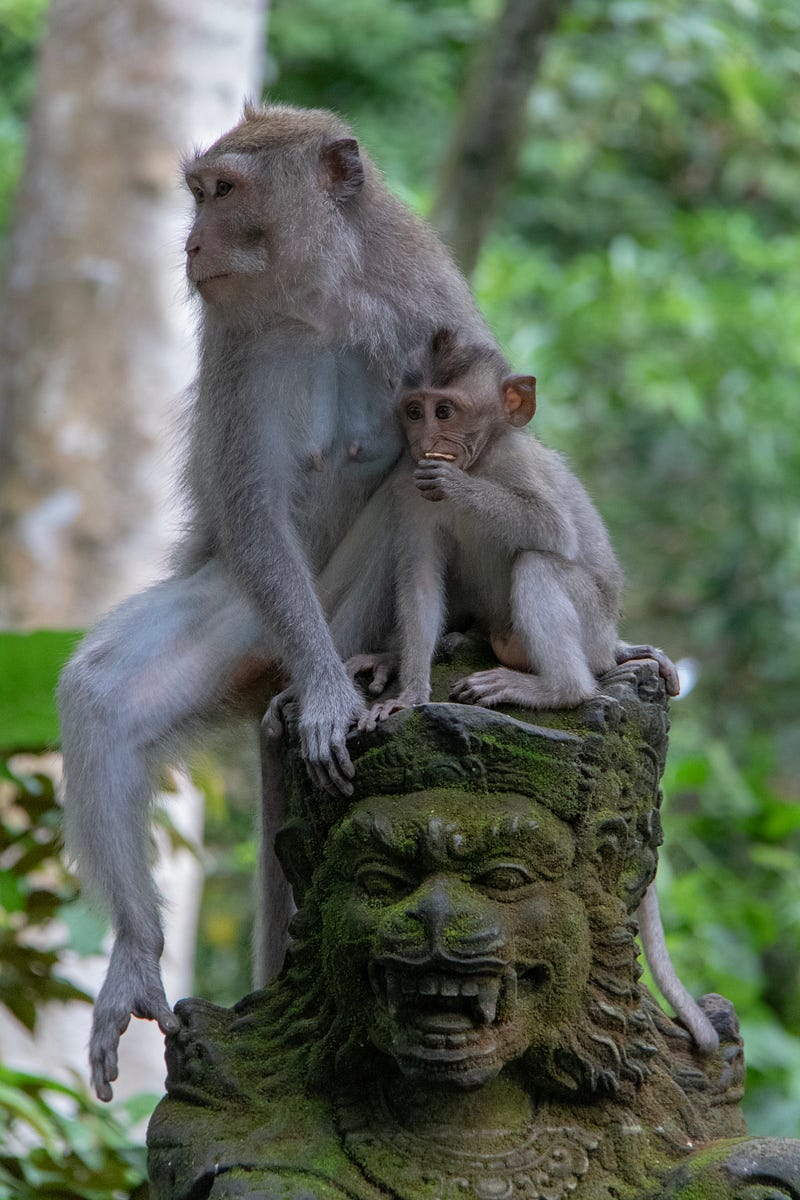
Biodiversity, ecosystem services and human wellbeing
In the past decades, humans have realized that their activities had an important impact on natural ecosystems. Agriculture and urbanization are culprits of transforming biodiverse wild land into monotonous, homogeneous and biologically poor areas. In addition, humans have transported and facilitated the invasion of various species in different corners of the world. Invaders which often completely transform the ecosystem, influence natural cycles and threaten native species.
A decade ago, humans realized that we receive many benefits from wildlife and natural ecosystems. In 2005, the Millennium Ecosystem Assessment co-signed by hundreds of scientists, made an inventory of all the services that biodiversity and ecosystems gave to humankind. Food of course is an obvious product that humans consume and enjoy every day and it is crucial to our wellbeing. Still, the products we buy like food or fuel (wood) are not the only benefits nature provides to humans. For example, beautiful landscapes where hikers spend hours would lose their attractiveness without trees, plants and greeneries. Moreover, many art pieces, religions and cultures rely on charismatic animals and plants. Even human creativity would be limited without the existence of a diversity of forms, colours and shapes in wildlife. How many inventions came from a close observation of nature? Biodiversity is key for the happy existence of humankind on Earth.
In addition, biodiversity is an insurance where each species of animals and plants complete each other and ensure the good functioning of an ecosystem. Ecosystems must function well, otherwise the environment as we know it will fall apart. For example, different plants in a forest clean the water going through their roots and prevent soil erosion. In a forest with only one species, such as a monoculture of acacia, the soil will not be as protected, and water will not be as filtered as in a rich and biodiverse forest.
Even though different species might have similar functions and roles in an ecosystem, their presence is an insurance for the constant functioning of the environment, if one species disappears another one will take its role and fill the niche. One could argue that we do not need all species and that biodiversity is not necessary for our wellbeing, however, one should remember that taking off one iron sheet from a plane increases the chance of a crash.
Biodiversity and nature in general significantly contribute to human wellbeing, and the unprecedented loss of animal and plant species we are witnessing now is a real threat to our wellbeing. As one million species are currently facing extinction and many more are constantly added to the IUCN Red List of endangered species, humans are innocently continuing to live on their high-rise buildings, breaking down their priceless connection to nature and forgetting its free contribution to their wellbeing.
An intergovernmental platform is like a classroom
At the 7th plenary of IPBES, the Global Assessment on Biodiversity and Ecosystem Services was prepared by scientists, then edited and agreed upon by policymakers for a wider distribution. During a week, hundreds of policymakers gathered to edit a word document on a large screen as big as the screen of your local movie theatre. Country representatives were debating, sometimes until 3 a.m, feeding themselves with gummy bears and coffee to stay awake and find the right words to put in the right paragraph. Interestingly, out of the hundred countries present at the plenary, only a dozen were actively speaking to propose changes in the document. I can vividly remember Bolivia delegates proposing changes on the text at every paragraphs. Bolivia was definitely the good pupil in the classroom! Delegates from other Latin American countries were also very active contributors. Countries from Asia were quieter and rarely spoke. Having worked and studied in Asia, I guess people from the Asia-Pacific region are culturally not used to speak in public and to give their opinions in class. I hope shy countries were able to provide inputs during the consultation period before the plenary week in Paris.
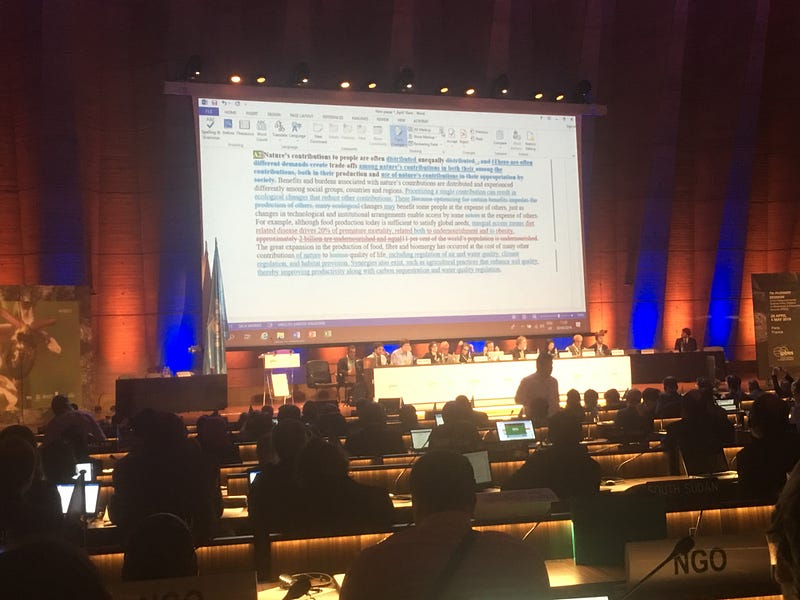
Besides not talking during the plenary, some countries sent delegates who might not be fit to their role. For example, some country delegates were from ministries of foreign affairs and therefore were not equipped with the knowledge to properly get involved in the negotiations. This either shows the country’s misunderstanding of the mission of IPBES or its disinterest to issues related to biodiversity and ecosystem services. IPBES goal would be achieved more easily if all member states of the platform could effectively participate and receive the necessary information prior to the plenary.
Governments agreed upon the scientific global assessment
Despite the platform challenges like increasing outreach and getting sustainable funding, the Intergovernmental Platform on Biodiversity and Ecosystem Services succeeded to have more than a hundred governments around the world to agree on this global assessment on biodiversity. It was the involvement of governments together with scientists which made this global assessment so unique. This assessment is not just another report in a long line of dire environmental prediction, but a summary of scientific evidences triggering an alarm bell which will ring in the ears of hundreds of governments to act now.
Governments agreed that nature highly contributed to human wellbeing and that many vital resources were provided by nature. Governments agreed that our current way of consuming and producing goods was not sustainable and that biodiversity and natural ecosystems were being degraded at an unprecedented pace. Governments agreed that something must be done to conserve biodiversity and the sustainable flow of goods and services we receive from nature. This global assessment is the proof that governments now recognize biodiversity loss as a global issue as important as climate change. As the global assessment was relayed in many national medias around the globe, I believe that IPBES has accomplished its mission to put biodiversity and ecosystem degradation at the same level of urgency as climate change in the mind of policymakers but also common people.
Now governments and people know
Looking at their grandchildren, people won’t have the excuse to say “we didn’t know” but they will have to take responsibility and tell them the stark truth “we didn’t act”. As government leaders are welcoming the global assessment, environmentalists are looking forward to how governments will implement solutions on the ground and achieve a transformative change where economic prosperity and human wellbeing will not be coupled with biodiversity loss and ecosystem degradation. I am personally looking forward to the COP-15 on Biodiversity which will be held in China in 2020 and where all governments will establish a strategic plan to save biodiversity and humankind in the years to come.
“I was born to know you To name you And with the power of one word I embrace life
Biodiversity”