avatarCarlyn Beccia

Free AI web copilot to create summaries, insights and extended knowledge, download it at here

3120

Abstract

carlynbeccia.com/">www.CarlynBeccia.com</a></figcaption></figure><p id="d11e">As you can see from the above cornucopia of dicks, the human penis is rather dull. No ridges, bumps, or corkscrews. Now I know what you naughty readers are thinking (because I went there too). Penile spines are merely bumps for her pleasure. What’s the problem?</p><p id="aaf1">Well, penile spines may have also abraded the vaginal canal, discouraging the young miss from having sex with multiple partners. Nothing like a scrub brush on your lady bits to make a gal monogamous.</p><p id="8301">Thus, anthropologists have theorized that humans lost their penile spines as we became more monogamous.</p><p id="7bc1">But that’s not the only adaptation influenced by mating strategies.</p><figure id="bcc7"><img src="https://cdn-images-1.readmedium.com/v2/resize:fit:800/1*1Z8BKv2SQu-LIExSw7EhBA.jpeg"><figcaption>Walrus Baculum — Penis bone Former collection of Armand de Montlezun | <i>Wikipedia</i>. <a href="https://en.wikipedia.org/wiki/Baculum#/media/File:Armand_de_Montlezun_(1841-1914)_Bacalum_Morse.jpg">CC BY-SA 4.0</a></figcaption></figure><h2 id="f2ae">Why did humans lose the bone in their boner?</h2><p id="462c">Early hominids once had an extraskeletal bone inside the penis called a baculum. The baculum is found in most mammals and primates and comes in different shapes and sizes depending on the species.</p><p id="cd34">Most scientists believe the baculum’s purpose is “post-copulatory sexual competition.” When a female mates with several males at a time, his sperm is in a mad race with his competitor’s sperm to reach the egg. The baculum then acts as a giant scooper to dislodge a competitor’s sperm and clear the path for fresh sperm.</p><p id="b712">Scientists aren’t entirely sure if the baculum’s only purpose was a sperm scooper. Another theory is that it stimulated ovulation. Unlike humans, most animals do not ovulate until they mate. So the baculum may have signaled the female to release an egg.</p><p id="aa93">Other researchers believe the baculum prolonged vaginal penetration so the woman couldn’t sneak off and have sex with another mate. We find this theory supported by primates. Primates who have prolonged sexy time also have a longer baculum, while the “hit it and quit it” primates have short bacula. For example, macaques have a long baculum because they take their time during sex. While the playboys of the jungle — gorillas — ejaculate quickly and have short bacula (and small penises).</p><p id="a67e">Either way, the baculum seems like a sweet addition to all penises. Add a bone, and you can always have a boner. So why did humans lose it?</p><p id="7b31">First, most outdated anatomy books show inaccurate illustrations of sexual intercourse. The penis is never straight inside a vagina during coitus. It makes a boomerang shape.</p><figure id="968e"><img src="https://cdn-images-1.readmedium.com/v2/resize:fit:800/1*OFnySz7dcZS_PeJ1p2N6AQ.jpeg"><figcaption>Artwork: © Carlyn Beccia | <a href="http://www.carlynbeccia.com/">www.CarlynBeccia.com</a></figcaption></figure><p id="f776">One theory

Options

is that a penis that lacked a bone had some advantages for the ladies. A boneless, flexible penis allowed humans to copulate in different positions and was more likely to stimulate the clitoral network. In other words, a penis that bends also bends for her pleasure.</p><p id="18dd">The reasons why the penis evolved are still unknown, but this begs a more pertinent question — is the penis done evolving?</p><p id="2031">If we move toward a more polygamous society, the penis might sprout bumps and corkscrew shapes to compete with a competitor’s sperm. Or perhaps society will swing more toward monogamy and close the orgasm gap. Then women will continue to sexually select the men with the most pleasurable penis shapes — smooth and bendable.</p><p id="6670">Evolution is always a slow-moving beast. How penises will look thousands of years from now is impossible to predict. Either way, removing the vagina scrubbing spines and rigid bone was an improvement we can appreciate.</p><h2 id="5f31">More from Carlyn Beccia:</h2><div id="9941" class="link-block"> <a href="https://readmedium.com/what-women-and-darwin-wish-men-knew-about-the-female-orgasm-a737f8ae72c8"> <div> <div> <h2>What Women (And Darwin) Wish Men Knew About The Female Orgasm</h2> <div><h3>It’s survival of the sexually fittest</h3></div> <div><p>medium.com</p></div> </div> <div> <div style="background-image: url(https://miro.readmedium.com/v2/resize:fit:320/1*LXRCIl4v3faosm1lb6bjrw.jpeg)"></div> </div> </div> </a> </div><div id="1eac" class="link-block"> <a href="https://readmedium.com/how-to-make-your-erection-last-without-pills-a8f80557d39"> <div> <div> <h2>How to Make Your Erection Last (Without Pills)</h2> <div><h3>Research shows you should do those Kegel exercises and eat your beans.</h3></div> <div><p>medium.com</p></div> </div> <div> <div style="background-image: url(https://miro.readmedium.com/v2/resize:fit:320/1*rv5eLES-Qnu399SF5u0dyg.jpeg)"></div> </div> </div> </a> </div><h2 id="9c47">To read more, please visit my affiliate link. A portion of your Medium subscription supports my writing and research:</h2><div id="21c4" class="link-block"> <a href="https://carlynbeccia.medium.com/membership"> <div> <div> <h2>Join Medium with my referral link - Carlyn Beccia</h2> <div><h3>Read every story from Carlyn Beccia (and thousands of other writers on Medium). Carlyn Beccia is an award-winning…</h3></div> <div><p>carlynbeccia.medium.com</p></div> </div> <div> <div style="background-image: url(https://miro.readmedium.com/v2/resize:fit:320/0*NHysj6sLz8PPydWk)"></div> </div> </div> </a> </div></article></body>

Did The Penis Evolve For Her Pleasure?

Losing the spines and bone was an improvement. Prove me wrong.
Artwork: © Carlyn Beccia | www.CarlynBeccia.com

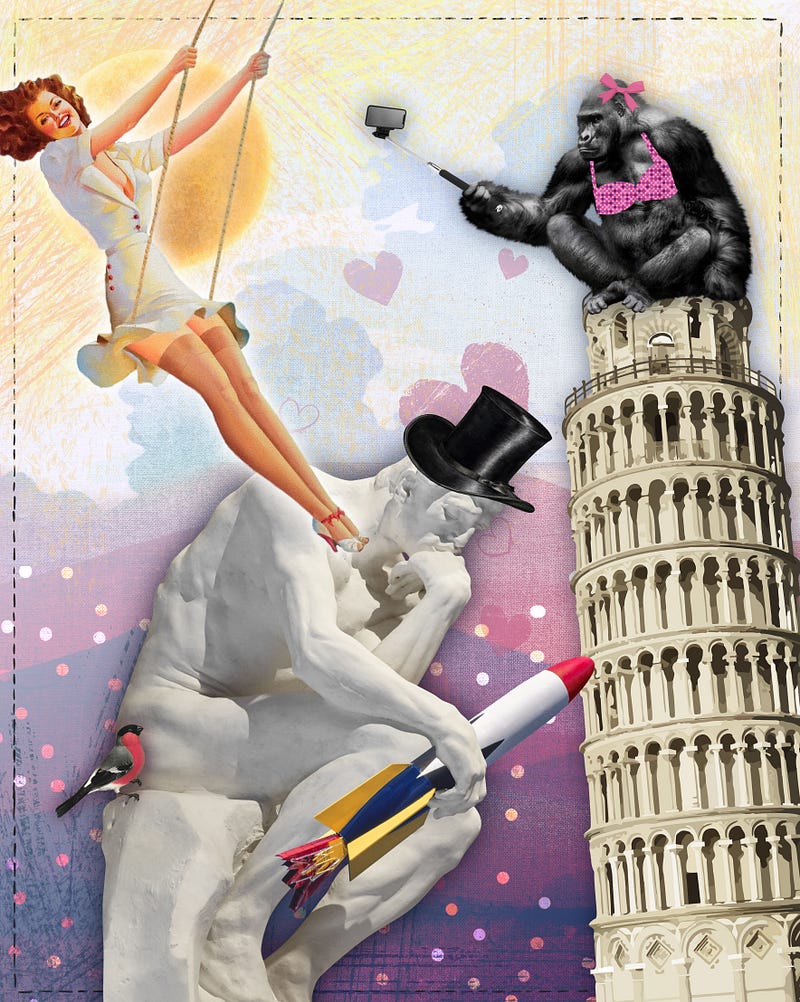
Have you ever wondered why gorillas have such minuscule penises (3cm/1.25 in.) and large testicles while humans have larger penises (13.12cm/5.16 in.) and small testicles? Even our closest human relatives, chimpanzees and bonobos, have small penises — 8cm or 3.14 in.

Some anthropologists have theorized that our early ancestors adapted larger penises to please the ladies. The larger penises felt better, so more women chose those men. Thus generation after generation, tiny gorilla-sized penises were weeded out through sexual selection.

Unfortunately, anthropologists can’t go back in time and measure our early hominids’ genitals. But you can bet we have some very creative dick pics on cave walls.
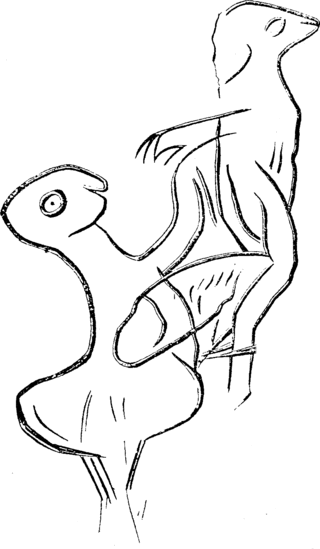
Cueva de Los Casares (Riba de Saelices, Spain) Cave art | Public Domain — Wikiwand

The above is a representation of a paleolithic drawing found in Cueva de Los Casares caves in Spain. I am not sure if this is a sex scene or the first example of goat yoga, but either way… that’s a big one. Most anthropologists believe these drawings were shamanistic representations meant to convey fertility rituals.

Obviously, we cannot glean much anatomical information from these fantastical cave drawings. We can only assume that a penis the size of a baseball bat was revered.

But although we don’t know the exact penis size of our prehistoric ancestors, we know that the penis once had spines. Fortunately, we lost that trait. And that might have been ladies' choice also.

Why did the penis lose its spines?

In a polygamous society, early hominids had much stiffer competition. Women copulated with multiple men in one frisky orgy. Multiple partners meant multiple inseminations. All that sperm competing for one egg… what’s a man to do?

He uses penile spines to remove the sperm of competitors.

Penile spines are tiny bump-like projections made of keratin — the same stuff in your hair and nails. Most primates and mammals still have penile spines, but at some point in our evolutionary story, early hominids lost these spines.

This is going to require a visual. I never thought I would use my medical illustration training to draw studded chimp dicks, but here we are.
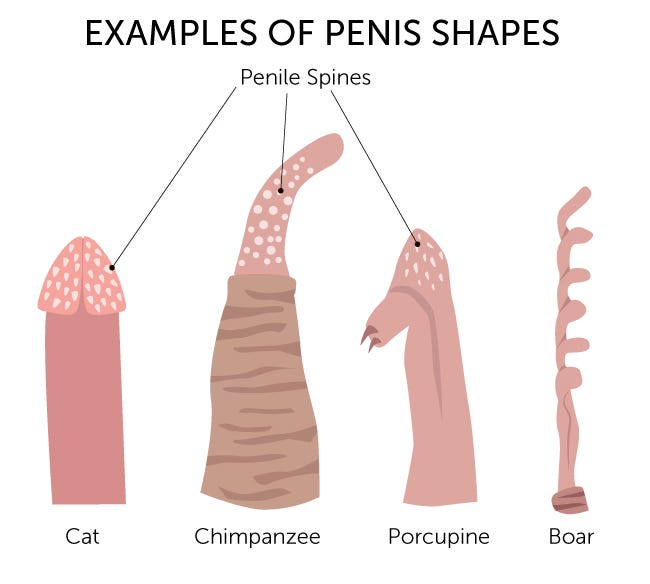
Artwork: © Carlyn Beccia | www.CarlynBeccia.com

As you can see from the above cornucopia of dicks, the human penis is rather dull. No ridges, bumps, or corkscrews. Now I know what you naughty readers are thinking (because I went there too). Penile spines are merely bumps for her pleasure. What’s the problem?

Well, penile spines may have also abraded the vaginal canal, discouraging the young miss from having sex with multiple partners. Nothing like a scrub brush on your lady bits to make a gal monogamous.

Thus, anthropologists have theorized that humans lost their penile spines as we became more monogamous.

But that’s not the only adaptation influenced by mating strategies.
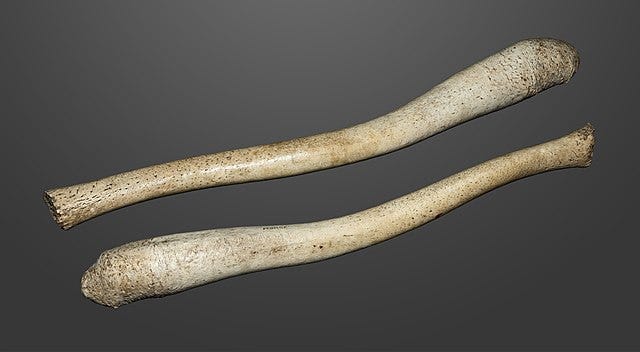
Walrus Baculum — Penis bone Former collection of Armand de Montlezun | Wikipedia. CC BY-SA 4.0

Why did humans lose the bone in their boner?

Early hominids once had an extraskeletal bone inside the penis called a baculum. The baculum is found in most mammals and primates and comes in different shapes and sizes depending on the species.

Most scientists believe the baculum’s purpose is “post-copulatory sexual competition.” When a female mates with several males at a time, his sperm is in a mad race with his competitor’s sperm to reach the egg. The baculum then acts as a giant scooper to dislodge a competitor’s sperm and clear the path for fresh sperm.

Scientists aren’t entirely sure if the baculum’s only purpose was a sperm scooper. Another theory is that it stimulated ovulation. Unlike humans, most animals do not ovulate until they mate. So the baculum may have signaled the female to release an egg.

Other researchers believe the baculum prolonged vaginal penetration so the woman couldn’t sneak off and have sex with another mate. We find this theory supported by primates. Primates who have prolonged sexy time also have a longer baculum, while the “hit it and quit it” primates have short bacula. For example, macaques have a long baculum because they take their time during sex. While the playboys of the jungle — gorillas — ejaculate quickly and have short bacula (and small penises).

Either way, the baculum seems like a sweet addition to all penises. Add a bone, and you can always have a boner. So why did humans lose it?

First, most outdated anatomy books show inaccurate illustrations of sexual intercourse. The penis is never straight inside a vagina during coitus. It makes a boomerang shape.
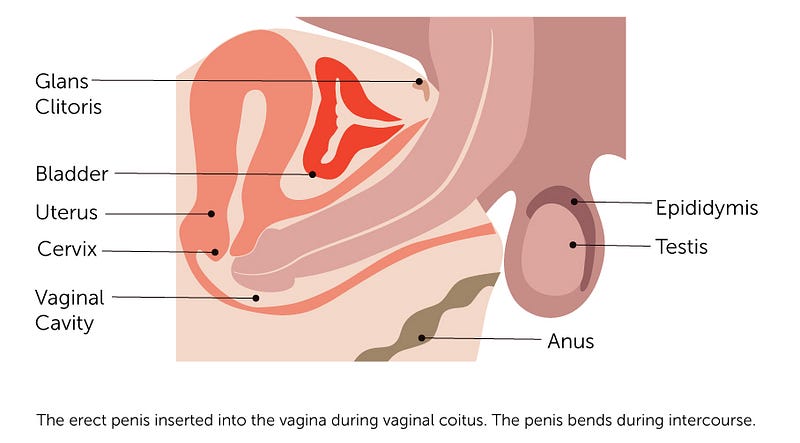
Artwork: © Carlyn Beccia | www.CarlynBeccia.com

One theory is that a penis that lacked a bone had some advantages for the ladies. A boneless, flexible penis allowed humans to copulate in different positions and was more likely to stimulate the clitoral network. In other words, a penis that bends also bends for her pleasure.

The reasons why the penis evolved are still unknown, but this begs a more pertinent question — is the penis done evolving?

If we move toward a more polygamous society, the penis might sprout bumps and corkscrew shapes to compete with a competitor’s sperm. Or perhaps society will swing more toward monogamy and close the orgasm gap. Then women will continue to sexually select the men with the most pleasurable penis shapes — smooth and bendable.

Evolution is always a slow-moving beast. How penises will look thousands of years from now is impossible to predict. Either way, removing the vagina scrubbing spines and rigid bone was an improvement we can appreciate.

More from Carlyn Beccia:

To read more, please visit my affiliate link. A portion of your Medium subscription supports my writing and research:

Sexuality
Science
Humor
Feminism
History
Recommended from ReadMedium