
Did Sports Broadcasting Ruin American English?
It wasn’t always the swamp of clichés it is today
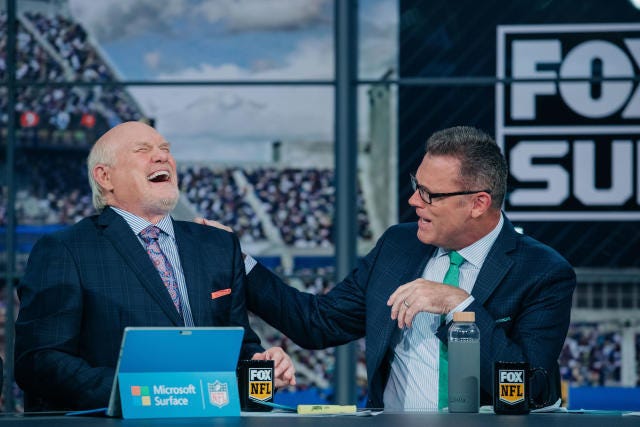
You might think, on otherwise glorious fall afternoons, that sportscasters have ruined American English with their theater-of-the-absurd commentary.
How many times have you heard a game analyst say that a team down by 32 points needs “to move the football downfield” and “put some points on the board”?
Maybe as often as you’ve heard during the World Series that a team behind by five runs has to “put some wood on the ball” and “score some runs.”
I’m the sort of fan who wants to shout at the TV set, “Excuse me, but isn’t moving the football downfield the entire point of this game?” And, “Please! Would you tell me something I can’t see by looking at the scoreboard?”
You can probably guess what went through my mind when an announcer praised a player’s great “vertical jump” in yesterday’s Alabama-Tennessee game: “As opposed to a horizontal jump?”
Sportscasting wasn’t always such a swamp of clichés and inanities, the late NBC newscaster Edwin Newman argued: The retired athletes wrecked it.
Newman wrote in Strictly Speaking: Will America Be the Death of English? (Warner, 1975):
“There is no way to measure the destructive effect of sports broadcasting on ordinary American English, but it must be considerable. In the early days sports broadcasting was done, with occasional exceptions such as Clem McCarthy, by non-experts, announcers. Their knowledge of the sports they described varied, but their English was generally of a high order. If they could not tell you much about the inside of the game they were covering, at any rate what they did tell you could understand.
“Then came the experts, which is to say the former athletes. They could tell you a great deal about the inside, but — again with some exceptions — not in a comprehensible way. They knew the terms the athletes themselves used, and for a while that added color to the broadcasts. But the inside terms were few, and the non-athlete announcers allowed themselves to be hemmed in by them — ‘He got good wood on that on,’ ‘He got the big jump,’ ‘He really challenged him on that one,’ ‘They’re high on him,’ ‘They came to play,’ ‘He’s really got the good hands,’ and ‘That has to be,’ as in ‘That has to be the best game Oakland has ever played.’
“The effect is deadening, on the enjoyment to be had from watching sports on television or reading about them, and, since sports make up so large a part of American life and do so much to set its tone, on the language we see and hear around us.”
Wouldn’t you like to know what Newman might have said about the cable TV news analysts who never say “It looks bad” when they can say the loftier “The optics are bad”?
@JaniceHarayda is an award-winning critic and journalist who has written for many major print and online media.
You might like some of my other stories about sports, including one written just before Georgia replaced Alabama as the №1 team in college football.