
Did I Kill George Floyd?
I’m a white person in America. Of course, I did.
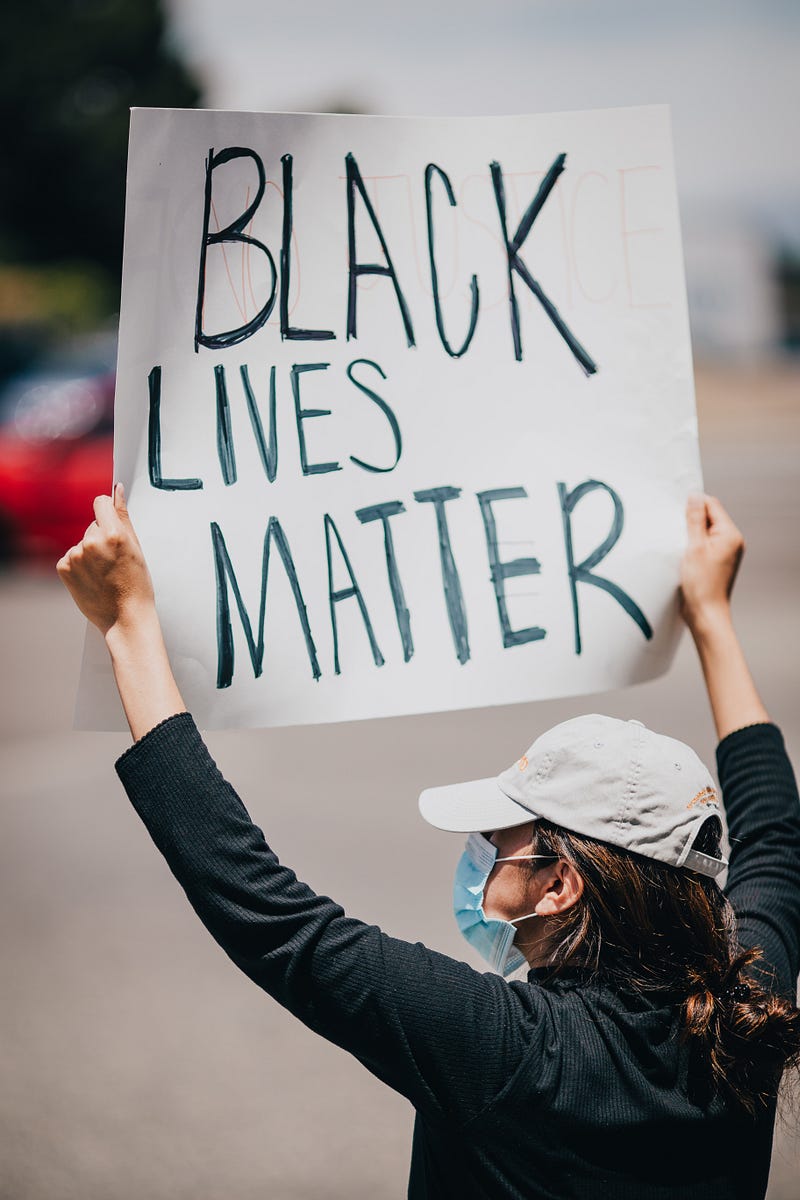
I have half a dozen pieces written on the outbreak of violence in this country since police murdered George Floyd.
Yet I haven’t published any of them.
The first few were written in the white heat of anger and revulsion about the act. Support for the protesters. My desire for change.
But as the days passed, I grew hesitant. What could I say that would add anything meaningful to the story, I wondered? As a white woman, were my words even welcome?
And then a paralysis set in as I watched events unfold that made me fear for all of us, that we were losing this country at the hands of both anarchists and authoritarians. I did not believe it was possible to feel any more shame about this current administration that represented me, but then, day after day, it showed there is no low too low.
Stories I might write came to mind, but the news moved too fast. Before I could finish one, my little insight became the morning headline.
One sign that kept showing up in protest after protest got my attention: White silence=violence.
That message has stayed with me because while it fits nicely as a slogan, as an editor, I can’t help but see that it needs some tweaking.
It’s white inaction that leads to violence.
But however, it’s written, that message gave me my marching orders. Time for me to put my message out there.
But then life took over, specifically deadlines by which I earn my living. And as I’ve worked nonstop on my client projects this week, with my iPad showing the news off in the corner so I could keep up, I realized what story I needed to tell. Not to you. You have all the stories you need. You just need to read them.
I need to understand my story for myself. I need to understand what this moment is saying to me as a white woman in America.
I need to understand if I killed George Floyd.
The verdict, of course, is yes, I absolutely did.
I need to understand my story for myself. I need to understand what this moment is saying to me as a white woman in America.
I need to understand if I killed George Floyd.
The verdict, of course, is yes, I absolutely did.
One story I started to write took me back to the Watts riots in the ’60s, possibly where the term guilty of driving while black may have originated. I vividly recall those weeks that tore up LA and riveted the nation after a black man was pulled over for speeding and reckless driving.
The question I wanted to pose was what has changed, but then so many other cable anchors beat me to it. However, the ’60s, rife with turmoil and social activism, was where I developed my political awareness. The hot button for whites confronting the civil rights era (sounds like a trend, like the Instapots and ripped jeans of today — watch out, they’ll go out of style, too) was whether or not whites bore guilt for slavery.
If you had a bleeding heart and liberal leanings back then, that question hit you in the gut. Your initial reaction was no, of course not. In my case, I never would have voted for slavery because, duh. Women didn’t get the vote until 1918. But you get my point. We can’t go back and say for sure how we would have resisted the pressures of a society that doesn’t even exist anymore.
Or does it?
I can recall my confusion over the issue of slavery back in my twenties. It sickened me, yet something about my role in the racism that took up the oxygen in the room before the passage of the Civil Rights Act made me squirm. Fifty years later, watching my country blow up, I can see clearly now, even without my glasses.
The question is not whether I’m responsible for slavery. Only the human traffickers who engaged in the filthy business carry that shame.
It’s the aftermath that weighs on my shoulders. All that happened in my life since a doctor’s visit to New York Hospital in the 1940's.
I was a bit of a sickly kid with asthma and allergies plaguing me since birth. At age seven or so, my mother took me to a clinic at New York Hospital for help when our GP offered nothing. If you know teaching hospitals, you know you never see one doctor, you’re treated by a team.
I’d received a battery of skin tests, and my arms were covered in itchy, red welts, the reactions to the plants, molds, and animals that caused my symptoms. My mother and I sat in a cramped examining room when the attending physician entered with half a dozen doctors in training that I now know would have been medical students, interns, and residents.
Each of them took a turn checking my arms, asking me questions, and rubbing their fingers over the bumps. I could barely breathe from the effort of resisting my need to scratch them. But I forgot my discomfort when the last doctor in line took his turn. I couldn’t keep my eyes off the distinguished man in the tie, shined shoes, and white coat with the stethoscope hanging out of his pocket, just like the other doctors. Because this doctor was black.
First, of course, I was astonished that a black person could also be a professional, but then I checked that shock when he asked to see my arm.
Was he really going to touch me, I recall asking my self in horror? I was raised to do as I was told, and back then, doctors were mini-gods, so whatever apprehension I had about being touched by a black man was over-ridden by my need to comply with a doctor’s request to stick out my arm one more time.
The black doctor sat down on the bench next to me and took my little arm in his hands and ran his fingers along my red and swollen skin. Instantly, I was struck dumb.
“He feels just like the others,” I thought.
I wish I could say there was a clap of thunder, that the heavens parted and angels began to sing at the opening of my mind. The man probably discussed my case with his colleagues as the others had, thanked my mother, and left the room, with no inkling that he had altered the course of my life. My allergies continued to plague me for the remainder of my life. However, that moment changed who I was.
In the years after, when I began to have my own social awakenings and took steps to break away from the bigoted environment in which I was raised, I credited that moment with the black doctor. He provided me with the realization that he was just like me in a fundamental way.
Yet, it took the past tumultuous, painful days to help me understand a basic truth about myself.
At age seven, eight, or nine, however old I was at the time of that medical exam, I was already a perfect little racist. I’ve never wanted to own that despicable term. But I had to be a racist, or I would never have been surprised that a black doctor even existed, nor would I have had the expectation that his skin would feel different from the half-dozen young white men who had just run their hands over my allergic reactions.
I knew what those guys would feel like. White people had been touching me since birth. They all felt the same more or less. My parents, brothers, and sisters, relatives, friends, even the nuns who taught me would usher me into the classroom or pew at mass by putting their familiar white hands on me.
So why would I expect a black hand to feel different? Because by then the racism in my family, my neighborhood, my school and church would have indoctrinated me. Somebody said give me a child until he’s seven and he’s mine for life. And with all the messages fed to me back then, like we’re all God’s children and do unto others, the one that got through was that black people were different, and damn, if I wasn’t better than them.
That man’s touch was the crack in the fabric of time for me. Because when that black doctor touched my skin, and his fingertips felt just like every white touch, something inside of me knew everything I’d absorbed about race was fake news.
But it took a long time for me to grow up and fully embrace my belief that we are all created equal. And in that time, and in the years since, too many black people have been killed in this country just because people who look like me can kneel on the necks of people who look like George Floyd.
The question for me now, almost 60 years after the advent of the Civil Rights Era that birthed my political sensitivities, is not whether I’m responsible for slavery, but what have I done about Jim Crow?
As a liberal white voter, I’ve never missed an election where I could put the “right” candidate in office. I say the “right” things about equality in public and have backed it up with letters to people in Congress. It sounds like a cliche, but I have black friends who are near and dear to me.
All good, but what about the rest of the time? How many of my 80-something years have I spent on the front lines fighting overt racism by volunteering for projects that fight unfair incarceration of blacks, or work on behalf of better schools and health care in minority communities?
I’m embarrassed to say almost none. I’m a big supporter of volunteerism, don’t get me wrong. I put in five life-altering years providing emotional support to people dying and grieving the loss of loved ones from AIDS. I trained for months and raised a boatload of money to walk 26.2 grueling miles to fight cancer.
But have I ever given up a pair of fancy shoes or a high-end piece of kitchen equipment in favor of donating to a civil rights cause when I couldn’t afford both? Please, don’t ask me to embarrass myself in public by admitting that I haven’t. Isn’t it enough I have to live with myself now that I’m taking stock of my life and my role in society, what I’ve done, and haven’t done to create change in this country?
Every free moment I‘ve wasted on frivolous living without an equal amount of time spent working for social justice is a mark against my so-called liberal credentials. In real terms, it means that as someone who holds a measure of privilege in this world, I’ve squandered my power to prevent police departments from normalizing brutality. I lost my chance to change minds and create a ripple effect that could have altered the outcome of elections that would have created fairer laws and truly equal representation.
Sure, I’ve done good things as a white person in this country, as things go, but when I look out at the horror of racism in this country, I haven’t done enough. Few white people have, or we wouldn’t have this stain on our national character.
And for that reason, yes, I killed George Floyd. So did every white person I know.
I don’t have much time left on this earth. It seems to have taken me a long time to learn some of my lessons. I hope that the black doctor that touched me so many years ago knows how deeply I felt his message. I’ve taken far too many detours, but I’m still learning.
What’s my next step? I can’t say, but no more sitting on the sidelines, just giving lip service to social justice. My friend Carol Piasente posted a powerful article yesterday, and it’s as good a manual for action as any.
It doesn’t really matter what I do next, or where I start, as long as I do something. Because White People+Action=Change.
I’m an editor and writer on Medium with Top Writer status. I’m also an editor for the publication, Rogues Gallery. I’ve published 55 titles on Amazon and edit for private clients. If you’d like to hire me as your editor for fiction, non-fiction, or business writing, please contact me here. If you’d like to read more of my work on Medium, click here to sign up for my newsletter. Thank you for reading.


