
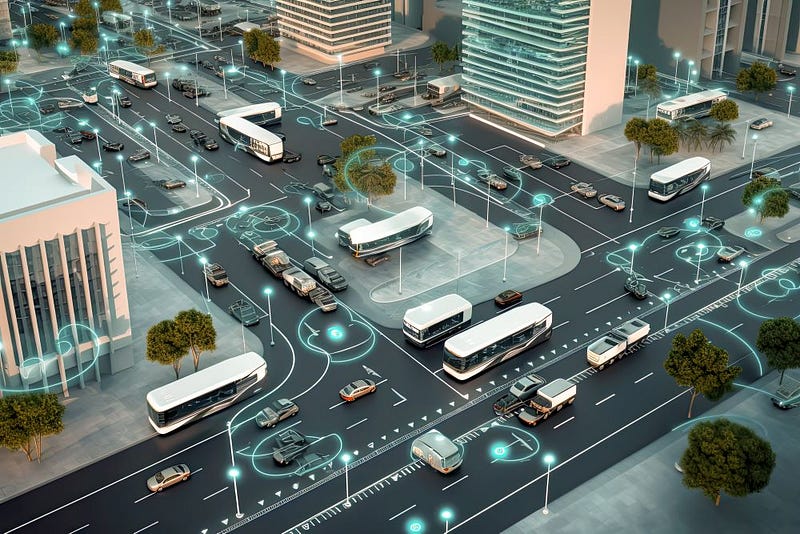
How AI Is Revolutionizing Transportation Efficiency and Safety
The integration of artificial intelligence (AI) into transportation infrastructure is ushering in a new era of improved efficiency, sustainability and safety across our mobility networks. As urban centers grapple with rising pollution, congestion and accident rates, AI-driven systems offer data-based solutions to optimize traffic flows, curb emissions and prevent collisions.
Streamlining Traffic, Reducing Carbon Footprints
In Seattle, Google’s use of machine learning to adjust traffic lights has already demonstrated profound impacts. By continuously analyzing traffic patterns and adjusting light sequences accordingly, commute times have dropped by 10% while stopping at red lights has reduced by 30%.
But the implications go beyond just commute improvements. With idling times decreased, over 100,000 hours of waiting has been eliminated annually, contributing to a noted 10% reduction in CO2 emissions from the studied intersections. This showcases AI’s immense potential to streamline urban mobility while diminishing the carbon footprints of our transport networks.
The AI Behind Smart Traffic Management
From predicting traffic flows based on time of day, events and weather patterns to employing computer vision for real-time vehicle detection, AI employs vast datasets and complex algorithms to gain deep insights into transportation dynamics.
In cities like Rome, AI adjusts traffic light phases based on traffic conditions. In Hamburg, the #transmove project combines machine learning with mobility forecasts to deliver reliable information on congestion and travel times across the city’s infrastructure.
Such smart traffic management is key to overcoming mobility bottlenecks and ensuring smooth traffic operations, with some implementations demonstrating 20–30% improvements in peak hour congestion.
Saving Lives Through Enhanced Safety
AI’s predictive capabilities are being directed towards analyzing accidents to identify collision hotspots. By studying trends in road geometry, time of day, weather patterns and driving behaviors, dangerous zones and periods can be pinpointed.
Interventions from better signage placement to speed limit adjustments are then enacted to minimize risk. In Hungary, insights from AI-based accident prediction models have led to modifications of dangerous road segments, contributing to a 17% year-on-year reduction in accidents.
And as autonomous vehicles become more prevalent, AI allows them to accurately perceive and interact with human drivers on the road, paving the way to reduced accidents through this machine-to-human coordination.
The Road Ahead: Promise and Challenges
As cities expand and mobility needs amplify, AI’s role in transportation will continue evolving. With greater proliferation of sensors across infrastructure and vehicles, the volume of data for AI systems to unlock value from will multiply exponentially. More holistic insights to advance efficiency, sustainability and safety efforts will emerge as machine learning capabilities progress.
However, to fully leverage AI’s potential, cities require significant investments towards technical capabilities and data infrastructure. As privacy and security considerations around mobility data rise, robust and transparent data governance will need to be instituted. And seamless integration with legacy systems remains an ongoing challenge.
But once harnessed responsibly, AI can transform the very fabric of transportation to make mobility safer, greener and more accessible for rapidly growing urban populations across the globe. The path ahead promises to be one paved with profound innovations that may one day redefine urban life altogether.