Devour, Digest, Defecate
Artist Wim Delvoye built an eating machine that celebrates biological processes whilst questioning the meaning of life and our worth in the world…
Belgian artist Wim Delvoye is the ‘bad boy’ of contemporary art, an agent provocateur who became notorious in the early twenty-first century when he built a machine that mimicked the human digestive system.
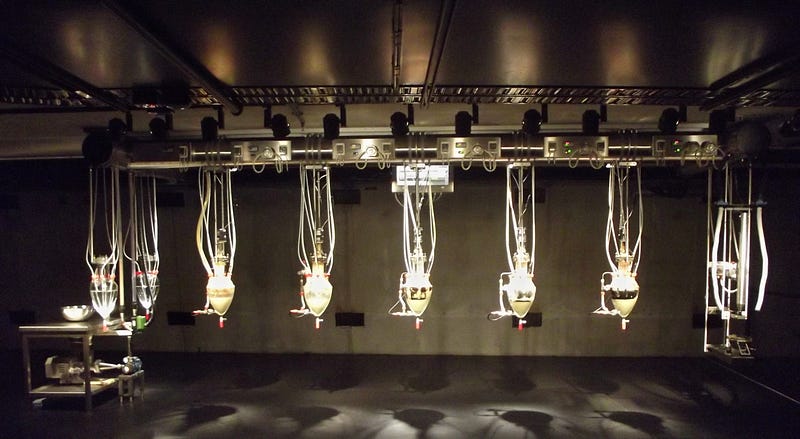
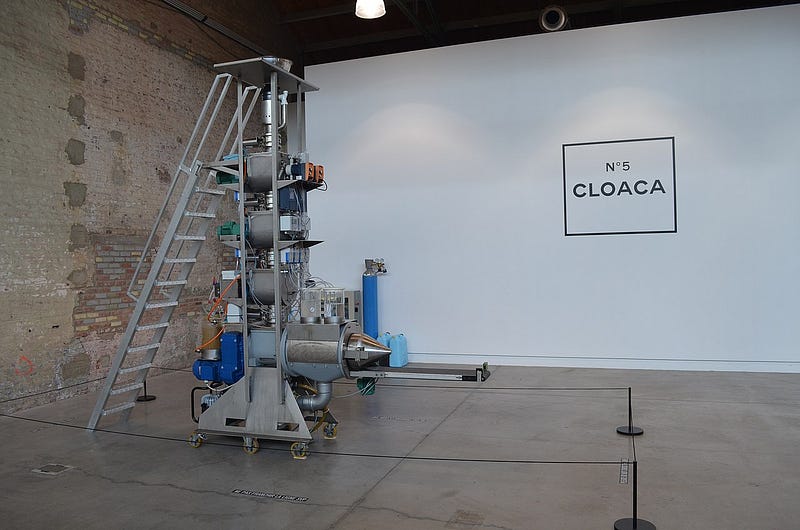
The Cloaca is a large contraption that he developed after much research with biologists, chemists, medics and manufacturers. It was a process of collaboration that extends beyond the artist and across several disciplines not usually associated with fine art. When activated, Cloaca needs food to function so the installation also requires a kitchen and a chef to prepare its two square meals a day.
.jpg)
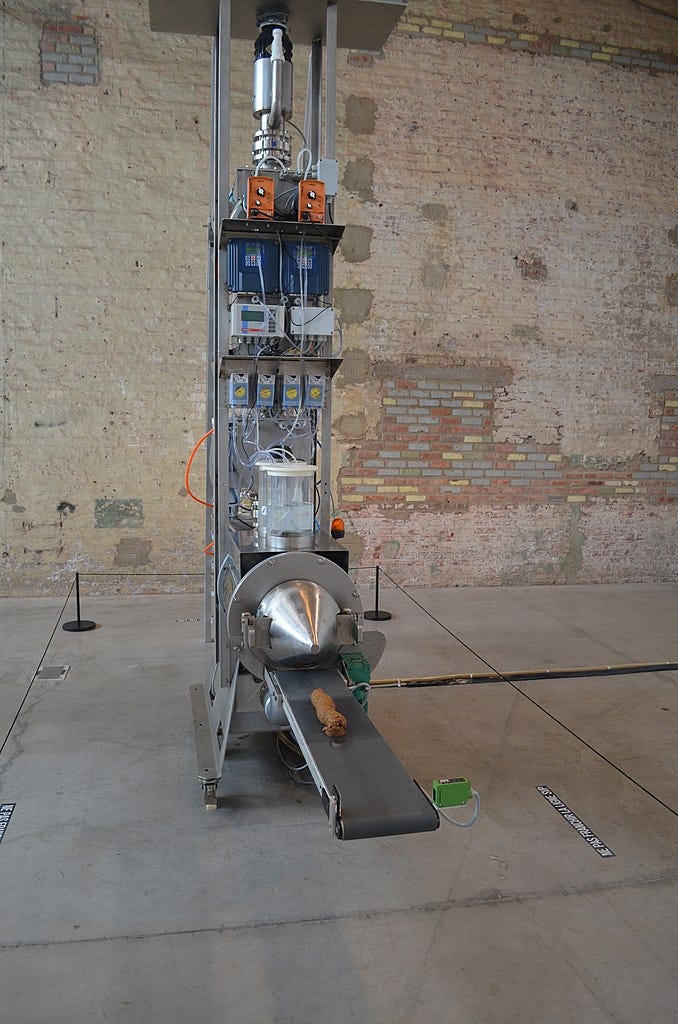
To do something that only approximates what our stomach and intestines are capable of, the machine needed to be ‘room-sized’. The food enters at one end via its ‘mouth’ and then passes through various chambers and mechanisms. Early versions utilised a washing machine filled with enzymes to act as a ‘stomach’.
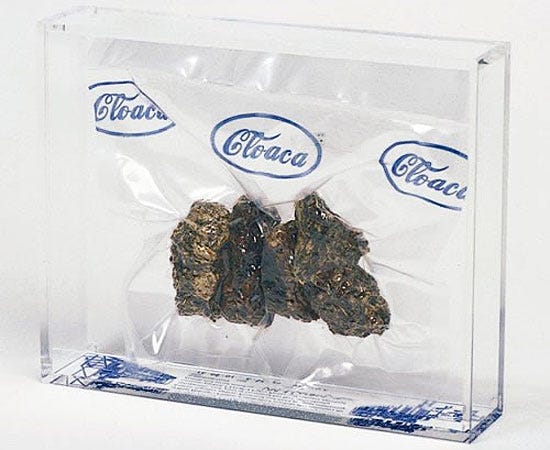
The digestive process takes about 24 hours, until the broken-down pulpy fluid is finally pumped through a series of tubes that separate the moisture from the solid material. Turds are excreted from its ‘anus’ and are then dried before being vacuum-packed and sold as art in small display cases. Delvoye also had toilet rolls produced, specially printed with the Cloaca logo. This, of course, elicited the predictable crap jokes from media and public alike.
It is a joke and Delvoye would be first to crack a smile. The entire work has been derided by some as pointless because all it does is consume and produce waste. Hang on, cannot the same be said of many people? So, perhaps that is the point. If we contribute nothing more, then we are similarly reduced to the mechanistic biological functions of our body. We devour, digest, defecate. What else?
So, joking aside, we may ponder what it is to be human. Art has continually tackled this question. Cloaca could align with Organic Surrealism’s preoccupation with automatons and human simulacra in the ongoing exploration of what makes us what we are. Are we no more than a collection of biochemical processes? At what point does such a collection of processes become life? Our actions, as expressions of our intellect, are all that set us aside from machines and make us more than a sum of our cells.
Cloaca challenges our validity and prompts us to prove our individual worth. Or, as Wim Delvoye once put it, “Imagine a very rich man who plays golf. He spends a massive amount of time and money for just one purpose: to put a little ball into a hole. Isn’t that absurd?”
Delvoye sees the digestive system as a thing of wonder that is under-represented, considering its huge importance in our daily lives. He finds it strange that artists creating representations of the human body in the form of sculpture, or making likenesses of its exterior using paints, are not at all controversial. Yet attempting to analyse and recreate an essential aspect of the human body can be dismissed so readily. In many ways, this is a more realistic portrait of ‘the human’ than any marble or bronze statue could be. It presents a semblance of life itself.
Cloaca is a portrait of biological processes and structures that have driven the evolution of complex, multi-cellular organisms. Really, the one-way gut can be thought of as the major feature that unites all complex animals, from ‘primitive’ worms to mammals …like us.


When the first animals began eating and digesting, competition for resources increased. The most efficient grazers could put more food into themselves, but the more adaptable gut could better extract the nourishment from a wider variety of available stuff. When one animal adapted to eat another, well, that’s when evolution through natural selection really sped up.
The latest research into the community of symbiotic microorganisms that live inside us, is revealing just how important it is. Our microbiome seems to be directly linked with our long term health and overall lifespan in an extremely complex and subtle way. What we eat really affects our ‘gut health’. Our personal biomes have now been linked to the cause and, more importantly, the prevention of many life-limiting illnesses.
Cloaca is process art. The process taking place within it is just as much a part of the work as the physical sculpture we see in the room, which has changed in configuration over the years. Since its debut in 2000, Cloaca has been exhibited in different, increasingly refined, versions. It’s almost as if it’s ‘growing’ — going through a kind of organic evolution itself. It’s become more elegant and efficient. Art and science have been in constant conversation and through their synthesis, profound philosophical notions have arisen.
It’s often said that the creative individual, author or artist, is enriched by their experiences that ‘feed’ into their work. No doubt this is true. I also recall a perceptive critic pointing out that if we think about that simile, we may realise that no matter what the quality of the ‘food’ we put in, the end result is pretty much the same…