avatarKarin Tamerius

Free AI web copilot to create summaries, insights and extended knowledge, download it at here

3336

Abstract

cular tend to be overlooked:</h2><ol><li><b>Winning is about <i>shifting</i> the spectrum away from opponents, not overpowering them. </b>That is, success has as much to do with undermining support for your opponent as it does with building up support for you.</li><li><b>The strategic objective for passive opponents is to <i>neutralize, not convert</i>. </b>That means we don’t need Republican supporters to vote for us, we just need them to be less committed to voting against us.</li></ol><h1 id="e8ad">Spectrum of Allies Analysis for 2020</h1><p id="0818">A <a href="https://beautifultrouble.org/principle/shift-the-spectrum-of-allies/">Spectrum analysis</a> for the Biden campaign looks like this (although we could quibble about whether some of those swing voters actually fall in the passive opponent or even active opponent categories):</p><p id="3258"><b>Active allies </b>(Reliable Democrats/strong Biden supporters)</p><ul><li><a href="https://washingtonmonthly.com/2020/01/17/who-exactly-makes-up-the-democratic-base/">Democratic base</a></li></ul><p id="7524"><b>Passive allies </b>(Unreliable Democrats/soft Biden supporters)</p><ul><li><a href="http://www.nytimes.com/2019/11/07/upshot/nonvoters-2020-presidential-election.html">Low-turnout/nonvoting Democrats</a></li><li><a href="https://www.nytimes.com/2020/02/26/opinion/black-voters-2020-election.html">Unregistered Democrats</a></li><li><a href="https://www.people-press.org/2019/03/14/political-independents-who-they-are-what-they-think/">Democratic-leaning independents</a></li><li><a href="https://www.nytimes.com/2020/03/09/opinion/joe-biden-never-trump.html">#NeverTrump Republicans</a></li></ul><p id="fa25"><b>Neutral </b>(Swing voters/persuadables)</p><ul><li><a href="https://www.politico.com/magazine/story/2017/06/01/democrats-new-crossover-voters-romney-clinton-215211">Romney/Clinton voters</a></li><li><a href="https://www.usatoday.com/story/news/politics/elections/2020/03/29/bernie-sanders-supporters-vote-trump-over-biden-poll/2936124001/">Sanders/Trump voters</a></li><li><a href="https://www.nytimes.com/2020/01/06/opinion/obama-trump-voters.html">Obama/Trump voters</a></li><li><a href="https://nymag.com/intelligencer/2019/03/true-independent-voters-are-few-in-number-often-apolitical.html">True independents</a></li><li><a href="https://www.usatoday.com/story/news/politics/2019/03/22/paleologos-poll-third-party-voters-could-decide-2020/3233830002/">Third-party voters</a></li></ul><p id="094c"><b>Passive opponents </b>(Unreliable Republicans/soft Trump supporters)</p><ul><li><a href="https://www.people-press.org/2019/03/14/political-independents-who-they-are-what-they-think/">Republican-leaning voters</a></li><li><a href="https://fivethirtyeight.com/features/increased-voter-turnout-could-benefit-republicans-or-democrats-in-2020/">Unregistered/low-turnout Republicans</a></li></ul><p id="f7a2"><b>Active opponents </b>(Reliable Republicans/strong Trump supporters)</p><ul><li><a href="https://www.washingtonpost.com/opinions/trumps-base-is-smaller-than-he-thinks/2019/10/06/0826a842-e6dd-11e9-a6e8-8759c5c7f608_story.html">Trump’s base</a></li></ul><h2 id="a302">According to this analysis, the three core objectives of Biden’s campaign should be:</h2><ol><li><b>Register & turn out</b> passive Democrats/Biden supporters</li><li><

Options

b>Persuade</b> swing voters to support Biden</li><li><b>Demobilize & dissuade</b> unreliable Republicans/soft Trump supporters</li></ol><p id="b8a3">Currently, however, Democrats are focusing exclusively on <a href="https://prospect.org/politics/why-2020-is-a-turnout-election/">#1 (voter mobilization)</a> and <a href="https://www.washingtonpost.com/opinions/2019/06/18/swing-voters-hold-key-heres-who-they-are/">#2 (persuasion)</a> while ignoring #3 (demobilization & dissuasion).</p><h1 id="8b84">Why This Matters</h1><h2 id="112c">1. Trump will get more votes.</h2><p id="8959">Remember, the goal isn’t to convert these voters into Biden supporters, but to decrease the likelihood that they feel passionate enough to vote against him. While many of these voter may lean toward Trump, they don’t necessarily love him and many may choose to stay home if they think Biden isn’t that much worse. To make that happen, we need to direct resources toward improving their perception of the Democratic nominee.</p><h2 id="7c60">2. Republicans will mobilize their voters more easily.</h2><p id="e7c9">When we ignore Republican voters, we cede a large percentage of the electorate from the get-go. That means Republican campaigns need to spend less time and money mobilizing these voters.</p><h2 id="0d97">3. Republicans will have more resources for other endeavors.</h2><p id="1d52">If Republicans don’t have to worry so much at mobilizing their voters, it will free up resources for other objectives, like persuading undecided voters and suppressing voter turnout.</p><h2 id="4d0c">4. Republican mobilization will translate into more than just votes.</h2><p id="f8f5">As Republican voters become mobilized, some of those voters will move further right, becoming activists or, more problematic, extremists. Even when we can’t get people to change their voting behavior, there’s a lot to be gained by reducing the likelihood they will go out and work against us.</p><h2 id="be47">5. We will inadvertently mobilize Republicans.</h2><p id="1447">When we don’t pay attention to the right side of the Spectrum, we don’t notice when our tactics have adverse side effects. As I recently pointed out in <a href="https://readmedium.com/dear-democrats-beware-the-dragon-of-the-2020-election-96378e500a40#0039">Dear Democrats, Beware Dragon Voters</a>, attacks on Trump and his supporters designed to rile up our base often simultaneously rile up Republicans. Any mobilization campaign that revs up Republicans as much or more than our base is a losing strategy.</p><h1 id="9847">Time for a change</h1><p id="f759">Democrats have a long history of doing what we’ve always done and thinking it will work better this time because we’re going to do it better.</p><p id="4308">The reality is the problem isn’t with execution so much as our strategy itself. Yes, mobilization is important. Yes, persuasion can make a difference. But ignoring the elephant in the room is a huge mistake that could very well cost us the election.</p><h1 id="d931">About the Author</h1><p id="4277">Dr. Karin Tamerius is the founder of Smart Politics, a former psychiatrist, and an expert in political psychology who specializes in teaching progressives how to communicate more productively and persuasively with people across the political spectrum.</p></article></body>

Democrats Are Failing Campaigning 101

Why do we always forget the right side of the Spectrum of Allies?
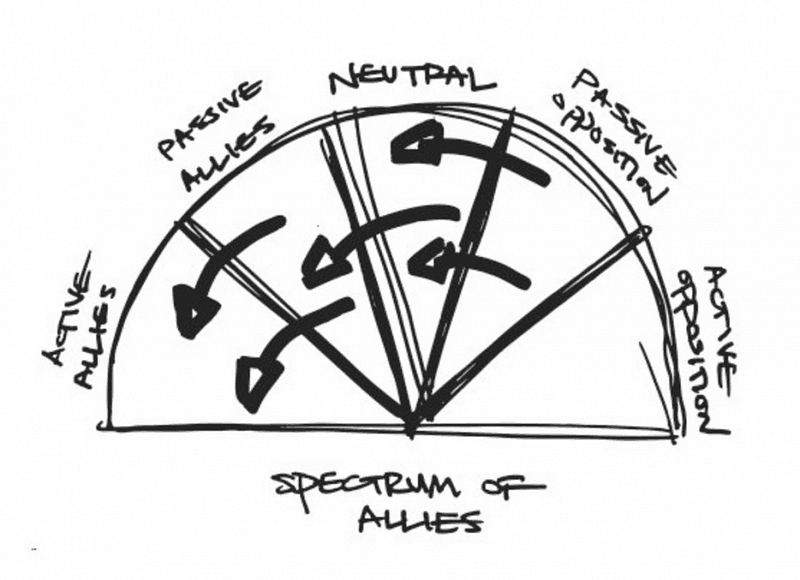
Art by Josh Kahn: Attribution-NonCommercial-ShareAlike CC BY-NC-SA

Democrats have a blind spot when it comes to campaign strategy.

In the 1960’s, George Lakey created a strategic model that changed political organizing forever. The Spectrum of Allies posits that the outcome of every social movement hinges on the behavior of five groups: active allies, passive allies, passive opponents, active opponents, and neutral observers.

According to the model, the opinions and behavior of groups at either end of the spectrum — strong supporters and strong opponents — are largely fixed, while the opinions and behavior of groups in the middle of the spectrum — passive supporters, the neutral, and passive opponents — are more fluid and open to change.

The job of political organizers is to influence the three middle groups, one, because we can and, two, because what those groups do will determine whether the movement succeeds or fails.

It turns out the Spectrum of Allies model maps on to election campaigns as well as it does on to social movements. Viewed through this lens, strong allies are reliable Democratic voters, passive allies are lower turnout Democratic voters and leaners, neutral people are swing voters, passive opponents are lower turnout Republican voters and leaners, and strong opponents are reliable Republican voters.

As a general rule, Democrats build excellent mobilization and persuasion campaigns for low-turnout Democrats and swing voters. But we leave the third group — lower turnout Republicans and leaners — almost entirely out of our calculations.

This is a strategic error and one that demonstrates a misunderstanding of the theoretical foundations of Lakey’s model.

The Spectrum of Allies Explained

While almost anyone who has spent significant time in community or campaign organizing can tell you what the Spectrum is, far fewer can articulate the core principles that make it revolutionary.

The core ideas:

  1. All people in a community fall on a five-category spectrum from active allies to active opponents.
  2. Success is achieved when people are shifted to the left of the spectrum (toward allies and away from opponents) — not when allies overpower opponents.
  3. To shift the spectrum, focus on influencing the people in the middle three categories — passive allies, neutral, and passive opponents — not the people at the extremes.
  4. The strategic objective for each group is to shift them one category to the left — passive allies to active allies, neutral to passive allies, and passive opponents to neutral.
  5. Achieving the unique strategic objective for each group requires different tactics.

Of these core ideas, two in particular tend to be overlooked:

  1. Winning is about shifting the spectrum away from opponents, not overpowering them. That is, success has as much to do with undermining support for your opponent as it does with building up support for you.
  2. The strategic objective for passive opponents is to neutralize, not convert. That means we don’t need Republican supporters to vote for us, we just need them to be less committed to voting against us.

Spectrum of Allies Analysis for 2020

A Spectrum analysis for the Biden campaign looks like this (although we could quibble about whether some of those swing voters actually fall in the passive opponent or even active opponent categories):

Active allies (Reliable Democrats/strong Biden supporters)

Passive allies (Unreliable Democrats/soft Biden supporters)

Neutral (Swing voters/persuadables)

Passive opponents (Unreliable Republicans/soft Trump supporters)

Active opponents (Reliable Republicans/strong Trump supporters)

According to this analysis, the three core objectives of Biden’s campaign should be:

  1. Register & turn out passive Democrats/Biden supporters
  2. Persuade swing voters to support Biden
  3. Demobilize & dissuade unreliable Republicans/soft Trump supporters

Currently, however, Democrats are focusing exclusively on #1 (voter mobilization) and #2 (persuasion) while ignoring #3 (demobilization & dissuasion).

Why This Matters

1. Trump will get more votes.

Remember, the goal isn’t to convert these voters into Biden supporters, but to decrease the likelihood that they feel passionate enough to vote against him. While many of these voter may lean toward Trump, they don’t necessarily love him and many may choose to stay home if they think Biden isn’t that much worse. To make that happen, we need to direct resources toward improving their perception of the Democratic nominee.

2. Republicans will mobilize their voters more easily.

When we ignore Republican voters, we cede a large percentage of the electorate from the get-go. That means Republican campaigns need to spend less time and money mobilizing these voters.

3. Republicans will have more resources for other endeavors.

If Republicans don’t have to worry so much at mobilizing their voters, it will free up resources for other objectives, like persuading undecided voters and suppressing voter turnout.

4. Republican mobilization will translate into more than just votes.

As Republican voters become mobilized, some of those voters will move further right, becoming activists or, more problematic, extremists. Even when we can’t get people to change their voting behavior, there’s a lot to be gained by reducing the likelihood they will go out and work against us.

5. We will inadvertently mobilize Republicans.

When we don’t pay attention to the right side of the Spectrum, we don’t notice when our tactics have adverse side effects. As I recently pointed out in Dear Democrats, Beware Dragon Voters, attacks on Trump and his supporters designed to rile up our base often simultaneously rile up Republicans. Any mobilization campaign that revs up Republicans as much or more than our base is a losing strategy.

Time for a change

Democrats have a long history of doing what we’ve always done and thinking it will work better this time because we’re going to do it better.

The reality is the problem isn’t with execution so much as our strategy itself. Yes, mobilization is important. Yes, persuasion can make a difference. But ignoring the elephant in the room is a huge mistake that could very well cost us the election.

About the Author

Dr. Karin Tamerius is the founder of Smart Politics, a former psychiatrist, and an expert in political psychology who specializes in teaching progressives how to communicate more productively and persuasively with people across the political spectrum.

Politics
Democrats
Elections
Strategy
Trump
Recommended from ReadMedium