
Demanding “Regime Change” While Claiming You Actually Aren’t — Dianne Feinstein Edition
“Regime change” is incredibly easy to oppose in the abstract. Seldom will you hear anyone of note tout their support for “regime change” as a general principle, and even the most unrepentant US hawks now typically acknowledge that previous “regime change” efforts undertaken in Iraq, Libya, and to some extent Syria have had disastrous results. The term itself— “regime change” — usually only comes up as a pejorative, and as an object of criticism.
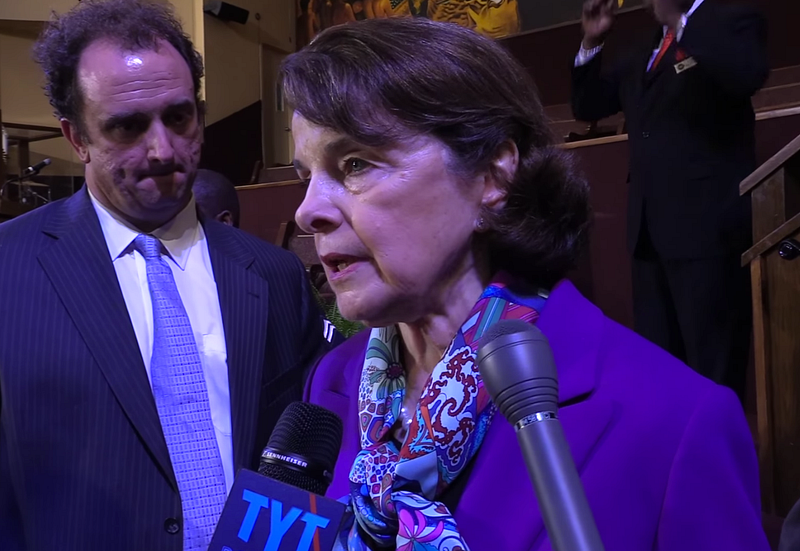
That’s why it’s imperative to discern accurately a politician’s views on “regime change” by reference to their position on particular, specific conflicts or initiatives, rather than their general feelings about “regime change.” For example, militarily ousting Assad would undoubtedly constitute “regime change” by any reasonable definition of the term, but politicians who favor that policy tend not to want admit what they’re really advocating. For example, at a town hall yesterday in Los Angeles, Sen. Dianne Feinstein (D-CA) declared that Assad “should be ousted from office,” and that the US must “take a more aggressive role” in facilitating that outcome. She reiterated her support for Trump’s missile strikes on a Syrian government installation earlier this month, much to the umbrage of a cadre of vocal constituents who booed vociferously.
If you are arguing that the United States ought to militarily oust a ruler from power, then you are unquestionably calling for “regime change,” notwithstanding the unpleasant connotation of that term. So, I tried to elucidate the paradox here by questioning Feinstein, asking her why her constituents should be at all confident in the ability of the US government to successfully facilitate “regime change” in Syria, given the failures of Iraq and Libya. She replied, “I don’t think we should have any confidence in regime change right now.” And yet the policy that she just got done affirming support for is nothing else if not “regime change.” Asked to explain this disjunction, Feinstein replied: “I don’t want to get into semantics… I think you know what I was saying.”
Well…it’s not really a matter of semantics. You can’t on the one hand run around solemnly affirming that the lessons of previous “regime change” escapades must be internalized, and then proceed to back every instance of “regime change” which comes before you. And yet, this illogic is thoroughly bipartisan. Rep. Mike Conaway (R-TX), the new chair of the House committee investigating alleged “Russian interference” in the 2016 election, made a similar comment to me last week; he too expressed reticence about the efficacy of regime change, but nevertheless affirmed the strategic value of Trump’s airstrikes on Syrian government targets. Even Sen. Bernie Sanders (I-VT) has made statements that are similarly incongruous.
“Regime change” as a desirable policy option is so ingrained in the body politic and the political class — perceived as so normal and so rational — that the people who demand it often aren’t even fully conscious of what it is they’re advocating. They can develop these elaborate mental gymnastic constructions that on the one hand allow them to pose as skeptics of “regime change” in the abstract, while on the other hand favoring specific instances of “regime change” policy without explicitly framing it as such.


