
Bernie Sanders And “The Resistance” Slink Away On Syria
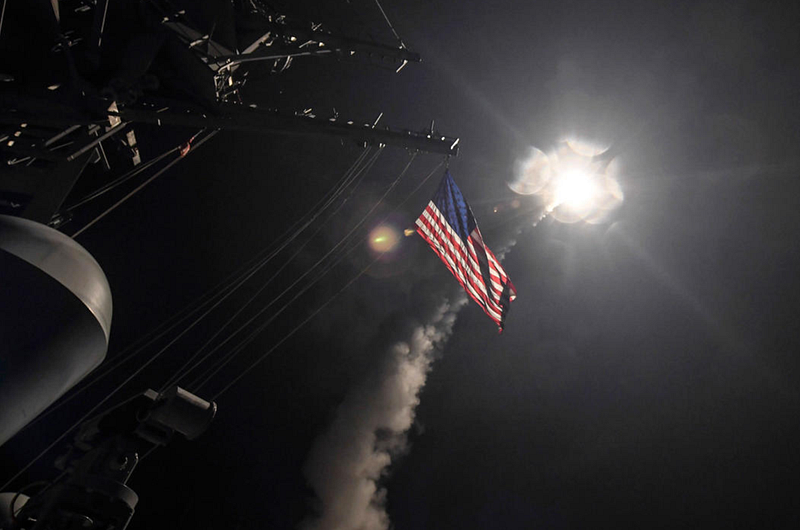
In the wake of last week’s missile strikes in Syria, a number of elected officials demonstrated that it was more than possible to state one’s opposition in clear, unambiguous terms. Sen. Brian Schatz (D-HI) said, “a military response is not the answer,” thus leaving no doubt as to his rejection of the utility of military force. Sen. Rand Paul (R-KY) said, “The United States was not attacked… Our prior interventions in this region have done nothing to make us safer, and Syria will be no different.” No equivocation there. Sen. Tim Kaine (D-VA) voiced clear opposition on procedural (but not necessarily principled or strategic) grounds, declaring the strikes “unlawful.” Others, like Rep. Tulsi Gabbard (D-HI) made their principled, strategic, and procedural objections abundantly plain: “President Trump’s missile attack on Syria is dangerous, rash and unconstitutional,” she wrote.
Notice how none of those statements require a convoluted interpretative effort to discern their meaning. Their message is communicated in plain terms without layering on extraneous qualifications. And so, in its compilation of senators’ positions on the strikes, FiveThirtyEight reasonably characterizes Kaine and Schatz as “opposed.” Not “Opposed, but…” or “Concerned.” Just “opposed.”


Meanwhile, here’s how FiveThirtyEight characterizes Bernie Sanders:

The characterization is apt. Sanders’ initial statement on the strikes contained nothing that could be reasonably construed as a declaration of opposition. Instead, the statement is a meandering mishmash of generalities and ‘reservations,’ couched in enough ambiguity that on a cursory skim it could be taken to signal opposition or condemnation. Slightly misleadingly, the statement was then excerpted into individual tweets, which falsely gave the impression that Sanders opposed the strikes, when all he had done was signal his “deep concern” as to the potential ramifications of the strikes. That’s a crucial distinction.
“Raising concerns” is not tantamount to an expression of clear, articulable opposition. One can support the Syria strikes, and yet be “concerned” about the second-order effect of them, and the escalated conflict that might result. (See Schumer, Chuck, who rushed to endorse Trump’s attack within hours, only to then follow-up later with expressions of “worry” as to the long-term consequences).
Similarly, Sanders expressed “concern” about the potential consequences of Trump’s attack, but not opposition to the act itself. Unlike Schatz, Paul, and Gabbard, he has not rejected on principle the utility of American military force in this circumstance. He merely wants Trump to “explain to the American people” what is to be achieved by the strikes, and to put forward a plan for a “political solution.” Neither of these demands constitutes first-order opposition to the strikes: They are second-order worries. Even Sanders’ procedural complaints don’t signify opposition — unlike Kaine, he doesn’t declare the strikes “unlawful,” he merely says that “Congress has a responsibility to weigh in,” which virtually no one in that body would disagree with.
Then, on Meet the Press this past Sunday, Sanders went further: “We eventually have got to get rid of Assad,” he told Chuck Todd, thereby endorsing the underlying logic of regime change. His only apparent recommendation is that this particular regime change be effectuated multi-laterally, i.e, the US should enlist some Middle Eastern autocrats to help out.
The notion that the US ought to be taking proactive measures (militarily or otherwise) to force the deposal of an existing government is nothing if not the classic definition of “regime change.” During the 2016 presidential campaign, Sanders repeatedly voiced skepticism of “regime change,” but, as ever, voicing skepticism in general terms — who likes interminable quagmires? — is much easier than voicing opposition to specific actions, in the midst of a propaganda onslaught and omni-directional public/political pressure.
In the immediate aftermath of a military action is when principled opposition to “regime change” would really count. And the plain fact is, Sanders does not oppose regime change in this instance, and he does not oppose on principle the US being a central actor in facilitating the ouster of Assad. That’s why FiveThirtyEight characterized him as “ambiguous” and noncommittal — because his comments since Thursday give credence to the logic underlying Trump’s attack.
Tulsi Gabbard made a point Sunday that is exactly correct:
In almost every other instance, the professional #Resistance crowd is chomping at the bit to oppose any Trump action purely because Trump is doing it: They view opposing Trump in all circumstances as the primary goal of their political program. They demanded that every Trump cabinet or judicial nominee be voted against even though doing so was purely symbolic and ultimately futile, given that essentially all the nominees got approved regardless. They denounce even the appearance of “colluding” or “collaborating” with Trump as unconscionable apostasy. And yet, when it comes to war on Syria, the shrieking #Resist crowd suddenly gets… a lot less vocal.
Perhaps that’s because the utility of regime change is affirmed by the political/media class on a wholly bipartisan basis, and #TheResistance was never much more than an establishment hoodwink intended to conjure a sense of renegade opposition while really just serving to rehabilitate the image of a failed liberal intelligentsia.
And then when even the nation’s premier democratic socialist and tribune of left-wing causes can’t bring himself to issue a forthright condemnation of an unprovoked attack on a sovereign government — and in turn the commencement of yet another indefinite Middle East conflict — one gets a sense of how deeply ingrained the pro-intervention attitude is in the political class. That’s why the incentives under which Trump is operating are so perverse: Taking aggressive military action is probably the least controversial thing he could do.