
Deflating the Mystique of Religious Language
The mundane and psychedelic origins of theological concepts

Religions are paradoxical since on the one hand their theological claims are obviously false, and the religious institutions even emphasize their absurdity in the creeds to test their members’ loyalty to the organization. Yet on the other hand, these religions persist for centuries or millennia.
Partly, as Richard Dawkins has remarked, this persistence of theistic absurdities is due to how the theologies and rituals are transmitted widely from adults to children in the familial context, so that religions benefit from the instinctive gullibility of each fresh generation of initiates.
But there’s also an underappreciated factor, which is the oddity of religious language. Religions tend to adopt a double conception of truth so that a theology will have exoteric and esoteric readings, meaning interpretations that are fit, respectively, for outsiders and insiders. The exoteric interpretations are simplistic, literalistic, and supposedly inerrant, while the esoteric ones are generally more mystical, philosophical, and equivocal.
So far, that’s familiar at least to those who study religions. What’s odd, though, is that the exoteric interpretations are the most supernatural, whereas the most esoteric way of understanding theism is subversive and naturalistic. Thus, religions’ farfetched claims and practices are popular because they’re socially useful, while religions’ deepest truths are likely to hide in plain sight.
Take, for instance, the religious talk of gods. Plainly, there are familial and political dimensions to this metaphor since children naturally look up to their elders, and throughout premodern civilized history all around the world, an elite upper class was effectively worshiped as divine.
Regardless of what was taken to be the exact relationship between the highest gods and the royals, whether the latter were regarded as the gods’ incarnations or chief representatives, for instance, the social fact is that these human leaders were treated as if they were worthy of worship. They alone lived the best life, full of luxuries and liberties. Kings had harems and wealth beyond imagining, and servants attended to their every need, while slaves and peasants lived almost like animals in comparison.
Yet the ancient talk of gods wasn’t exclusively so political. The gods were characters in myths, and they were associated with forces that had cosmic obligations such as the maintenance of nature’s cycles. How, then, did the political and the cosmological aspects of religious discourse interrelate?

Two directions of influence
Two possibilities present themselves:
- The family unit and the monarchical concentration of political power acted as models for theological speculation.
- Those social structures themselves were driven by theological knowledge or religious experience.
At first glance, the second option seems quite dubious since there are independent reasons for those social inequalities.
Whether they’re polygamous or monogamous, human parents are unequal to their children for obvious biological reasons: infants are born helpless with an oversized, still growing head, and they must be born prematurely lest their head damage the mother’s birth canal. (This evolutionary fact alone shows that our species isn’t the direct product of intelligent design.) Parents or other elder guardians must care for the offspring since unlike the young of other species, human babies aren’t independent.
Consequently, children implicitly trust their elders since they must learn from them to survive. And our species has been living with that biological inequality between generations for hundreds of thousands of years.
It’s much more likely, then, that religions project that sociobiological relationship onto the gods’ alleged condescension towards us than that our species’ evolution is due to some real, prior supernatural inequality between gods and mortals.
Similarly, there are pragmatic reasons for the concentration of political power in large societies. Smaller groups of nomadic hunter-gatherers could have operated anarchically since the group dynamics wouldn’t have been as complex, and each member of the clan had to be independent, to survive in the wild and to keep up with the animal herds.
Early sedentary societies kept the anarchical, egalitarian values, but as these societies competed for resources and members, to compensate for the perils of agriculture, social hierarchies developed to manage the larger groups and to enforce laws that protected the society even at the expense of some of its members. Indeed, the lower class’s interests came to be sacrificed to benefit the elite minority.
In short, with imperialism came the logic of the so-called law of oligarchy: power was centralized for the Hobbesian reason that imperialism had to be perpetuated by fear since this social system was manifestly unjust. The conscience had to be overcome, so an elite class had to be elevated to the point of virtual godhood so it could terrorize the masses into sacrificing themselves for the collective good.
Some such sociological explanation, at any rate, makes secular sense of that emerging inequality between civilized classes, so once again there’s no need for any appeal to a prior inequality between supernatural masters and human servants.
Yet that’s not the end of the story since there’s a natural basis for religious experience, too, namely the psychonautics of shamanism. The gods were seemingly encountered in hallucinations and peak states of consciousness, due to the spiritual leader’s ingestion of psychoactive plants, frenzied dancing and chanting, near-death experiences, and so on.
Again, the naturalistic explanation is stronger than any theistic one since what’s encountered in these heightened or bizarre states of consciousness is more likely to be an aspect of the self than an extraterrestrial agent.
Thus, both directions of influence seem to have occurred, creating a feedback loop between them.
Historically, religious experience likely preceded the political factor, although not the familial one. Cannabis use, for instance, is as old as 8,200 BCE, according to archeological evidence from Japan. Conceivably, the religious experience that’s essential to shamanism could have impacted the choice of nomadic and sedentary social structures since once the theistic mythos was in play, shamans, priests, and political leaders might have associated themselves with the presumed divine heroes or supernatural forces to marshal popular support for their initiatives.
That theocratic propaganda would have dovetailed with the evolutionary basis for generational inequalities and with the law of oligarchy that took over in large sedentary societies.
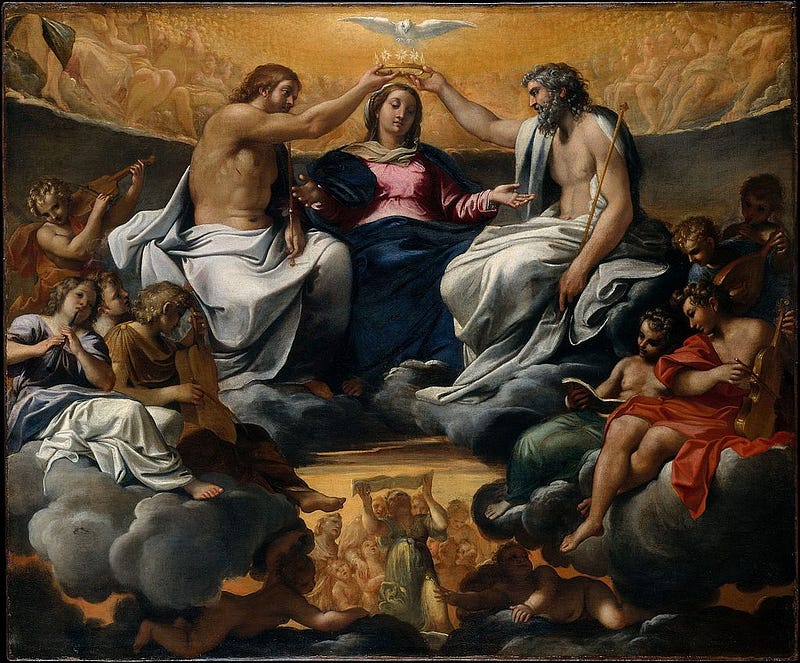

The double meaning of religious language
The relevance of that analysis is that it helps us explain the mystique of religious language.
When we talk about gods or “angels” in the twenty-first century, we have in mind some supernatural figures or forces. To identify the gods with powerful humans would deflate the religion since however lofty the royals might have been treated, they were still mortal and fallible. The “heavenly” cosmological responsibilities were larger than mere humans could manage.
Thus, the mundane meaning of religious language had to be inflated, so that the familial and political inequalities were projected onto the outer-worldly scope of the mythos. The gods, too, had families, and they ruled over their chosen tribes or societies, just as the human upper class ruled over its slaves and peasants.
Again, there’s that dual aspect of religious meaning, but now we see more of the trickery involved in the semantic shifts. Religious language can seem lofty, despite its palpable absurdity because it’s based on mundane realities. Human elders really are revered by children since the former are relatively all-knowing and all-powerful. And the political upper class really did live as a pantheon of godlike beings in ancient polytheistic societies. Those social disparities are matters of natural and historical fact.
All theism does, then, is obfuscate those mundane inequalities by extending them to an intuitive form of religious cosmology. Now the natural cycles themselves were similarly ruled by parental figures or political rulers. As the occultists say, what’s below was reflected in what’s above. Naively, the heavens and the earth were deemed analogous.
Setting aside the question of whether the theistic discourse is likely true or false, we can at least appreciate the dual meanings involved, and how the mundane meanings grounded the theology and rituals. Rather than being flatly insane, the religious absurdities that test the faithful have a kernel of relevance since they’re based on that occult analogy.
Jews, for instance, speak of Yahweh as a father, ruler of their tribe, or king of the universe. Even as their scriptures indulge in personification, Jews eschew idolatry. Thus, we have the double meaning at issue. The exoteric meaning is supposed to be the crude comparison between God and human authority figures, while the esoteric significance is mystical (kabbalistic): God is supposed to be mysterious and unlike anything corporeal.
Yet the more the esoteric meaning is stressed, the more absurd and irrelevant monotheistic theology becomes since an immaterial deity is as good as nothing at all, and an impersonal god is hardly any comfort to worshippers. Thus, there’s a crucial equivocation in theistic religions, as the mystical abstractions borrow their gravitas from the mundane idolatry, as in the literalistic analogies between God and the human hero or other authority figure.
Academic religious abstractions could be dismissed as intellectual showboating, but in so far as religious folks equivocate between them and the self-serving personifications, the pair of meanings affords the best of both worlds. The impersonal abstractions will seem realistic because of their biological, political, and psychedelic meanings, but they’ll be immune to refutation because of they’re supposed to belong to an elevated, supernatural context.
On atheistic grounds, however, there’s a sense in which the idols’ crudity makes for the esoteric truth since that direction of influence subverts the religions. Religious institutions and indeed cultures generally glorify their ethos with grandiose stories, and the stories can enchant only when the audience is able to suspend its disbelief in the mythic conceits.
Of course, atheists reject religious language as misleading and counterproductive, so they’d be inclined to emphasize theology’s mundane origins, and this would deflate the theist’s pretensions.
At any rate, there’s no need to appeal to theism to explain the mystique behind religious language since that power to enchant and enthrall worshippers is founded on a dubious equivocation between the mundane, rather bathetic origins of theistic concepts, and the grandiose, cosmological abstractions.
I collect my Medium writings in paperback and eBook forms, and I put them up on Amazon. Check them out if you’d like to have them handy and to support my writing in that way. The newest one is Aristocrats in the Wild, and its 538 pages are filled with 89 recent articles of mine on religion and philosophy.