
Roleplaying Games / Board Games
Death Sports on TV are Inevitable
The Hunt: The Ultimate Arena Sport
Tactical tabletop RPGs are having a moment. I want that moment to stop right the fuck now. Lancer’s tactical mechanics ruined an otherwise brilliant sci-fi game. Then Lancer’s publisher made a fantasy counterpart, ICON. Now the creator of the beloved and very not-tactical Wanderhome has thrown their hat into that terrible ring with In The Time Of Monsters.
All this dudes-on-a-grid nonsense has forced me to come to grips with my own past sins. Many moons ago, before I knew better, I once liked a heavily tactical RPG. And I am ashamed.
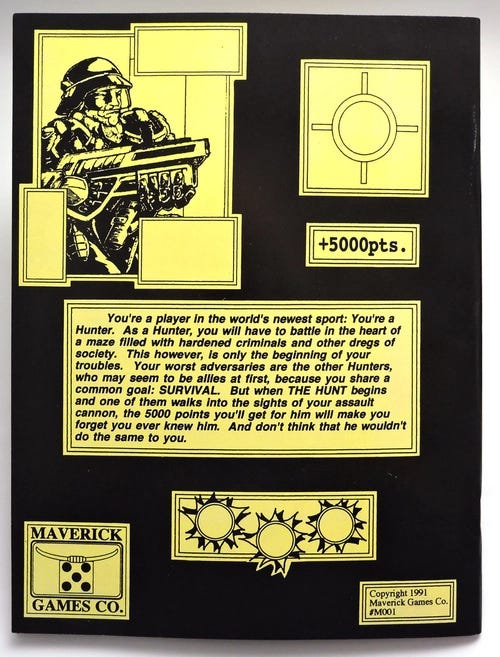
A while back I mentioned The Hunt in a piece about the recent TSR drama. What I failed to mention was that I had re-bought the damn thing but had yet to write about it. I didn’t know how to approach it. It barely qualifies as an RPG. If you flipped through it, you’d be forgiven for thinking it’s a Space Hulk-ish skirmish game. It’s listed on Board Game Geek but not RPG Geek. That’s telling.
The fact that the real-world game and the in-universe sport share the same name doesn’t help. To avoid confusion, I will call the game you play “The Hunt” and the in-universe sport “THE HUNT”.
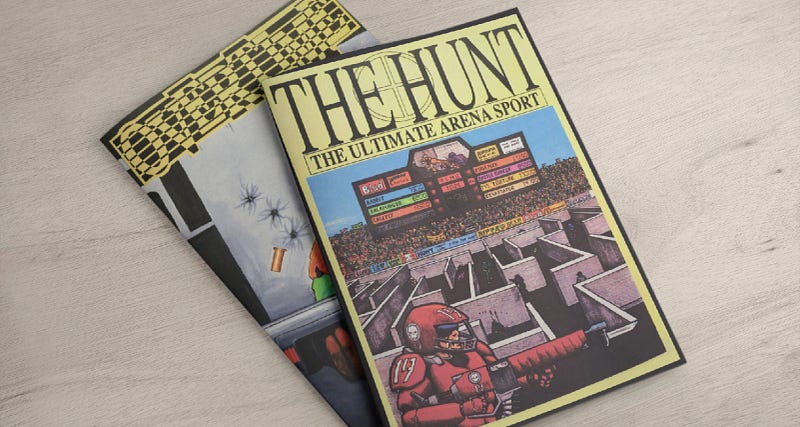
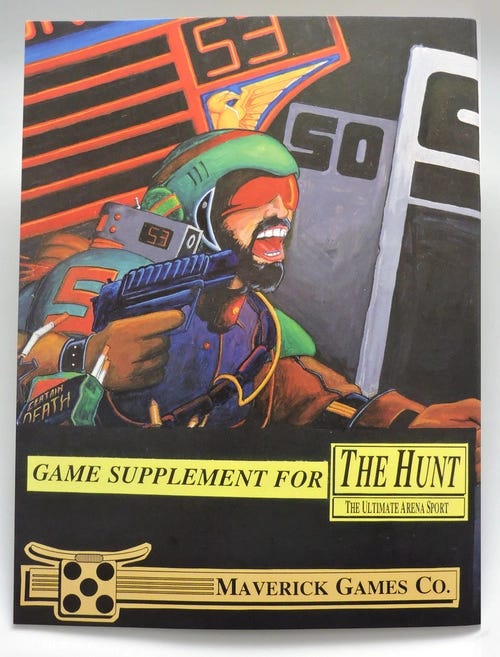
Currently the The Hunt comes bundled with its sole supplement, Overtime.
The Good
THE HUNT Makes Tragic and Terrible Sense
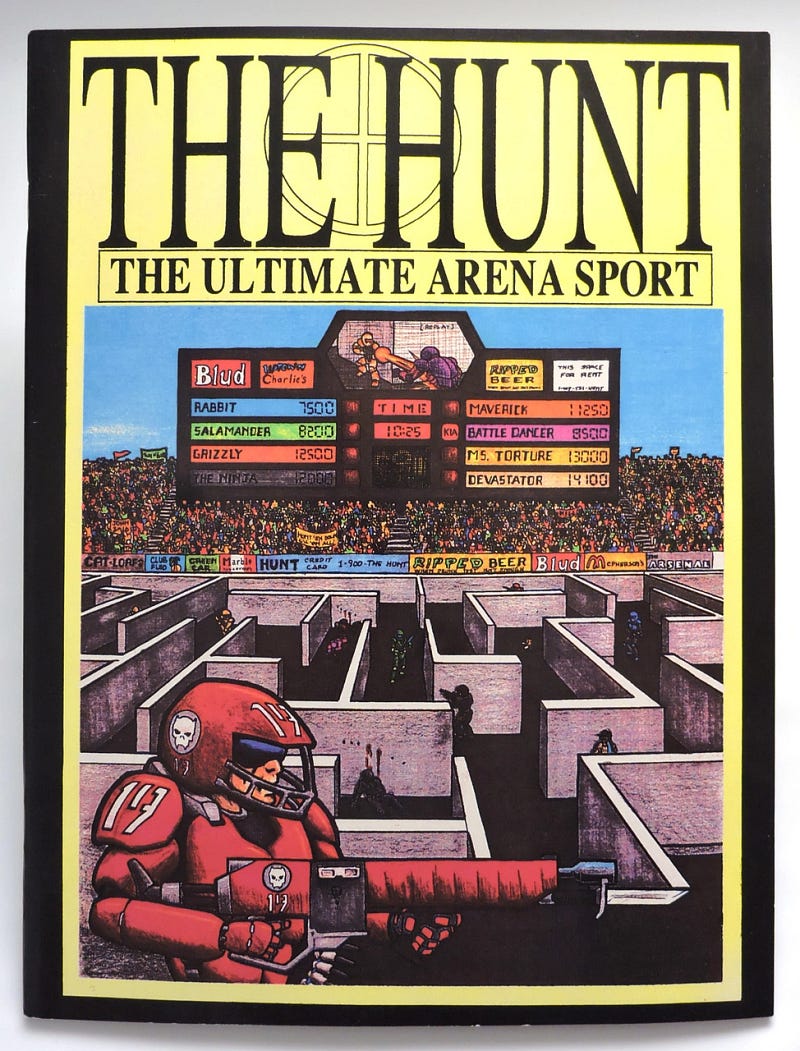
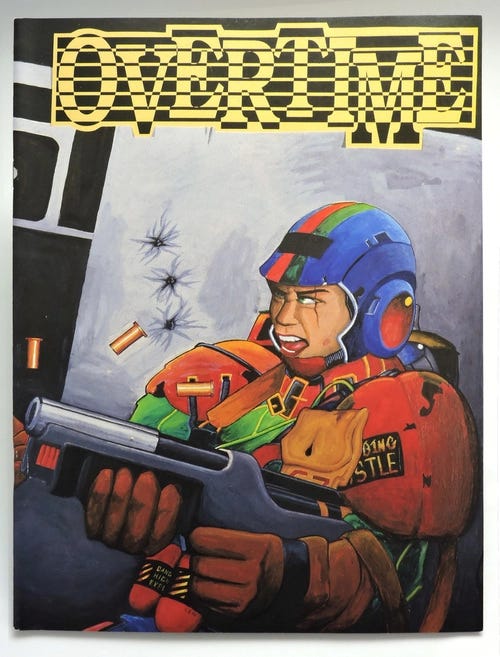
The Hunt was published at a time when America couldn’t wait until death sports were a real thing. The Running Man had come out a few years earlier and The Hunt is obviously inspired by it. But instead of a sprawling route of big zones, THE HUNT is limited to a maze in a stadium. And instead of death-wrestlers with gimmicky weapons, the THE HUNT features fairly normal gunmen. There is the odd flamethrower or katana, but the Hunters mostly use conventional firearms.
The setting is atrocious, which makes the sport believable. The backstory is a typical corporations-own-everything dark future, just like The Running Man, Death Race, and the original Rollerball. This terrible televised spectacle is designed to give hope to the masses that they can someday escape their toil. Ultimately both the Hunters and the audience are victims of this con. The audience gets its fill of inspiration and continues to let the megacorps work them to death. The Hunters gamble with their lives for a long-shot chance at living the good life. Either way, THE HUNT Corporation profits from their desperation.
Attributes Simplify Character Generation
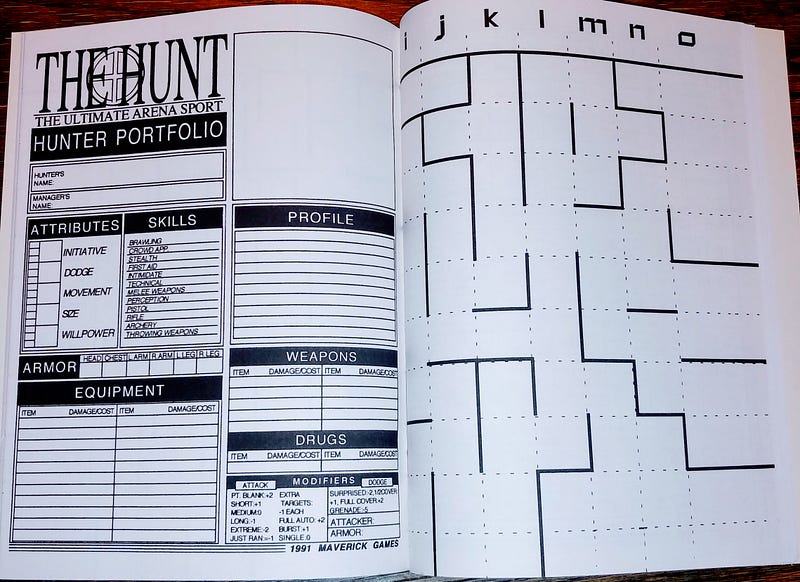
Instead of classic stats like Strength, Wisdom, etc, the core Attributes are Initiative, Size, Movement, Dodge, and Willpower. Most RPGs would consider these derived stats. This isn’t ground-breaking by any stretch, but different enough to stand out. It also removes the need for extra calculations during character gen. Most 90s RPGs had some kind of stat-to-substat conversions to consider.
The Carnage Chart
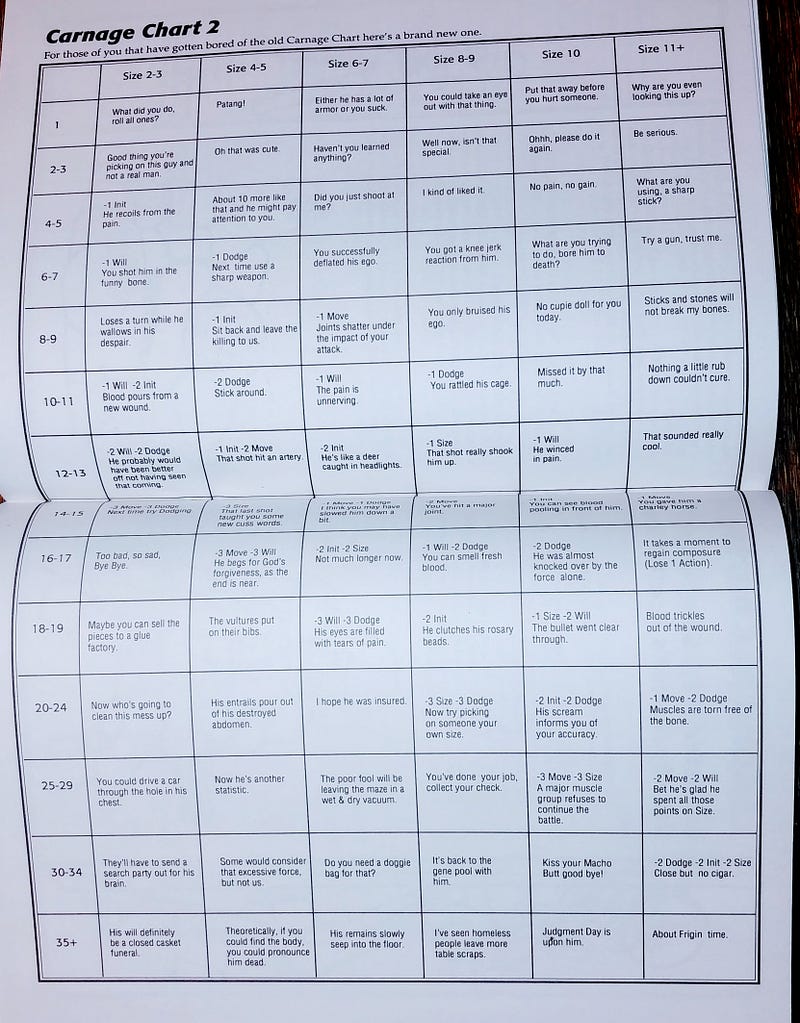
The Hunt doesn’t have hit points. Damage that penetrates armor is looked up against the target’s Size Attribute on the Carnage Chart. The Chart dictates penalties to specific Attributes, along with some flavor text for the injury. Results range from, “That Hurt. You could see him grimace.” to “Blood covers the floor. -2 Move.” to “He’s dead, expired, deceased.” Since it’s possible to get penalties to Size, future injuries can be worse even if they caused by the same amount of damage.
Damage in The Hunt feels more foreign and unwelcome than in other RPGs. You’re not subtracting from an abstracted value of health. Damage in The Hunt feels like it happens TO you. AT you.
Overtime includes an alternative Carnage Chart. It’s not meant to replace the one in the core book, but it adds variety for gamers who play the The Hunt a lot.
White Collar Criminals Get Their Comeuppance
There are three classes of prisoners in THE HUNT. Foxes are the highly skilled and heavily armed “co-stars”. Below them are the Game Animals, who are armed and dangerous to varying degrees. Then there are the Prey.
The Prey are usually white collar criminals. Embezzlers, tax cheats, insider traders, etc. They have no combat experience, no muscle, and no chance in Hell of surviving. They’re rarely armed, and when they are it’s with a knife or something equally pointless. The author obviously thought the “Gordon Geckos” of the world deserved to be herded like lambs to the slaughter. I love that.
Sadly, this is just fiction. There is no way we would send Not-Poors to a death sport. Life just isn’t that fair.
Lots of Optional Rules
Both the core book and Overtime include lots of new rules and variants to keep both the game and the sport interesting. Preset Traps. Multiple Foxes. Hidden Movement. Limited Ammo. Fun stuff.
The Bad
There’s Almost No Gameplay Outside of the Arena
The Hunt is the opposite of a Story Game. There are a grand total of two social skills: Intimidate and Crowd Appeal. The core book has no gameplay outside of the sport. The Referee Section provides tips for new refs but none of it applies to the game’s narrative.
Overtime adds the option of doing the company’s dirty work in purely combat scenarios. It also details what goes on before your first match and between matches, but you’re not meant to actually play out any of that.
Roleplaying your Hunter working the media or dealing with rivals would have added a lot of flavor. In Overtime the designer admits The Hunt isn’t a roleplay-intensive game.
The Just-World Fallacy
While the Hunters and the audience are painted as victims of this corporatized world, the prisoners aren’t. The Prey, Game Animals, and Foxes are portrayed as fully deserving of their fate. Again, the early 90s. To be fair, most Foxes are psychos and the Prey are bankers and other scumbags. No one will miss them.
THE HUNT exists because of the Just-World Fallacy — the assumption that people get what they deserve. The Hunt’s designers have the same bias. The fictional system in The Hunt is basically a neocon fantasy of a simple and efficient justice system without any exceptions or extenuating circumstances. There are no plea deals, bail, or parole. There are five possible sentences.
- Warning: Just what it says.
- Work Camp: One to ten years of labor that “benefits the overall society”. Apparently for-profit prisons weren’t big news back in the 90s.
- Life Sentence: You go to THE HUNT. It’s not even optional. If you survive, you’re free to go.
- Multiple Life Sentences: Same as before, but more so. One survived match equals one less life sentence until you either work them all off or die.
- Death: You go to THE HUNT and you stay there until you die.
Here’s why it’s especially shitty for Game Animals. A prisoner can willingly exchange their Work Camp sentence for a Life Sentence and go to THE HUNT. After all, a slim chance at freedom is probably worth the risk, because prison sucks. And even if prisons in this fictional world aren’t for-profit, THE HUNT sure as Hell is.
Foxes are generally serving death sentences, so there’s no “winning” for them. Plus, most Foxes are truly terrible people. But typical lawbreakers with long Work Camp sentences would be tempted to volunteer for THE HUNT. Their chances are slim but not impossible. They are armed and kinda armored. They can even team up if they can convince other Game Animals to do so. All that tempts low-level street criminals into taking a bullet on national TV.
Again, nobody gives a shit about Prey.
The Referee Must Manage a LOT of NPCs.
NPCs follow most of the procedures the Hunters do. The Prey are mostly the same but the five flavors of Game Animals are different enough to require more prep or page-flipping. And the Foxes are completely unique. All this requires a lot of lift from the Ref. Plus Game Animal and Prey actions can take a while since they all go at the same time.
I realize this was typical for old-school RPGs but we’re not in an old-school world anymore. If combat was rules-lite, it wouldn’t be an issue. But combat in The Hunt is heavy and a giant pain the ass.
You Can’t Play a Fox
There are no rules for player-character Foxes. And there are no rules for a prisoner breaking out or winning the crowd over. The Hunt might have been pre-Gladiator, but it was post-Running Man! This was a missed opportunity.
The Ugly
Combat Makes Me Want to Swallow a Bullet
As much as I dislike Lancer’s combat mechanics, they’re nowhere near as simulationist as The Hunt’s. Combat, which is the entirety of the game, is excruciatingly granular. There are 13 discrete steps for resolving an attack! Even if you played it purely as a board game, it’s way too detailed to be fun. A board game with a similar set-up would be better, like Adrenaline or Frag (which is sadly out of print).
The Players Can Buy Slaves
Overtime includes the option to buy Pleasure or Work slaves when you start running out of gear to buy. The book makes it clear that slavery isn’t legal in this world. The text reads, “…everybody has a price, all you have to do is find it”. This implies that completely destitute and desperate people sell themselves into servitude.
I almost shit myself when I read that part. I realize that The Hunt is set in a grimdark, crapsack world and that it fits thematically. Plus, the game IS from the 90s. But the author did not have to be so casual about it. They should have examined how utterly desperate and brutally transactional a society has to become to consider slavery anything other than anathema. Even Underground didn’t go there.
THE HUNT, or something like it, will become a real thing in about a decade. Not just the sports entertainment show, but also the conditions that make it possible. What sick shit are we in for once that happens? Survive this fucked-up game show and you’ll get that cancer treatment! Or you can send your kid to college! Or you won’t get deported…because one of your grandparents was brown and we took away your citizenship!
The Hunt is an interesting artifact of a bygone era. It’s a fascinating, and fucked-up, read. That said, I will never play it again as-is. At best, I might apply the setting and set-up to another game, like Mothership or Risus Skirmish.