
Roleplaying Games
‘Mothership’ is a D&D Killer 🔪
10 reasons to dump high fantasy for sci-fi horror
“Final report, the commercial star-ship Nostromo. Third officer reporting. The other members of the crew — Kane, Lambert, Parker, Brett, Ash, and Captain Dallas — are dead. Cargo and ship destroyed. I should reach the frontier within six weeks. With a little luck the network will pick me up. This is Ripley, last survivor of the Nostromo, signing off.”
— Ellen Ripley, “Alien”
To the first-time or newly-minted gamer, D&D is considered the default RPG. That shit needs to stop. As I’ve said many times, Dungeons & Dragons is the conservative oligarch of roleplaying games.
Mothership is one of a new wave of “artpunk” RPGs, alongside Mörk Borg, iHunt, and AGON. Most gamers would call it OSR-ish, but Mothership lists itself as its own rule system. I don’t know how this sort of thing is decided, but there it is.
Here’s why you should abandon D&D and make Mothership your go-to RPG.
It’s sci-fi (which is always better than fantasy)
The default setting is fairly hard sci-fi. More Firefly and Battlestar Galactica. Less Star Trek and Farscape. There is hyperspace travel, but no posthuman craziness. You can recognize humanity. It’s just in space.
There are no alien governments to trade or go to war with. All the alien life are basically animals, just weird. There are no laser-swords or super weapons. Ships don’t look like they were designed by Apple. Everything is fairly industrial.
It’s horror (which is often better than fantasy)
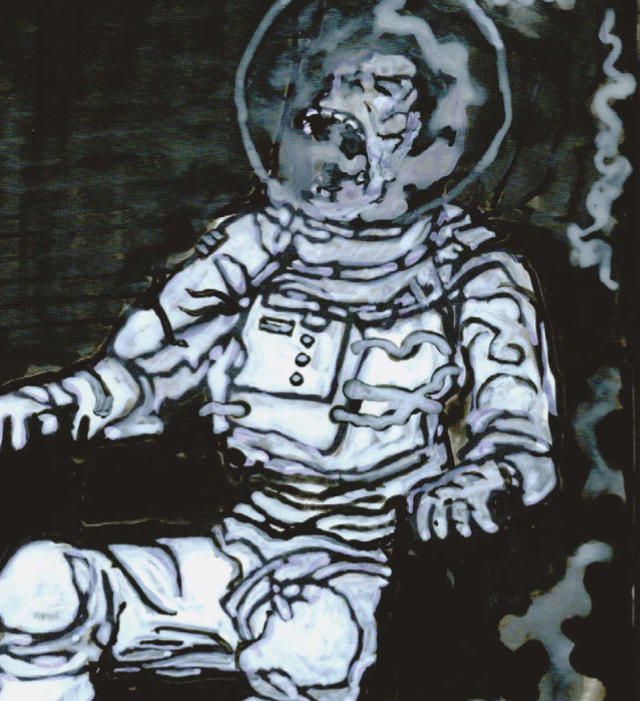
The Player’s Survival Guide, the game’s core book, doesn’t explicitly state what kind of horror Mothership is supposed to be, but the rules and art imply a mix of survival, psychological, and splatter horror. Think Dead Space, Eclipse Phase, Sunshine, Annihilation, and, obviously, Alien.
It’s obviously not gothic horror. Vampires and werewolves would be out of place. That said, Frankenstein and Jekyll & Hyde might make good inspiration.
It’s rules-lite and designed to be easily referenced
The rules are lightweight, but it’s not a narrative game. It just relies on what S. John Ross calls The Invisible Rulebook more than most RPGs, so edge cases don’t clutter up the rules.
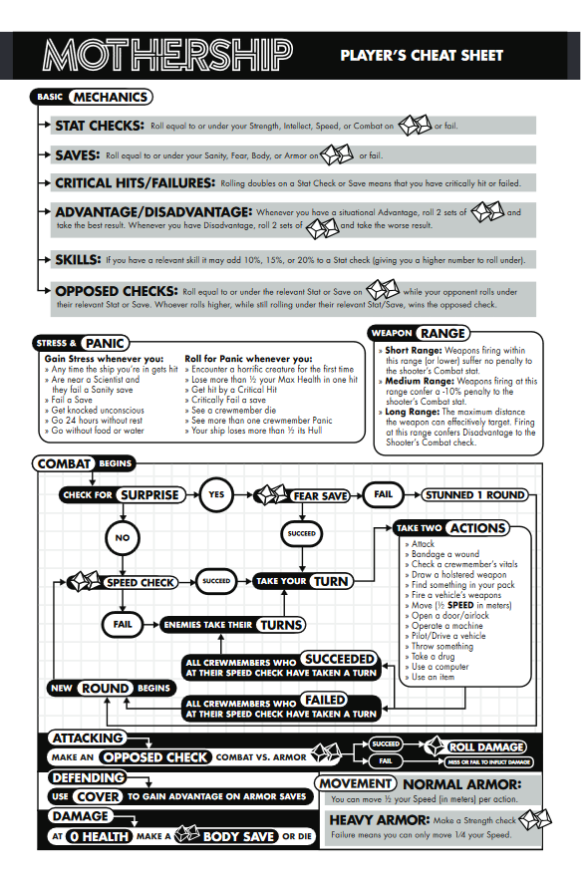
Mothership was designed to be easily referenced. Each system or topic exists “control panel” style, on two pages. You’ll rarely have to flip from one part of the book to another. DM screens exist because D&D has so many charts in so many different places. Mothership trims that down to a one-page cheat sheet.
It doesn’t rely on miniatures
While ship and space station maps are essential, scale maps and miniatures are not. Combat is run theater-of-the-mind style. It also almost always starts with a surprise attack, and it’s rarely the PCs doing the surprising. Rarely do you get to shout, “Let’s rock!” before mowing down an alien. But on the off chance of a straight-up firefight, the combat system is fairly low-crunch.
Mothership’s character sheet is WAY better designed
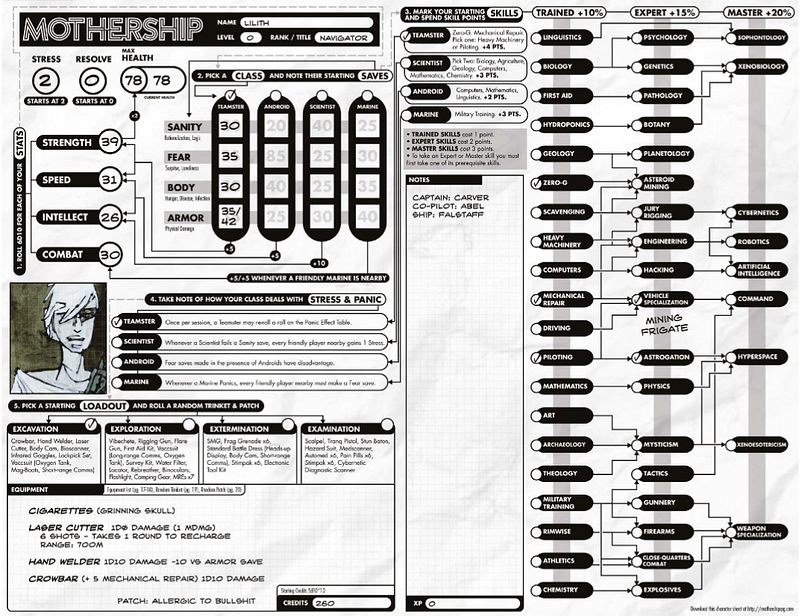
The character sheet itself is a flowchart. Most experienced gamers could probably make a character and only need to refer to the rulebook once or twice. Same goes with ship design, although most parties won’t have multiple ships.
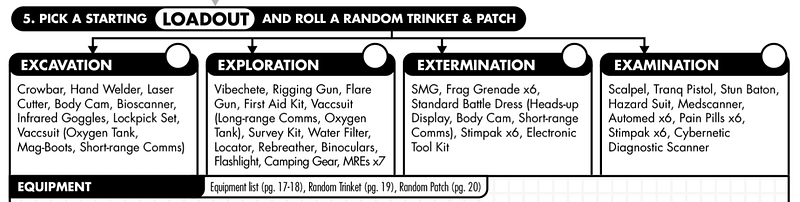
Starting Loadouts are a godsend
Pre-built packages of starting gear speed up character creation a lot. That’s convenient when you have to make a new character right after your old character blows themself out of an airlock as a sacrifice to the Old Ones.
Mercenaries and Scum are more fun than hirelings
Mercenaries are just like D&D hirelings, but in space. While “mercenary” usually refers to a soldier of fortune, Mothership’s mercenaries range from Marines and Surgeons to Archaeologists and Void Urchins.
But if you can’t find a legit merc to hire but still need some extra help, you can always hire scum.
Scum are fuck-ups and losers, all. Their stats are meh and half of them have some sort of flaw that will get you killed. You can’t even choose what kind of scum you hire. You just declare you’re hiring scum, roll on a chart, and live with the consequences. The Whiskey Tango Ronin is a wannabe samurai. The Preening Pseudo-Intellectual is basically a 4chan-er. The Rich Kid is Barron Trump. The other 7 scum types are no better. On the plus side, they’re cheap.
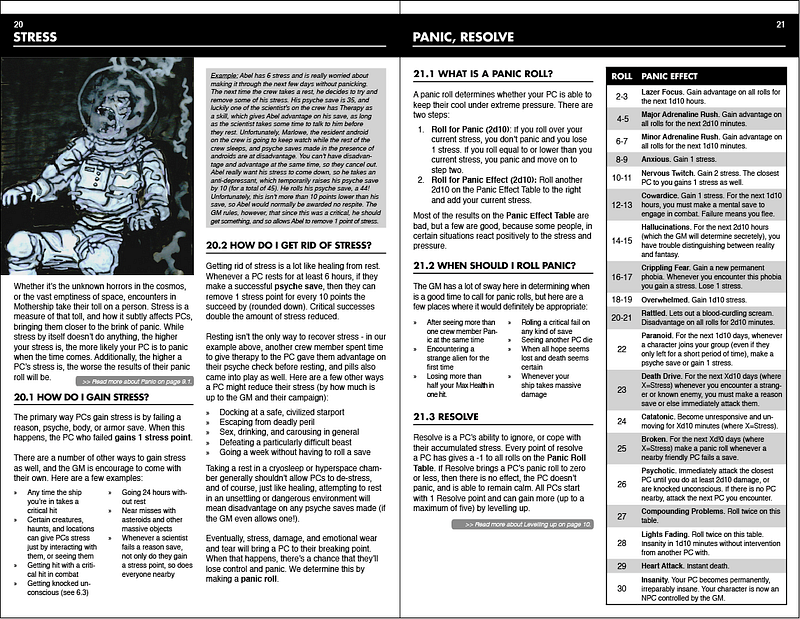
Panic Effects make everything more interesting
D&D is built with the assumption that feelings don’t exist. Because Mothership wasn’t designed in the Stone Age, its Stress and Panic mechanics are central to the game. When you build up too much Stress, you make a Panic Check. Panic can cause a wide range of effects, most of which are bad. It’s possible to gain an advantage from an adrenaline rush. It’s also possible to suffer a massive heart attack and fall over dead. No matter what happens, it’ll be interesting.
Mothership doesn’t treat you like a child
If Mothership had come out last decade, I would have said “this isn’t a beginner’s RPG”. There’s no advice for the GM, called the Warden in Mothership, and no lists of monsters or threats. But this is the age of Critical Roll. Everyone that cares knows what roleplaying games are, how to play them, and how to make shit up for them.
If you really are lost with Mothership, just steal from the Alien and Cloverfield movies, Fringe, the SCP Foundation, and Lovecraft Country until you get it.
There’s one last source of inspiration for a Mothership game: iHunt’s “capitalism is horror” shtick. Remember, it was company orders that put Ellen Ripley in that whole mess to begin with, and it was a corporate suit who fucked Ripley and the marines over for a goddamn percentage.
It’s cheap
The core book is 15 bucks for the print edition and 7 bucks for the PDF. And the digital supplements average around $5. Beat that with your $90 set of core D&D books.
BONUS REASON — Among Us: The Unofficial Roleplaying Game
A ship or station based on the official maps + the Saboteur module from The Game Changers + a reason why everything goes sideways = Among Us-inspired one-shot.