
Buddhism
Death Is Compulsory Meditation
And the Famous Reclining Buddha in Thailand Isn’t Chilling Out. He Is Dying.
I am not enlightened. The following article is a series of ideas that have spewed forth from my crazy mind. They should not be taken as spiritual advice but only as food for contemplation. If you seek a spiritual path, please look for the guidance of a fully-realised master — not a sharp-tongued lizard-like myself.
First, put on a Youtube Video with the sound of whales fucking.
Now burn some cheap incense that smells great until you light it.
Sit cross-legged on a purple OM cushion that you bought from some commercial hippy shop.
Put yer index fingers together like you are holding a sushi roll in each hand.
Breath in and out like yer in labour and try desperately to remember what the fuck Eckhart Tolle said about being in the powerful now or whatever.
Let’s begin
You’re shit scared of death.
You might think you aren’t, but you are.
And that’s okay. Everyone is.
You might anaesthetise the sting with fables such as,
death isn’t painful or no one really separates — they are still with you in spirit, or we all get to fuck virgins or get bathed by God after we die.
But these statements are nothing but words.
They are no more comforting than if I told you that euphoria is a natural quality of your mind — because they are ideas, not experiences.
This is a statue of Padmasambhava. He lived in the 8th Century.
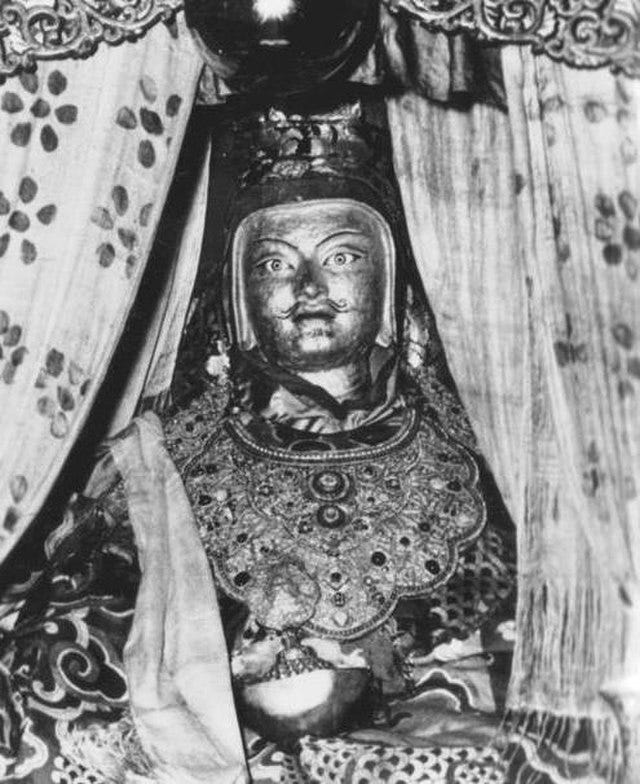
Padmasambhava wrote detailed teachings on the after-death state and the specific methods for coordinating the mind during the experience.
Still, they will never be comforting because most people will not read and practice them.
Why?
Because there is no proof that it is true, since — how can a human know?
So we sit here instead, at our bus stop of life, eating the cheese sandwich of fear and waiting for science to come up with something instead.
When you read descriptions of meditation by experienced masters, they are consistent with each other.
Not only are they consistent with each other, but they are also consistent with the experience of death described in the Bardo Thodral — Padmasambhava’s guide to the after-death state.
Death is the separation of the mind from the body. The body does not lose its ability to maintain consciousness all at once, but does so gradually with each element of the body losing its supportive ability in turn.
First the earth element sinks, or dissolves, into the water element and then the water element sinks into the fire and fire into the air, and the air element into consciousness itself. Such a description is useful for meditation but should not be taken literally.
For example, when it is said that the earth element sinks into the water element, this means that as the solid portions of the body are losing their ability to function and are becoming less intimately interconnected with the dying person’s mind, the liquid element appears stronger and more evident.
As these various physical elements become stronger and weaker in turn, the dying person experiences certain external and internal signs associated with the dissolution process. (Lama Thubten Yeshe)
The five elements are not separate.
In Buddhism, they are categories within a single spectrum of awareness.
You cannot find a line where earth ends and water begins or a gap between fire and air. There are varying degrees of each. I have spoken about this before in relation to gender fluidity.
Male and female signify parts on the gender spectrum.
The same applies to colour. Blue and yellow are both parts of the spectrum. You will never find a line where blue ends and green begins.
Words and categories are only used to give us some sense of security — some imaginary boundaries in a world without boundaries.
The processes of both death and meditation involve the dissolution of the elements one into another.
When the dying process begins, the person is said to experience a sense of groundlessness.
This is described as disorientation or the feeling of falling or being compressed and physical weakness. The senses can also fail at this point. The vision can become blurred and the hearing weaker.
In the teachings, this stage is said to be accompanied by a blue shimmering or mirage-like appearance. These are the signs that the earth element is dissolving into the water element.
As the water element dissolves into fire, the person experiences thirst or a dry mouth. The eyes can water, the nose can run and the mouth can dribble. They may experience a vision of swirling smoke.
As the fire element dissolves into the air element, the person will feel cold. It’s probably the best-known part of the dying process. When a person is feeling cold, they are getting close. This lack of heat can be accompanied by a loss of mental clarity as well as a vision of red sparks above a fire.
Next, there is a sense of a great wind and a vision of a torch or lamp. The dying person is not too aware of the outside world at this stage. When the air element dissolves into space, the ‘outer breath’ will cease. This is the point where, in our culture, a doctor will say something like,
‘He’s gone’
And everyone will cry.
But not according to Padma.
When the outer breath ceases, the process of death continues for the dying person.
After the air element dissolves into space, the first experience is pure white light as the essence of the father’s sperm descends from the crown of the head into the heart. Then there is an experience of deep red light as the Mother’s essence ascends from just below the navel.
As they meet at the heart centre, all the blood is gathered there. The experience is of a great blackness as if in the deepest reaches of space — a great nothingness.
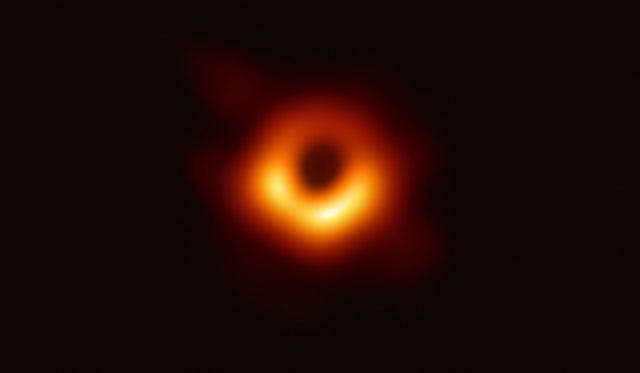
Out of this space arises an experience of clarity which many people might associate with meeting God.
Buddhists call this the clear light or the ‘Body of Truth’— Dharmakaya.
From the Buddhist perspective, death is the most profound opportunity for enlightenment since the clear light expresses itself so directly during this process.
Even for someone who has not experienced meditation fully, this is a great opportunity.
There are a few hurdles though.
We can explain this clear light in words, and it sounds so easy to recognise. But, words are limited and for someone who has never experienced that state in life, it might be challenging to recognise it after death.
Also, for someone who has had no meditation training, it is said that the Clear Light manifests only briefly before the karmic habits of the person start pulling them in another direction.
And the Bardo Thodral offers numerous other ways for beings to become liberated in the stages that follow, up to, and including the act of ‘entering a womb’.
Still, someone who has read about it a lot might recognise Dharmakaya. But, how would they know how to remain in that state since remaining in that state is the instruction given to experienced practitioners?
Someone with some training might be able to remain in that state longer.
But someone trained thoroughly in this life can gain stability in that state after death and thus be fully liberated.
A good meditation practitioner can practice this dissolution of the elements and will have similar experiences to the practitioner at death.
A great practitioner will, in the beginning, rehearse dissolving these elements in their meditation, resulting in an experience of clear light.
The counsel of a good teacher is important during this practice to offer clarity on what is and what isn’t the final experience.
A more extraordinary practitioner will take a shorter time to move through the elements to this state. Then they might remain in this state for longer and longer periods.
It should be noted that this experience is seen as a reflection of the after death experience in the same way that a drop of saltwater has the taste of the ocean, but it isn’t the entire ocean.
It might be a little scary to think about things this way, but in meditation, we are practising for death.
Sure, we can start by looking for peace of mind but ultimately — from the Buddhist perspective at least — meditation is a rehearsal of the dying process.
Death is compulsory meditation and we have a choice to either go into it practised or unpracticed.
In practice, we don’t have to go through the various steps like first do this, now do that. We only need to let go.
No whale noises, no purple cushions.
We just let go. And, since the elements are only sustained through tension, we can undo them through relaxing and letting go.
But, as most of us know, letting go isn’t that easy.
When our thoughts run wild, we can practice the preliminary steps of learning to concentrate, which slows the flow of thoughts.
Again the guidance of a teacher is advised since it can lead to blissful states of concentration, which can be mistaken for Dharmakaya. Concentration is not an endpoint. It is a tool to facilitate letting go.
But if a person can naturally let go, they can dissolve their elements, experience some of the dissolution experience of death, and end up at the Clear Light.
Recognising and then assimilating that into one’s experience is often a lifetime of work. But that is the path.
Sitting and letting go is not the only method of recognising Clear Light.
In some traditions, a master can introduce it directly to you.
In other paths such as Tantric Buddhism, a practitioner can cultivate physical bliss to overwhelm the conceptual mind and expose Dharmakaya directly.
But the ultimate goal is to recognise this Dharmakaya and become so familiar with that state that after death when the drop of your Dharmakaya meets the true ocean of Dharmakaya, you can merge them and remain there.
This is often referred to as the meeting of the Mother and Child luminosities.
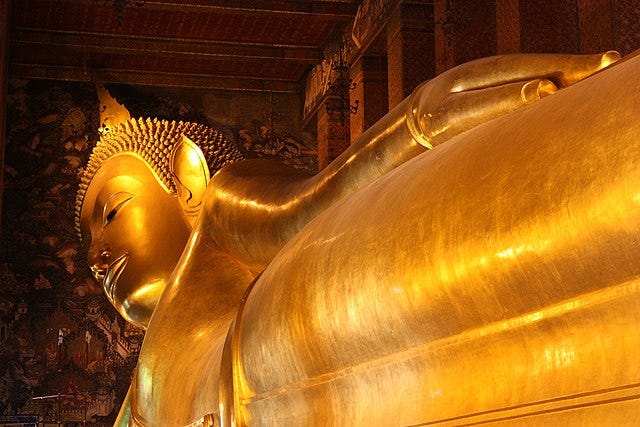
So when we see statues of the reclining Buddha in Thailand, it is essential to remember that it’s not a sign that the Buddha was well chilled out, although he probably was. It’s a symbol to remind us that death is coming and that the methods are there if you want to be prepared.
Rather than feeling, “Oh no, I don’t want to be here,” we should be full of enthusiasm and curiosity (toward the dying process). We should resolve to remain calm and to be courageous. It is like exploring any new place. (Dzogchen Ponlop Rinpoche)
Sure, you can wait for science to come up with something, but you could be waiting a while.
The best way to practice Buddhism is in secret. That way it is more likely that your own Buddhist pride won’t disrupt your progress.
You practice the method internally and share it with no one. You work hard on it like you are an athlete secretly practising for a great race.
Then, when the time of death arrives, you can still pretend to be upset, but on the inside, if you have spent your life practising well, you will be more excited than a young child seeing a sign that says:

Sign up for my free newsletter. That’s where I put all the really good stuff.


