
Dear Mr. Altman. Want High Quality Information? This is how you get it!
Unlocking the Future of AI: The Blueprint for Feeding ChatGPT with Gold-Standard Information.
Integrate Verified, High-Quality Information into ChatGPT, and you’ll dominate the information world, Mr. Altman. The good news? The technology exists; it’s all about assembling the pieces in a user-friendly way. Mr. Altman understands that reliable information is as valuable as gold.
The Three Pillars of AI Success
You can develop the most advanced LLM (ChatGPT) model, but you are dependent on three external factors to succeed:
- Horsepower and Storage: Lots of high-quality GPUs and ample storage space are needed to process the vast amount of information. All the major US tech companies, including Tesla, are currently developing their own GPUs, reducing their reliance on Nvidia.
- Funding for Training: Training new models is extremely expensive, even with the necessary GPUs and storage. The estimated cost of running ChatGPT for a single day is $700,000.
- High-Quality Data: This can be achieved either by collecting comprehensive information and then using reinforcement learning to verify the results or by relying on vetted, high-quality data (quality in -> quality out).
Status, Mr. Altman: We know you have the first two points covered, but what about the third? The principle of ‘garbage in, garbage out’ still applies to OpenAI.
You: Feel free to read this article before continuing. It provides some background information for this article:
The Future of Publishing Information
The web is teeming with information, and its volume will continue to grow rapidly, including content generated by AI bots. Quality information is poised to become the new currency. However, for this transition to occur, we need dependable information, and Mr. Altman understands this better than most.
If you’re looking to publish high-quality information on the web and want recognition for your genuine efforts (ensuring, for instance, that you didn’t merely use an AI bot and that no one can plagiarize your content), how should you proceed in the future?
The answer is straightforward. When uploading or publishing information online, you can authenticate your authorship using your digital identity from Worldcoin, as provided by Mr. Altman.
I’ve referred to this application as “InfoGrader” in a previous article (potentially a product of Mr. Altman). InfoGrader will check for:
- AI Bot-Generated Content: Verified using AI.
- Plagiarism: Checked using AI.
Upon successful verification:
- A unique (invisible) digital watermark is generated for your content using artificial intelligence.
- A transaction, which includes a hash of the digital watermark, is created on the InfoGrader Blockchain. With this watermark, actually the hash, one can search for the record within InfoGrader.
- InfoGrader also stores details about the author(s) within a Multisig NFT, allowing you to authenticate your authorship.
- Users receive confirmation that their registration has been completed.
Once registered, your content is available online and is uniquely linked to you. Moreover, it’s safeguarded against tampering. An inherent proof is embedded within the digital watermark and stored on the InfoGrader Blockchain, ensuring any modifications are detected.
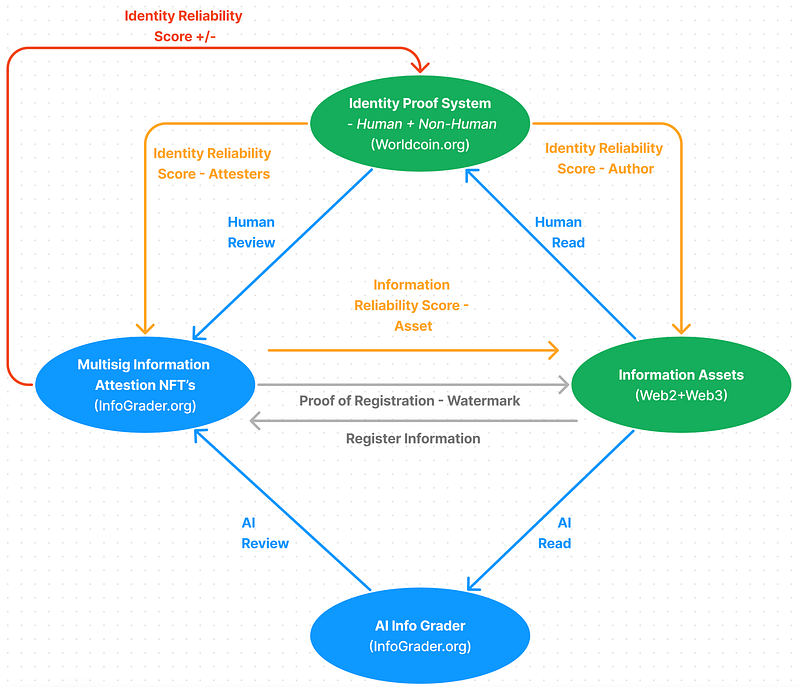
In the illustration below, the grey lines depict the process of registering information on InfoGrader and subsequently receiving the NFT and digital watermark.
Increasing Trust in Published Information
There are several methods to enhance the trustworthiness and reliability of published information:
- Co-Authors and Reviewers (represented by yellow lines)
- Publication through an Institution (yellow lines via personal identity)
- Previous Reputation (represented by the red line)
Co-Authors and Reviewers
While you might be the primary publisher of the information, there could be co-authors or reviewers involved. How is this managed? Initially, when you publish, the content remains in a draft state, receiving its Digital Watermark. However, the registration process is only finalized once all relevant co-authors or reviewers have endorsed the NFT. Multi-signing enhances the credibility of the information. Why? All involved parties have a stake in the content, lending their names and reputations to the published work, thereby fostering trust.
Institutions
Individuals like Mr. Altman and many others recognize that personal publications might not garner the same level of trust as those released by esteemed institutions like the Washington Post. Some institutions inherently command more trust than others.
Using a Soul Bound Token, the Washington Post can verify that they published specific content. Why introduce an SBT? It allows the Washington Post to confirm their association with the content and, if discrepancies arise, to take appropriate action.
However, they must initially endorse the content. Is this process cumbersome? Not necessarily. Through a smart contract, the Washington Post can automate the approval process, leveraging a streamlined and digitized system.
Reputation
Lastly, an individual’s established reputation can be a significant asset when publishing. If the public holds a high level of trust in the author, the reliability of the information they provide is naturally elevated. The red line symbolizes this added credibility.
Empowering Content: The Power of Likes
What would an information platform be without the ability to express appreciation for published content? Likes not only generate interest, prompting others to engage with the content, but they also add a layer of credibility to the information shared.
The blue lines depict human interaction and review of the content, but it’s essential to understand that AI can also review and endorse content in tandem.
However, the challenge lies in integrating these likes with InfoGrader, especially when platforms like Medium don’t operate through a digital identity like Worldcoin. The solution? The InfoGrader browser plugin. By logging into the plugin, much like you would with Metamask or similar web plugins, you can effortlessly ‘like’ and validate content. It’s that straightforward.
ChatGPT — “Want some Candy?”
Imagine, Mr. Altman, if OpenAI could harness InfoGrader to pinpoint trustworthy information sources. Information published across the web would come with an inherent reliability score. Here’s what you’d be certain of:
- The content is human-generated (with current methods, it’s fairly easy to discern this).
- The source of the information is credible, as assessed by other users.
- If the content is found to be deceptive, the authors could face penalties for publishing it, as indicated by the red line’s negative value.
- The information will be consistently evaluated for both quality and reliability.
Believe me when I say, “For LLM models (ChatGPT), this is akin to striking gold!” The ability to prioritize information during model training is invaluable. Quality In leads to Quality Out.
Personal Letter to Mr. Altman
Dear Mr. Altman,
Don’t you believe that humans are still essential for providing reliable information and ensuring authors receive credit for their work?
I believe you do, and I sense you’re devising a strategy that will yield far more trustworthy information from ChatGPT and future models from OpenAI. Am I right or wrong?
Notably, Infograder.org remains an available domain and offers a unique opportunity. So,….I trust you haven’t had the chance to read my previous article… yet!
Best Regards,
Jesper Krognos
Disclaimer:
This article is for informational purposes only; it should not be considered financial, tax or legal advice. You can consult a financial professional before making any significant financial decisions.